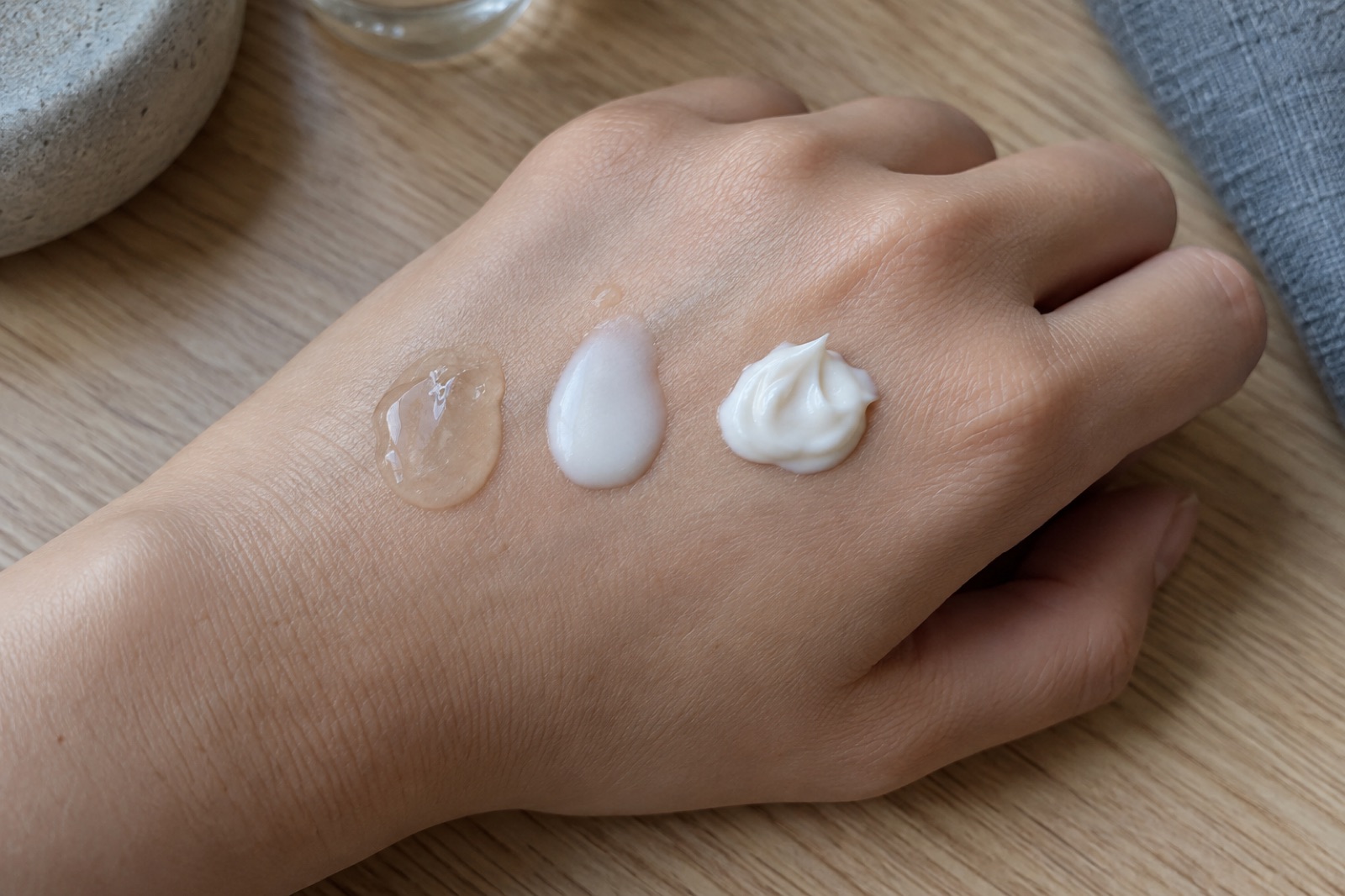
Lotion vs Cream vs Oil vs Petrolatum: What Studies Show
No study we found ranks lotion, cream, oil and petrolatum by how well they moisturize; the comparison trials mostly measured the arms or legs of a few dozen people, and each one moved different readings.
In this article7 sections
- Lotion vs cream: which is more moisturizing?
- What changed when oil and petrolatum were tested side by side?
- Do you need a heavy, rich cream in fall and winter?
- Is squalane cream or oil good for oily skin?
- Is there evidence you should switch moisturizers with the seasons?
- Lotion, cream, oil and petrolatum studies at a glance
- When to see a dermatologist
| Item | What the research found | Evidence grade |
|---|---|---|
| Texture ranking | We found no human study that lines up lotion, cream, oil and petrolatum by moisturizing readings | No such study |
| Five bases, applied once | On the inner forearms of 60 healthy adults, petrolatum and foam lowered transepidermal water loss (TEWL), and stratum corneum hydration rose most with Beeler’s base | A (within-person randomized trial) |
| Oil vs petrolatum over 42 days | In 24 adults with dry skin on the legs, expert ratings were similar, at 60% for the oil and 68% for petrolatum, and TEWL did not change significantly with either | A (randomized trial · abstract) |
| Olive oil vs petrolatum | On the inner forearms of 54 healthy adults, both raised stratum corneum hydration, and only petrolatum lowered TEWL | A (within-person randomized trial · abstract) |
| Winter vs summer | In 140 people, TEWL, pH and skin blood flow differed between the seasons, but no one switched moisturizers in this study | B (observational study) |
Lotion vs cream: which is more moisturizing?
We found no human study that lines up moisturizers by texture name and moisturizing readings, so even within one skincare line, there is no evidence-based order for lotion, serum and cream. The closest evidence is a 2022 within-person randomized trial. Researchers applied five bases (petrolatum, foam, Beeler’s base, water-in-oil or W/O, and oil-in-water or O/W) once each to the inner forearms of 60 healthy adults with a mean age of 32, and compared the readings with a spot left bare. Petrolatum and foam lowered transepidermal water loss (TEWL), stratum corneum hydration rose most with Beeler’s base, and all five bases lowered redness readings.
The researchers concluded only that each base affects skin barrier function differently; they did not rank them. These were bases with no active ingredients, applied a single time, so the results don’t turn into an order for store-bought lotions, serums and creams. For the order in which to apply products from the same line, the step written on each container is the more accurate guide.

What changed when oil and petrolatum were tested side by side?
In the two trials that compared oil with petrolatum directly, the readings on the oil side moved too, and where petrolatum stood out more was TEWL and the scaling index in one of the trials. A 2012 randomized trial asked 24 adults with dry skin on their legs to apply either a wax ester oil taken from a deep-sea fish (orange roughy) or a commercial petrolatum-based moisturizer twice a day for 42 days. Expert ratings came out similar, at 60% for the oil and 68% for petrolatum, and TEWL did not change significantly with either. A second study looked at 22 people with dry skin on the face and forearms, and its rise in skin hydration readings can’t be assigned to one product or the other from the abstract alone.
A 2025 within-person randomized trial applied extra virgin olive oil and petrolatum to set spots on the inner forearms of 54 healthy adults. Both raised stratum corneum hydration and lowered redness and skin temperature, and only petrolatum lowered TEWL. Both also lowered the desquamation (scaling) index, with a larger drop on the petrolatum side. The abstract gives no application period, and the raw ingredients were applied as they were.
Neither “oil alone can’t moisturize” nor “petrolatum is always the strongest” is backed by these two trials. Where oil belongs in a routine was not a question these studies asked, so we don’t set one here.
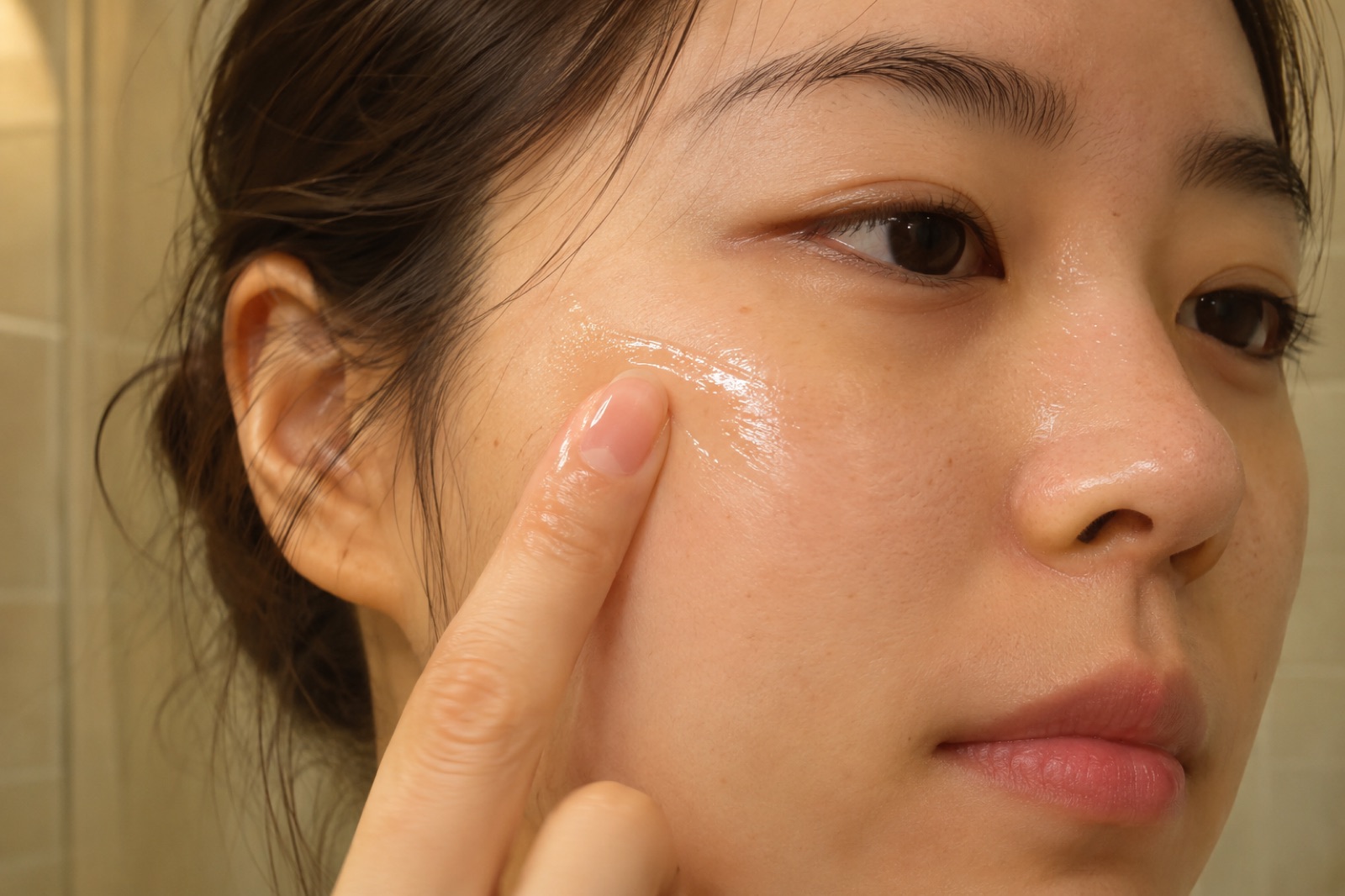
Do you need a heavy, rich cream in fall and winter?
We found no study supporting a ranking in which only heavy textures moisturize; there are only separate trials of a heavier option and a lighter one. A 2016 study applied two similar water-in-oil (W/O) emulsions to normal skin and to skin that had been damaged on purpose, then used a lab test on skin outside the body and an investigator-blinded randomized trial to look at how far the water phase got into the stratum corneum and how barrier function changed. The researchers summarized that adding water-attracting (hygroscopic) substances alone only partly achieved water delivery, and that the effect was mainly explained by the oil phase covering the skin (the abstract gives no number of participants or length).
Lotion textures, the lighter option, have been tested too. A 2014 randomized double-blind trial compared a commercial moisturizing lotion containing colloidal oatmeal with the same product’s base (vehicle) in people with dry skin, and reported that the lotion did significantly better on several dryness measures. But what it compared was the same lotion with and without one ingredient, not a lotion against a cream, and the abstract gives no number of people, length or figures, so it can’t be read as evidence that “a lotion is enough.”
Is squalane cream or oil good for oily skin?
No study in the evidence behind this article answers this directly, so we can’t say that squalane feels heavy, or that it does or doesn’t cause breakouts. The oil and petrolatum comparisons we found all looked at dry or healthy skin. Only the second study in the 2012 oil trial (22 people with dry skin on the face and forearms) measured the face; the rest looked at arms or legs, or give no body site in the abstract. We also found no trial of squalane on its own, and no grade A study that looked at whether oil or petrolatum clogs pores or adds breakouts on the faces of people with oily or breakout-prone skin.
So whether squalane suits an oily or dehydrated oily face (known in Korea as “subuji”) is something to check on your own skin, not a research finding. How to try one new product at a time on a small area first is covered in our article on sensitive, breakout-prone skin. If tiny bumps or redness increase after you apply it and don’t settle easily, see a dermatologist instead of continuing to switch products.

Is there evidence you should switch moisturizers with the seasons?
There is observational data showing that skin readings differ by season, but no study in the evidence behind this article tested which texture to switch to. A 2022 observational study used a questionnaire and irritation test results to sort 140 people into four groups, made up of healthy-skin and sensitive-skin subgroups, and measured skin physiology in winter and in summer. In all four groups, TEWL, skin pH and skin blood flow differed significantly between winter and summer.
No one in the study was asked to switch moisturizers, though, so a conclusion such as “use a heavier texture in winter” does not come from this data.
Lotion, cream, oil and petrolatum studies at a glance
Here are the six studies this article cites, one row each. This is not a texture ranking; the last column shows how far each result carries over to questions about store-bought moisturizers.
| Study (year · subjects · number · site) | What was compared | Length · frequency | What was measured | Result | How far it carries over to store-bought moisturizers |
|---|---|---|---|---|---|
| 2022 · 60 healthy adults · inner forearm | Five bases (petrolatum, foam, Beeler’s base, W/O, O/W) and a bare spot | Once | Stratum corneum hydration, TEWL, pH, temperature, redness, melanin, elasticity | Petrolatum and foam lowered TEWL; hydration rose most with Beeler’s base; all five lowered redness | Only that each base moved different readings. Not an order for store-bought products with active ingredients |
| 2012 · 24 adults with dry legs / 22 adults with dry face and forearms | Wax ester oil from a deep-sea fish, commercial petrolatum-based moisturizer, no application | 42 days · twice a day | Dryness score, expert rating, TEWL, skin hydration | Expert ratings similar (oil 60% · petrolatum 68%); no significant TEWL change with either | Results for one specific raw oil. Not carried over to store-bought face oils or to oily faces |
| 2025 · 54 healthy adults · inner forearm | Extra virgin olive oil, petrolatum | No length in abstract | Stratum corneum hydration, TEWL, temperature, redness, desquamation index | Both raised hydration and lowered redness; only petrolatum lowered TEWL | Raw ingredients applied as they were. Not results for products that contain olive oil |
| 2016 · normal skin and skin damaged on purpose (number not in abstract) | Two similar W/O emulsions | No length in abstract | Water-phase penetration into the stratum corneum (lab test outside the body), barrier function changes | Water-attracting substances alone only partly delivered water; mainly explained by the oil phase covering the skin | An explanation of how a covering texture works. Not a comparison showing cream beats lotion |
| 2014 · people with dry skin (number not in abstract) | Colloidal oatmeal moisturizing lotion, the same product’s base | No length in abstract | Several measures of skin dryness | The lotion did significantly better on several measures | The same lotion with vs. without an ingredient. Not lotion vs. cream |
| 2022 · 140 people with healthy or sensitive skin (4 groups) · site not in abstract | Winter vs. summer (no intervention) | Measured in both seasons | TEWL, pH, skin blood flow and more | In all four groups, the three readings differed significantly between seasons | Only that readings vary by season. Not a result telling you to switch textures |
What carries over from the table to questions about store-bought moisturizers is this much: there are trials in which a base, an oil or petrolatum moved readings on the arms or legs, and there is no trial that produced a texture ranking. Which store-bought product beats another, what happens on oily faces, and which step or how much to apply are not answered by any of the six studies. Differences by cream name, such as hydrating creams and barrier creams, are covered separately in our article on types of moisturizers.
When to see a dermatologist
- If your skin cracks and oozes, or itching keeps you up at night even after you switch moisturizers, see a dermatologist instead of looking for another texture.
- If white flakes spread beyond your face to your body or build up like thick scales, see a doctor to have the cause checked.
- If tiny bumps or redness increase after a new oil or cream and don’t settle even after you stop that product, talk to a dermatologist.
- If your face stings and feels hot every time the season changes, have a dermatologist look at your skin first.
Frequently asked questions
In the same skincare line, which is more moisturizing: lotion, serum or cream?
No study in the sources this article checked supports an order like that. The closest is a 2022 trial that applied five bases once each to the inner forearms of 60 healthy adults: petrolatum and foam lowered transepidermal water loss, while stratum corneum hydration rose most with Beeler's base, so a different base led on each measure. It tested the bases themselves, not finished store-bought products, so for the order to use products from the same line, the step printed on each container is the more accurate guide.
Is squalane good for oily skin, or will it feel heavy and cause breakouts?
The sources in this article give no basis for saying either way. The oil and petrolatum comparisons looked at dry or healthy skin and mostly measured arms or legs, and we found no trial of squalane on its own and no grade A study that checked for clogged pores on the faces of people with oily or breakout-prone skin. If you want to try it, test one product at a time on a small area first, and if tiny bumps or redness increase and don't settle, see a dermatologist.
Do you need a heavy, rich cream to moisturize in fall and winter?
No study supports a ranking that says it has to be a heavy cream. A 2016 study, which applied two water-in-oil emulsions to normal skin and to skin damaged on purpose in a lab test outside the body and a randomized trial, explained water delivery mainly by the oil phase covering the skin, and a 2014 randomized double-blind trial in people with dry skin reported that a colloidal oatmeal lotion did significantly better than the same product's base on several dryness measures. Neither compared a cream with a lotion directly, and neither abstract gives the number of people or the length, so they can't tell you how heavy a cream should be for the season.
Can you use face oil instead of moisturizer?
In trials where only a raw oil was applied, hydration readings still rose. In a 2025 trial, extra virgin olive oil applied to the inner forearms of 54 healthy adults raised stratum corneum hydration, and in a 2012 trial in which 24 adults with dry skin on their legs applied a wax ester oil from a deep-sea fish twice a day for 42 days, experts rated the oil similarly to a petrolatum-based moisturizer. Both trials used a specific raw ingredient as it was, though, so the results don't carry over directly to putting a store-bought face oil on your face.
Is petrolatum a good moisturizer?
In arm and leg trials it moved the readings, but there is no basis for saying it led on every measure. In the 2022 trial that applied five bases once each to the inner forearms of 60 healthy adults, petrolatum lowered transepidermal water loss, but stratum corneum hydration rose most with Beeler's base; in the 2025 trial on the inner forearms of 54 healthy adults, it raised hydration along with olive oil, and only petrolatum lowered water loss. In the 2012 trial of 24 adults with dry legs over 42 days, expert ratings were similar, at 68% for petrolatum and 60% for the oil, and water loss did not change significantly with either.
Should you switch moisturizers between summer and winter?
No study in the sources this article checked concluded that you should change textures by season. A 2022 observational study split 140 people into four groups and measured skin readings in winter and summer, and in every group, transepidermal water loss, skin pH and skin blood flow differed significantly between the two seasons. No one was asked to switch moisturizers, so all it supports is that skin readings can differ from season to season.
Should you choose a lightweight moisturizer or a more moisturizing one?
No study in the evidence behind this article measured feel and moisturizing together to set a priority. In the trial that applied five bases once each to the inner forearms of 60 healthy adults, the foam base was on the side that lowered transepidermal water loss, along with petrolatum, while stratum corneum hydration rose most with yet another base, so a texture's weight and the readings did not move in one direction. Check the step on the container and the full ingredient list, and keep in mind that the same product suits different people to different degrees.
Can you use body lotion on your face?
No study in the sources this article checked compared a body lotion with a face moisturizer on the face, so there is no basis for saying it is fine or not. The comparison trials here that name a body site mostly measured the inner forearm or the legs, and only the second study in the 2012 oil trial (22 people with dry skin on the face and forearms) measured the face, so readings that moved on arms or legs can't tell you whether a product suits your face. If you want to try it, first check the area of use printed on the container, and if tiny bumps or redness increase on a small test area and don't settle, see a dermatologist.
Sources
- The Assessment of Skin Homeostasis Changes after Using Different Types of Excipients in Healthy Individuals (Ordoñez-Toro A et al., Int J Environ Res Public Health, 2022, PMID 36554558)A
- Evaluation of the efficacy of orange roughy (Hoplostetbus atlanticus) oil in subjects with dry skin (Domoto N et al., Int J Cosmet Sci, 2012, PMID 22554123)A
- Effects of Extra Virgin Olive Oil and Petrolatum on Skin Barrier Function and Microtopography (Rubio-Santoyo A et al., J Clin Med, 2025, PMID 40649050)A
- Preclinical and clinical characterization of the cutaneous bioavailability of the hydrophilic phase of a water-in-oil emulsion (Wohlrab J et al., J Dtsch Dermatol Ges, 2016, PMID 26636922)A
- Randomized, double-blind controlled study of a moisturizing lotion with colloidal oatmeal versus its own vehicle in people with dry skin (Kalaaji AN, Wallo W, J Drugs Dermatol, 2014, PMID 25607563)A
- Seasonal changes in the physiological features of healthy and sensitive skin (Jiang W et al., J Cosmet Dermatol, 2022, PMID 34599628)B
We never use YouTube videos or community posts as evidence for facts. Editorial policy
Product information related to this article
Product information from the site operator (KW Cosmetic, maker of the SKIN9HARI brand).
Revive Therapy N.F Cream
₩28,000 (KRW)
None of the base, oil or petrolatum studies in this article tested this cream, and no data sets it against a lotion, oil or balm (Skin9hari makes no oil or balm products). It is a 50 ml tube cream with 4 ceramides and 5 types of hyaluronic acid, with no added fragrance per its full ingredient list and a patch test result under set conditions, though skin varies. It is a cosmetic, not a medicine. Its product page places it last, after the toner and ampoule; stop if red spots, swelling or itching appear, and avoid broken skin. For choosing one final-step cream by its label, not a texture ranking, the product we suggest is Revive Therapy N.F Cream.
- Cream with 4 ceramides (NP, NS, EOP, AP), 5 types of hyaluronic acid and D-panthenol, 50 ml
- No added fragrance
- Low-irritation formula
Product details
- Type and size
- Soft, cushiony cream, 50 mL (1.69 fl oz)
- Step in routine
- Step 4 of 4 · Moisturize, the last step
- How to use
- As the last step of your routine, squeeze out a small amount. Warm it slightly between your palms. Press gently over your face, working outward from the center. Use morning and night after your ampoule or serum step.
- Before you use
- Contains dimethicone (silicone) — this is not a silicone-free formula. If redness, swelling or itching occurs, stop using and consult a dermatologist.
Based on the official product page, checked 2026-10-02
Cosmetics do not diagnose, treat, cure or prevent any disease. Test results apply only to the stated conditions.