Sensitive Skin: Signs and How to Pick Products When You Break Out
Sensitive skin reacts easily to things like products or temperature, with stinging or redness. If you also break out, check ingredient lists for common irritants and test new products one at a time.

In this article6 sections
| Topic | What the evidence says | Source |
|---|---|---|
| How common | In a meta-analysis covering 18 countries, 71% reported at least somewhat sensitive skin, and 40% said very or fairly sensitive | Sensitive skin · A |
| Sex differences | 45% of women and 33% of men reported sensitive skin | Sensitive skin · A |
| Linked factors | In a meta-analysis of 13 survey studies, cosmetics had the highest OR at 7.12, followed by humid air (3.83) and air conditioning (3.60) (not cause and effect) | Sensitive skin and cosmetic ingredients · A |
| How it’s defined | Often linked with reduced barrier function and reactive blood vessels, but there is no standard definition or measurement | Sensitive skin · A |
| Low-irritation claims | Patch test results apply only to that product under those conditions, and false negatives happen | Patch testing · A |
What are the signs of sensitive skin?
Sensitive skin usually means your skin, by your own account, easily stings, burns, itches, or turns red in response to products or temperature changes. Studies mostly define it by self-report, and it is common: 71% say their skin is at least somewhat sensitive. A systematic review most often linked it with reduced skin barrier function and more reactive blood vessels.
But there is no standard test that diagnoses sensitive skin in one go. Studies use different criteria, such as self-report, questionnaire scores, or a test that applies lactic acid to see if it stings. So “sensitive skin” is closer to a name for how your skin is reacting than a diagnosis.
My cheeks sting and feel thin. Do I have sensitive skin?
Stinging cheeks that feel thin are commonly described with sensitive skin, but you can’t pin down the cause from the feeling alone. Even in studies, how sensitive people felt did not always match their measured reactions. So the first step is to retrace any products you recently changed, how often you exfoliate, and any change in season.
Survey studies reported cosmetics, humid air, air conditioning, and heat alongside sensitive reactions. These are associations, not proof of cause. Writing down when the stinging started and what you changed around that time makes it easier to find what to cut back on.
What should you check first for sensitive, acne-prone skin?
When you have sensitive skin and breakouts, look at possible irritants on the ingredient list and how many exfoliating ingredients you use before any benefit claims. The American Academy of Dermatology (AAD) advises people with rosacea to avoid products containing alcohol, camphor, fragrance, glycolic acid, lactic acid, menthol, sodium lauryl sulfate, and urea. The list is written for rosacea, a skin condition a dermatologist diagnoses, but it makes a useful first checklist for reading labels when your skin is reactive.
Because you also break out, look for a noncomedogenic label, too. Health organizations recommend noncomedogenic products for acne-prone skin, but the label is not an official standard managed by regulators. Preservatives are also worth a look: among patients patch-tested for a suspected contact allergy, 5.48% tested positive for methylisothiazolinone (MI). A “natural” label isn’t a standard either. In a comparison of 120 people with sensitive skin, natural-origin and synthetic product groups had mixed results depending on the measure, and there is no evidence that “natural” lowers allergy worries.
What does “low-irritation tested” mean?
“Low-irritation tested” means the product showed a low irritation response when tested with a set method. It is not a guarantee that it suits everyone’s skin. Patch tests usually involve taping a product to the backs of healthy people and watching for reactions, which is different from real use on your face. Patch tests can also give false negatives, so a negative result doesn’t guarantee safety.
There are also cases where a “gentle” label didn’t match measured results. In a test on 40 healthy adults, a children’s cleanser marketed as gentle was more irritating than two industrial cleansers. So look at whether the test method and number of people are disclosed rather than the wording, and in the end, check on your own skin one product at a time.
5 checks for products for sensitive, acne-prone skin
| Check | How to check | Why it matters | Evidence level |
|---|---|---|---|
| 1. Fragrance, alcohol, menthol | Look near the top of the ingredient list | On the AAD’s avoid list for rosacea-prone skin. But one study found a fragranced cleanser was tolerated about as well as a fragrance-free one | Institutions · A (mixed) |
| 2. Number of exfoliating ingredients | Add up AHAs, BHAs, PHAs, retinol, and so on across your routine | Overlap can increase burning, and the AAD advises stopping exfoliation for sensitive rosacea-prone skin | Institutions · A (small studies) |
| 3. Noncomedogenic label | The label and whether the test method is disclosed | Matches expert advice for acne-prone skin, but not an official standard | Institutions · A (literature review) |
| 4. Low-irritation claims and preservatives | Test method and number of people, preservative names | Patch results depend on the conditions, and false negatives happen. If you have allergies, check for those ingredients | A |
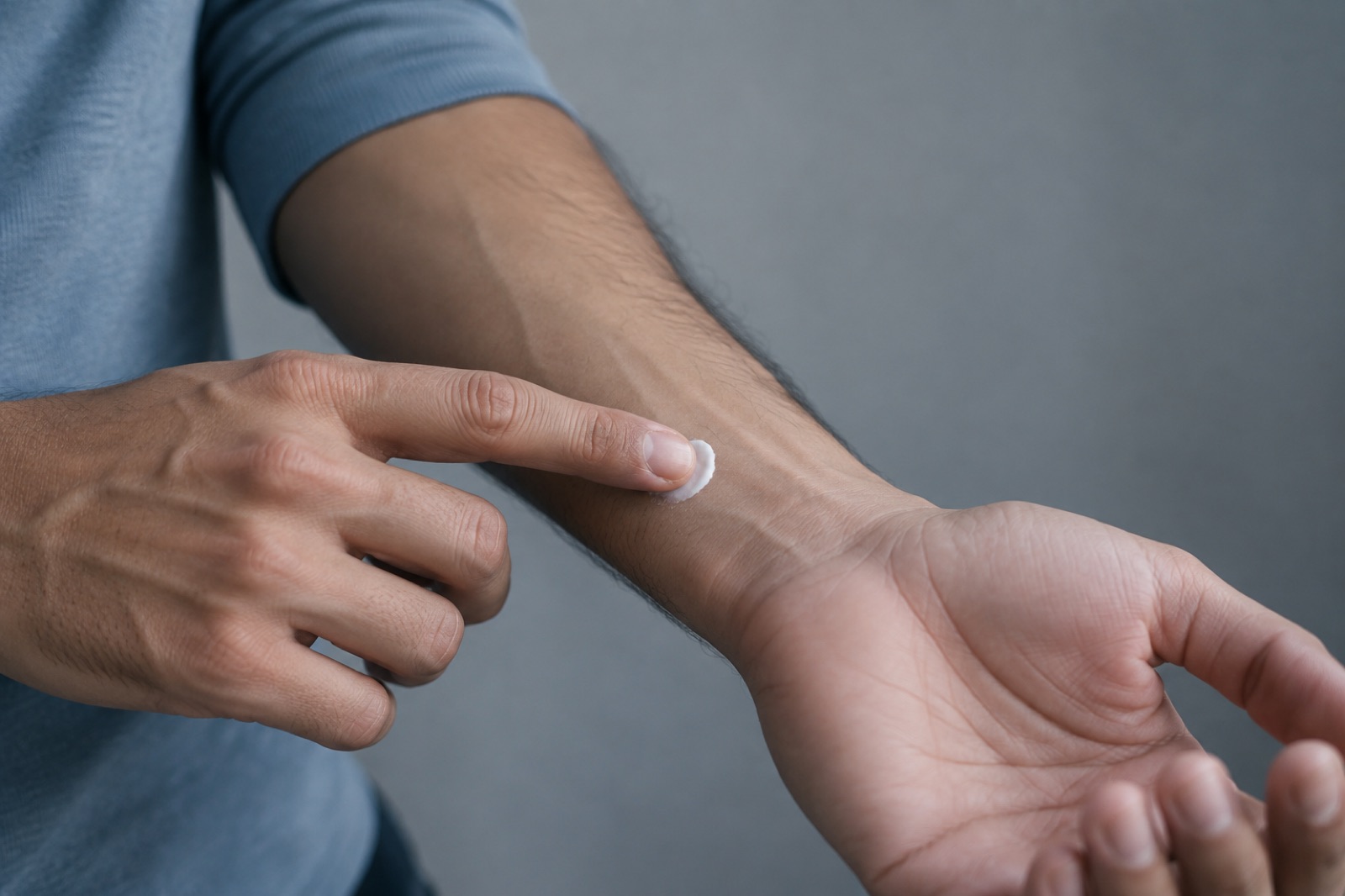
| 5. How to test a new product | One at a time, on a small area first | The AAD advises testing a new product before using it on your whole face. The accuracy of self-testing hasn’t been established | Institutions |
When to see a dermatologist
- If stinging or redness continues for weeks even after you cut back on products, consider seeing a dermatologist.
- If the area where you applied a product swells, itches, or oozes, stop using it and get checked at a clinic.
- If you seem to react to the same ingredient again and again, ask a dermatologist about patch testing.
- If flushing with burning keeps coming back and your bumps look different from acne, get checked by a doctor.
Frequently asked questions
What is sensitive skin?
It usually means skin that, by your own account, easily stings, burns, itches, or turns red in response to products or temperature changes. Most studies also define it by self-report, and there is no standard test that diagnoses it in one go, so it's closer to a name for how your skin is reacting right now than a diagnosis.
What are the symptoms of sensitive skin?
Stinging, burning, itching, and redness are the symptoms people describe most. In a meta-analysis covering 18 countries, 71% said their skin was at least somewhat sensitive, and survey studies reported cosmetics, humid air, and air conditioning alongside sensitive reactions, though none of this proves they are the cause.
What's a good face wash for sensitive skin?
Look at possible irritants on the ingredient list before any specific product. The American Academy of Dermatology (AAD) advises people with rosacea to avoid products with alcohol, fragrance, menthol, sodium lauryl sulfate, and similar ingredients, so check the cleansing agents and fragrance on the label and try new products one at a time.
How should you wash sensitive skin?
None of the evidence behind this article compared washing methods for sensitive skin specifically. The goal is to cut down possible irritants, so exfoliate less often, change only one cleanser at a time, and note when stinging or redness starts.
Is sensitive skin the same as a damaged skin barrier?
No. Studies often link sensitive skin with reduced barrier function and more reactive blood vessels, but there is still no standard for diagnosing sensitive skin.
Does 'low-irritation tested' mean a product is safe for everyone?
No. Those results apply only to the product tested, the method (an occlusive patch), healthy skin, and the number of people in the test. Patch tests can also give false negatives, so you still need to check how your own skin reacts.
Should you avoid all products with fragrance?
The AAD recommends fragrance-free products for sensitive, rosacea-prone skin. But in one study, a cleanser with added fragrance was tolerated about as well as a fragrance-free one, so don't decide on fragrance alone. Keep track of how your skin reacts.
Sources
- The prevalence of self-declared sensitive skin: a systematic review and meta-analysis (2020, PMID 31869523)A
- Triggering factors in sensitive skin from the worldwide patients' point of view: a systematic literature review and meta-analysis (2020, PMID 31571336)A
- What is sensitive skin? A systematic literature review of objective measurements (2015, PMID 25322670)A
- Prevalence of Contact Allergy to Isothiazolinones in Dermatitis Patients From 2000 to 2025: A Systematic Review and Meta-Analysis (2026, PMID 41804652)A
- Evaluation of the Performance of a Nature-Based Sensitive Skin Regimen in Subjects With Clinically Diagnosed Sensitive Skin (2018, PMID 30124733)A
- Tolerance of fragranced and fragrance-free facial cleansers in adults with clinically sensitive skin (2015, PMID 26682289)A
- Irritancy of industrial hand cleansers tested by repeated open application on human skin (1999, PMID 10048652)A
- The efficacy of glycolic acid, salicylic acid, gluconolactone, and licochalcone A combined with 0.1% adapalene vs adapalene monotherapy in mild-to-moderate acne vulgaris: a double-blinded within-person comparative study (2019, PMID 30858720)A
- Overcoming False-Negative Patch Tests: A Systematic Literature Review (2024, PMID 38181174)A
- Clinical utility of marketing terms used for over-the-counter dermatologic products (2018, PMID 29671667)A
- AAD — How to care for your rosaceaInstitutional
We never use YouTube videos or community posts as evidence for facts. Editorial policy
Product information related to this article
Product information from the site operator (KW Cosmetic, maker of the SKIN9HARI brand).
Revive Therapy N.F Cream
₩28,000 (KRW)
- Cream with 4 ceramides (NP, NS, EOP, AP), 5 types of hyaluronic acid and D-panthenol, 50 ml
- No added fragrance
- Low-irritation formula
Product details
- Type and size
- Soft, cushiony cream, 50 mL (1.69 fl oz)
- Step in routine
- Step 4 of 4 · Moisturize, the last step
- How to use
- As the last step of your routine, squeeze out a small amount. Warm it slightly between your palms. Press gently over your face, working outward from the center. Use morning and night after your ampoule or serum step.
- Before you use
- Contains dimethicone (silicone) — this is not a silicone-free formula. If redness, swelling or itching occurs, stop using and consult a dermatologist.
Based on the official product page, checked 2026-10-02
Cosmetics do not diagnose, treat, cure or prevent any disease. Test results apply only to the stated conditions.