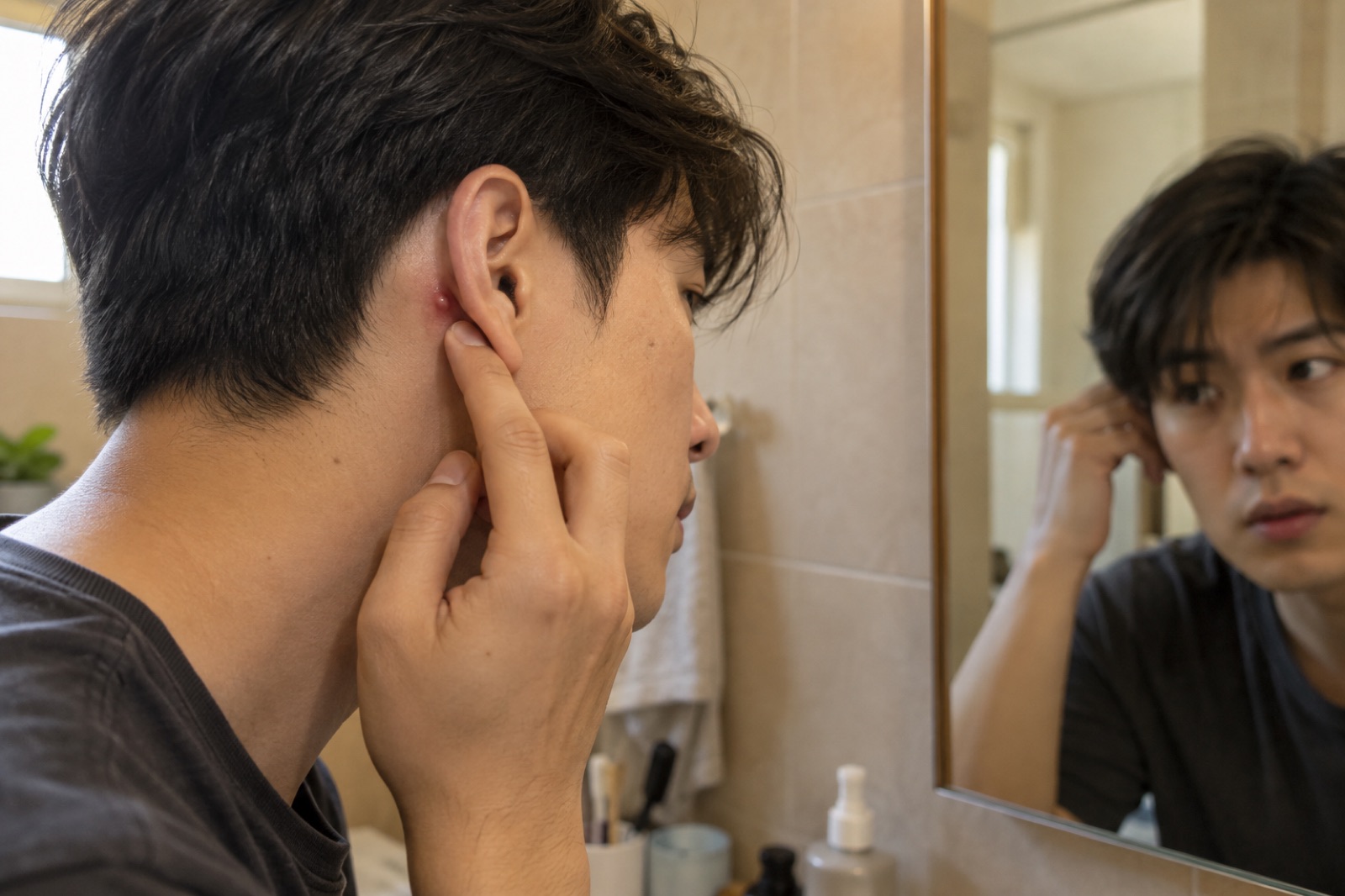
Pimple on Ear: Have Acne Studies Ever Looked at the Ears?
The acne studies and dermatology guidance reviewed here did not count the ears separately. The only sources that counted the ear directly looked at reactions to earring metal and pressure from protective gear.
In this article5 sections
| Topic | What we know | Source |
|---|---|---|
| Acne-by-area study | A study of 965 people with acne referred to dermatologists rated only the face, chest, and back, and the ear does not appear in the abstract | 2008 PMID 18561586 · B |
| Friction acne guidance | The AAD’s list of sports gear does not name anything that touches the ear | AAD · Institution |
| Data that names behind the ears | Of 757 health professionals who wore protective gear for long hours, 70% had soreness or pressure injuries behind the ears | 2022 PMID 35980915 · B |
| Data that counts the earlobe | Of 242 students who wore earrings, 130 (54%) reported symptoms on their earlobes | 2019 PMID 31055872 · B |
| Causes and frequency | We found no source showing what causes ear pimples, how often they happen, or how to make them show up less | Scope of sources |
Have acne studies ever counted pimples on the ear?
None of the acne-by-area studies or institutional guidance this article reviewed counted the ear separately. The 2008 study of 965 people with acne referred to dermatologists set three rating areas from the start (the face, chest, and back), and the word “ear” appears nowhere in its abstract. There was no box for the ear at all, so this study can’t tell you how often acne shows up on the ear.
Institutional guidance looks much the same. The American Academy of Dermatology (AAD) calls acne that forms when gear traps heat and sweat and rubs the skin “acne mechanica,” and it lists gear by sport: helmets, chin straps, shoulder pads, backpack straps, and wrestling face guards. None of the lines points to the ear. Looking at things that keep touching your ear through this idea is an inference, not something that has been confirmed on the ear.

Pimple behind ear: what data mentions the area behind the ears?
Within this article’s sources, the only one that put a number on the area behind the ears was a survey on wearing protective gear for long hours. In a 2022 online survey answered by 757 health professionals in Canada, 70% said they had soreness or pressure injuries behind the ears from mask-related problems. In the same survey, 52% reported new or worsening acne, but that number was not split by area, such as the face, so don’t read it as the share of people with acne behind the ears.
What this data shows goes only as far as this: something that presses behind the ears for a long time, like a mask strap, can leave soreness and injury in that spot. These are self-reports from people who wore protective gear through whole shifts in health care settings, and pimples were not counted separately. A way to go through things that touch your ears one at a time, such as earbuds and glasses arms, is laid out in ear acne causes.

Pimple on earlobe: what did studies that counted the earlobe look at?
The studies that directly counted the earlobe looked at reactions to earring metal touching the skin, not at acne. In a 1989 Italian study, symptoms started on the earlobes in 70% of 300 patients who reacted to nickel, and 62% of 735 schoolgirls had earlobe symptoms; all of them regularly wore cheap earrings. In a 2019 survey in Rome, 130 of 242 students who wore earrings (54%) reported earlobe symptoms, and 4 of 21 earring parts (20%) released more nickel than the legal limit.
The AAD explains that with this kind of contact reaction, the first sign is often itchy skin followed by a rash, that it does not spread from person to person, and that fragrance and nickel are among the more common causes. In an experiment where nickel discs were placed on the skin of 16 adults with a nickel allergy for 10 minutes, three times, 3 people (19%) reacted even on normal earlobe skin. Itchy symptoms that keep coming back on the earlobe fall outside the acne data, and they may not be acne, so it makes sense to have a doctor or dermatologist check what they are.
Ear pimple evidence: what each source can and can’t tell you
If you sort the sources people use to explain ear pimples into six columns, you can see that what they can say about the ear is narrower than you might expect.
| Source | Who · design | Areas studied | Ear listed separately? | What it tells you | What it can’t tell you |
|---|---|---|---|---|---|
| 2008 acne-by-area study (PMID 18561586) | 965 people with acne referred to dermatologists · severity rated by area | Face, chest, back | No — “ear” not in the abstract | The study set only three rating areas from the start | How often acne appears on the ear |
| AAD hair product guidance | Patient guidance · Institution | Hairline, upper forehead, back of the neck | No | Small pimples can form where oil from hair products touches the skin | Whether behind or under the ears counts as the same kind of area |
| AAD friction acne guidance | Patient guidance · Institution | Areas touched by helmets, chin straps, shoulder pads, backpack straps | No | Gear that traps heat and sweat and rubs the skin can lead to acne | Whether earbuds, headphones, or glasses arms do the same to the ear |
| 1989 cheap earring study (PMID 2598650) | 300 patients who reacted to nickel · 735 schoolgirls | Earlobe | Yes — earlobe | The earlobe is a common place for metal contact reactions to start | Whether earlobe bumps are acne |
| 2019 Rome earring survey (PMID 31055872) | Survey of 315 students · earring parts tested | Earlobe | Yes — earlobe | About half of students who wore earrings reported earlobe symptoms | What kind of symptoms they were |
| 2022 protective gear survey (PMID 35980915) | 757 health professionals in Canada · online cross-sectional survey | Behind the ears, face, hands | Yes — soreness or pressure injuries behind the ears | Straps that press for a long time can leave soreness and injury behind the ears | The share of acne behind the ears; whether the same is true for everyday masks |
Put the six rows together, and they say two things. One is the general idea that pressure, rubbing, and contact reach the ear too. The other is that itchy reactions that keep coming back on the earlobe belong to the contact reaction data, not the acne data. This article found no source showing what causes ear pimples, how often they happen, or how to make them show up less. To see whether they line up with your menstrual cycle, the only way is to write down the dates, as in the log in acne before your period.
When to see a dermatologist
- If symptoms on your earlobe or where your earrings sit get itchy and spread, or keep coming back in the same spot, have a dermatologist check what they are.
- If you feel a lump that hurts when you press it and keeps getting bigger, don’t just watch it at home; see a dermatologist. Lumps that feel hard deep under the skin are covered in nodular acne.
- If the inside of your ear hurts or is oozing, see a doctor.
Frequently asked questions
Why do I keep getting pimples under my ears and along my hairline?
This article did not find any source that looked at the area under the ears on its own and explained the cause. The closest source is the American Academy of Dermatology (AAD) guidance on hair products, but the areas it names are the hairline, the upper forehead, and the back of the neck, not the ears. So applying that guidance to the skin under your ears only goes as far as guessing that the conditions there may be similar. It can't tell you what is causing the pimples under your ears.
I suddenly got dozens of pimples along the edges of my face and behind my ears. Can hats cause that?
Within the sources this article reviewed, nothing checked behind the ears to show that hats or other headwear cause pimples there. The only source that listed behind the ears separately was a survey of health professionals who wore masks and other protective gear for long hours, and its 70% figure is about soreness and pressure injuries behind the ears. If dozens appeared all at once, that goes beyond what you should just watch at home, so have a dermatologist check what it is.
How do I stop getting pimples on my earlobe and where it joins my face?
This article did not find any source that tested a way to make pimples on the earlobe or the side of the ear show up less. The sources that directly counted repeated symptoms on the earlobe were studies of reactions to earring metal, not studies of acne. If the same spot keeps getting itchy and spreading, or a firm bump keeps coming back, it may not be acne, so get it checked by a doctor or dermatologist.
Before every period I get hard bumps on my jawline, neck, and behind my ears. Has any study looked behind the ears?
None of the sources this article reviewed looked at the menstrual cycle and the area behind the ears together. The only source that listed behind the ears separately was a survey of health professionals who wore protective gear for long hours, and its numbers describe soreness and injury where mask straps pressed, which has nothing to do with the cycle. The only way to see whether your bumps line up with your cycle is to write down the dates, and if hard bumps keep coming up in the same spot, see a dermatologist.
Is there any evidence for patch testing a new product behind your ear?
Testing a product behind the ear first has been studied for hair dye. In a study of 42 people who were already allergic to a hair dye ingredient (PPD), a test product was left on the skin for 45 minutes, and 39 people (93%) behind the ear and 38 people (90.5%) on the forearm had a reaction noticeable enough to spot on their own. But that study was about hair dye allergy, not skin care in general or pimples, so a pimple behind your ear doesn't by itself mean a product caused it.
Sources
- Prevalence and severity of facial and truncal acne in a referral cohort (2008, PMID 18561586)B
- Impact of prolonged PPE use on Canadian health professionals (2022, PMID 35980915)B
- Nickel dermatitis from cheap earrings (1989, PMID 2598650)B
- Nickel dermatitis from earrings 15 years after EU directive implementation: a clinical-epidemiological study and a market survey in Rome, Italy (2019, PMID 31055872)B
- Short contact with nickel causes allergic contact dermatitis: an experimental study (2018, PMID 29959775)B
- Allergy Alert Test for p-Phenylenediamine-Allergic Hair Dye Users (2018, PMID 30234613)B
- AAD — Sports equipment can cause acneInstitutional
- AAD — Hair care products that cause acneInstitutional
- AAD — Contact dermatitis: OverviewInstitutional
We never use YouTube videos or community posts as evidence for facts. Editorial policy
Product information related to this article
Product information from the site operator (KW Cosmetic, maker of the SKIN9HARI brand).
Revive Therapy N.F Toner
₩29,000 (KRW)
The earring and protective-gear studies in this article's table have nothing to do with this toner, so they are not evidence for it. What can be confirmed about this toner is limited to its labeled mildly acidic pH (5.5–6.5) and 150 ml size, plus the setup of a finished-product comedogenicity test (12 closed patch applications over 4 weeks, on upper-back skin), so that test did not examine the ears either. The directions on the product page do not name the ears as a place to apply it. With those limits in mind, the product we suggest for the step after cleansing is Revive Therapy N.F Toner.
- Mildly acidic toner (pH 5.5–6.5), 150 ml
- Contains niacinamide 2.0% and beta-glucan 1.0%
- Low-irritation formula
- Contains ethanol and fragrance ingredients (orange peel oil, lavender oil); check the full ingredient list
Product details
- Type and size
- Clear, water-light toner, pH 5.5–6.5, 150 mL (5.07 fl oz)
- Step in routine
- Step 2 of 4 · Tone, right after cleansing
- How to use
- After cleansing, pour a small amount onto a cotton pad or your palms. Sweep or press gently over your face and neck. Pat lightly until fully absorbed. Follow with Revive Therapy N.F Ampoule, then N.F Cream.
- Before you use
- Contains ethanol (3.0%) and fragrance, including the allergens linalool and limonene — this is not an alcohol-free formula. If redness, swelling or itching occurs, stop using and consult a dermatologist.
Based on the official product page, checked 2026-10-02
Cosmetics do not diagnose, treat, cure or prevent any disease. Test results apply only to the stated conditions.