Nodular Acne: Why It Feels Like a Hard Lump Under the Skin
A nodule is acne whose inflammation has reached deep into the skin, so when you touch it, it feels like a firm lump below the surface rather than a bump on top.
In this article6 sections
| Topic | What the sources say | Source |
|---|---|---|
| Nodules and cysts | Forms where inflammation has reached deep into the skin; both can hurt. A cyst contains pus, and a nodule, which has no pus, feels firmer | AAD acne symptoms and scars · Institution |
| Scarring | The NHS considers cysts the most severe type, with the highest risk of permanent scarring | NHS acne overview · Institution |
| Severe acne | Many large, painful papules, pustules, nodules, or cysts, possibly with scarring, is classed as severe | NHS acne diagnosis · Institution |
| Specialist referral | Nodulocystic acne and cases with an uncertain diagnosis should be referred to a dermatology specialist team | NICE NG198 · Institution |
| Scar risk factors | An assessment tool built on severity, duration, family history, and picking (sensitivity 82%, specificity 43%) | Acne scar research summary · A |
Why does it feel like a hard lump under the skin?
A nodule is acne whose inflammation has reached deep layers of the skin rather than staying on the surface, so it feels like a firm lump underneath. The American Academy of Dermatology (AAD) describes both nodules and cysts as forms where inflammation has gone deep into the skin, and explains that both can hurt and that the main difference is pus: a cyst is filled with pus, while a nodule has no pus and feels firmer to the touch. It sits at a different depth from a pustule, where yellow pus is visible on the surface. Much of what people search for as a “hard pimple under the skin” or a “blind pimple” overlaps with this form.
Why should you be more careful with nodular acne?
Nodules and cysts are the forms of acne most likely to lead to scarring, which is why you need to be more careful with them. Among 6 types of acne, the NHS considers cysts the most severe, with the highest risk of permanent scarring. The NHS classes acne as severe when there are many large, painful lesions, nodules, or cysts, possibly with scarring. The AAD’s guidance on severe acne also notes that this kind of acne is hard to manage with over-the-counter products alone.
Why you shouldn’t squeeze a hard pimple under the skin
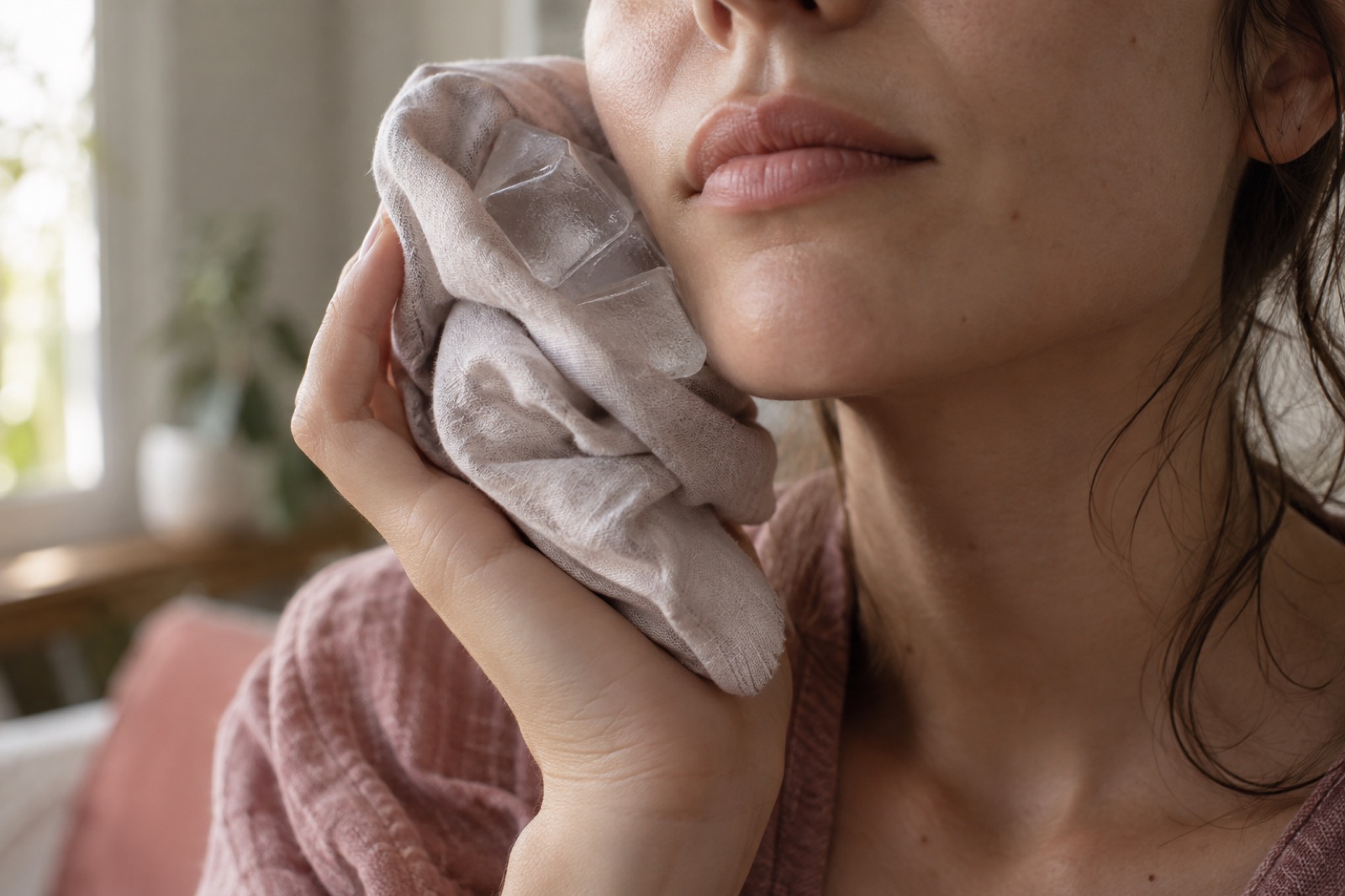
Not squeezing a hard lump is the common rule across health organization guidance. The AAD advises against squeezing cysts and nodules at home, citing the risk of infection. For deep, painful acne, the AAD suggests using ice to ease pain, swelling, and redness. Wrap the ice in a cloth; don’t put it directly on your skin. Picking is one of the 4 factors in an acne scar risk assessment tool, so pressing on it again and again because it won’t come out can do more harm than good. Poking a deep pimple with a needle is not recommended for the same reason; the AAD describes opening lesions with instruments as something done at a dermatologist’s office.
Could the lump under your skin be something other than acne?
Not every lump you can feel under the skin is acne, and a medical visit is where they are told apart. People searching online often confuse sebaceous or epidermoid cysts with nodular acne, but our sources include no way to tell them apart at home. The AAD describes hidradenitis suppurativa, which causes acne-like cysts where skin rubs together such as the armpits and groin, as a condition that can be mistaken for acne. NICE also lists cases with an uncertain diagnosis for referral to a dermatology specialist.

Lump log: 5 things to write down before your visit
Filling in these five columns by date makes it easier to explain at your appointment.
| What to record | How to write it | Why |
|---|---|---|
| Location | Jawline, cheek, back, chest, armpit, groin | Lumps that keep returning where skin rubs together can point to a different condition (AAD) |
| How it feels | Firm / soft / painful when pressed | Compare with the AAD’s description: a nodule without pus feels firmer, and both can hurt |
| Size change | Getting bigger or staying the same, by date | Check whether it lasts a long time without changing |
| Repeats | How many times in the same spot | Lets you tell the doctor whether it keeps returning in one place |
| Scar risk factors | Family members with scars, whether you have squeezed or picked | Family history and picking are scar risk factors |
When to see a dermatologist
- If you have several hard or painful lumps, or scars are starting to form. The NHS classes this as severe.
- If lumps keep coming back where skin rubs together, like the armpits or groin (AAD).
- If you can’t tell whether it is acne or another kind of lump. NICE recommends referral to a dermatology specialist when the diagnosis is uncertain.
- If family members have acne scars. The AAD suggests seeing a dermatologist early in that case.
Frequently asked questions
What causes nodular acne?
A nodule forms when inflammation inside a clogged pore reaches deep layers of the skin instead of staying near the surface (American Academy of Dermatology). Our sources have no way to predict which pimples will go this deep, but severity, duration, family history, and picking are listed as factors that raise the risk of scarring.
What happens if you pop a nodule?
The AAD advises against squeezing cysts and nodules at home, citing the risk of infection. Picking is one of the 4 factors in an acne scar risk assessment tool, so if you keep pressing on it because it won't come out, you are more likely to end up with a scar.
Does nodular acne go away on its own?
There is not enough evidence to say how long it takes to settle. The AAD's guidance on severe acne says it usually takes 2 to 3 months to see changes even with medical care. In the meantime, don't squeeze it; using ice to ease pain and swelling is about as far as home care goes.
Should you use a needle on a hard pimple under the skin?
It is not recommended. The AAD explains that opening lesions with instruments is something done at a dermatologist's office, and poking and squeezing at home raises the risk of infection and scarring. If you have several hard lumps or they keep coming back, see a dermatologist.
Nodular acne vs cystic acne: what's the difference?
The AAD sees both as forms where inflammation has reached deep into the skin, and explains that both can hurt and the main difference is pus: a cyst is filled with pus, while a nodule has no pus and feels firmer to the touch. The NHS classifies cysts as the most severe type of acne.
How do I know if a lump is a cyst or a pimple?
Our sources include no way to tell the two apart at home. Don't judge by look alone; have a dermatologist check it.
Sources
- AAD — Acne: SymptomsInstitutional
- AAD — Severe acne: How it's treatedInstitutional
- AAD — Pimple popping: Why only a dermatologist should do itInstitutional
- AAD — Is that stubborn acne really acne?Institutional
- NHS 111 Wales — Health A-Z: Acne (updated 2024-11-07)Institutional
- NICE NG198 — Acne vulgaris: managementInstitutional
- Development of an atrophic acne scar risk assessment tool (2017, PMID 28499079)A
We never use YouTube videos or community posts as evidence for facts. Editorial policy
Product information related to this article
Product information from the site operator (KW Cosmetic, maker of the SKIN9HARI brand).
Revive Therapy N.F Cream
₩28,000 (KRW)
The AAD and NHS sources and the lump log in this article are not evidence for this cream, and no test has looked at the deep bumps covered here. Revive Therapy N.F Cream is a 50 ml cream with four ceramides (NP, NS, EOP, AP) and five types of hyaluronic acid, with no added fragrance per its ingredient list. Its product page places it after the ampoule, as the last step; skip broken or squeezed skin. Separate from any clinic visit, for the final moisturizing step after daily cleansing, the product we suggest is Revive Therapy N.F Cream.
- Cream with 4 ceramides (NP, NS, EOP, AP), 5 types of hyaluronic acid and D-panthenol, 50 ml
- No added fragrance
- Low-irritation formula
Product details
- Type and size
- Soft, cushiony cream, 50 mL (1.69 fl oz)
- Step in routine
- Step 4 of 4 · Moisturize, the last step
- How to use
- As the last step of your routine, squeeze out a small amount. Warm it slightly between your palms. Press gently over your face, working outward from the center. Use morning and night after your ampoule or serum step.
- Before you use
- Contains dimethicone (silicone) — this is not a silicone-free formula. If redness, swelling or itching occurs, stop using and consult a dermatologist.
Based on the official product page, checked 2026-10-02
Cosmetics do not diagnose, treat, cure or prevent any disease. Test results apply only to the stated conditions.