Ear Acne: Earlobe and In-Ear Pimples, and Why Not to Pop Them
Few studies look at ear acne on its own, so start by checking what touches your ears, such as headphones, hair products, and earrings, and don't squeeze.
In this article8 sections
- What causes ear acne?
- Can a pimple on your earlobe come from earrings?
- Can things that touch your ears cause pimples?
- Can hair products and pillows cause breakouts around the ears?
- Should you pop a pimple on your ear?
- Pimple in the ear canal: ENT doctor or dermatologist?
- Checklist: what to note when ear pimples keep coming back
- When to see a doctor
| Topic | What we know | Source |
|---|---|---|
| Evidence on ears alone | We did not find any study or official guidance that covers ear acne alone | Literature review |
| How acne forms | Oil and dead skin cells clog the pore, bacteria grow in the blocked follicle, and inflammation follows | NIAMS · Institution |
| Repeated friction | Gear that rubs the skin again and again and traps heat and sweat can cause friction acne | AAD · Institution |
| Earrings | Nickel released from earrings was 1.4 to 93 times the level that triggered reactions in people with nickel allergy | Patch testing and metal-release testing in 12 people with nickel allergy · A |
| Squeezing | Squeezing a pimple yourself raises the risk of inflammation, infection, and permanent scars | AAD · Institution |
What causes ear acne?
We did not find any study or official guidance in our sources on what causes acne only on the ears, so it helps to look separately at how acne forms in general and at what touches your ears. The US National Institute of Arthritis and Musculoskeletal and Skin Diseases (NIAMS) explains that oil and dead skin cells clump together in the pore and block it, then bacteria that normally live on the skin grow inside the blocked follicle, leading to inflammation such as redness, swelling, and pain. Hormone changes and family history raise the risk, and friction, pressure, and squeezing are not direct causes but can make acne worse.
The UK’s NHS lists the face, back, and chest as common places for acne and does not mention the ears. So if pimples keep coming back in the same spot on your ear, first try to tell whether it is acne or a contact reaction from metal or a product.
Can a pimple on your earlobe come from earrings?
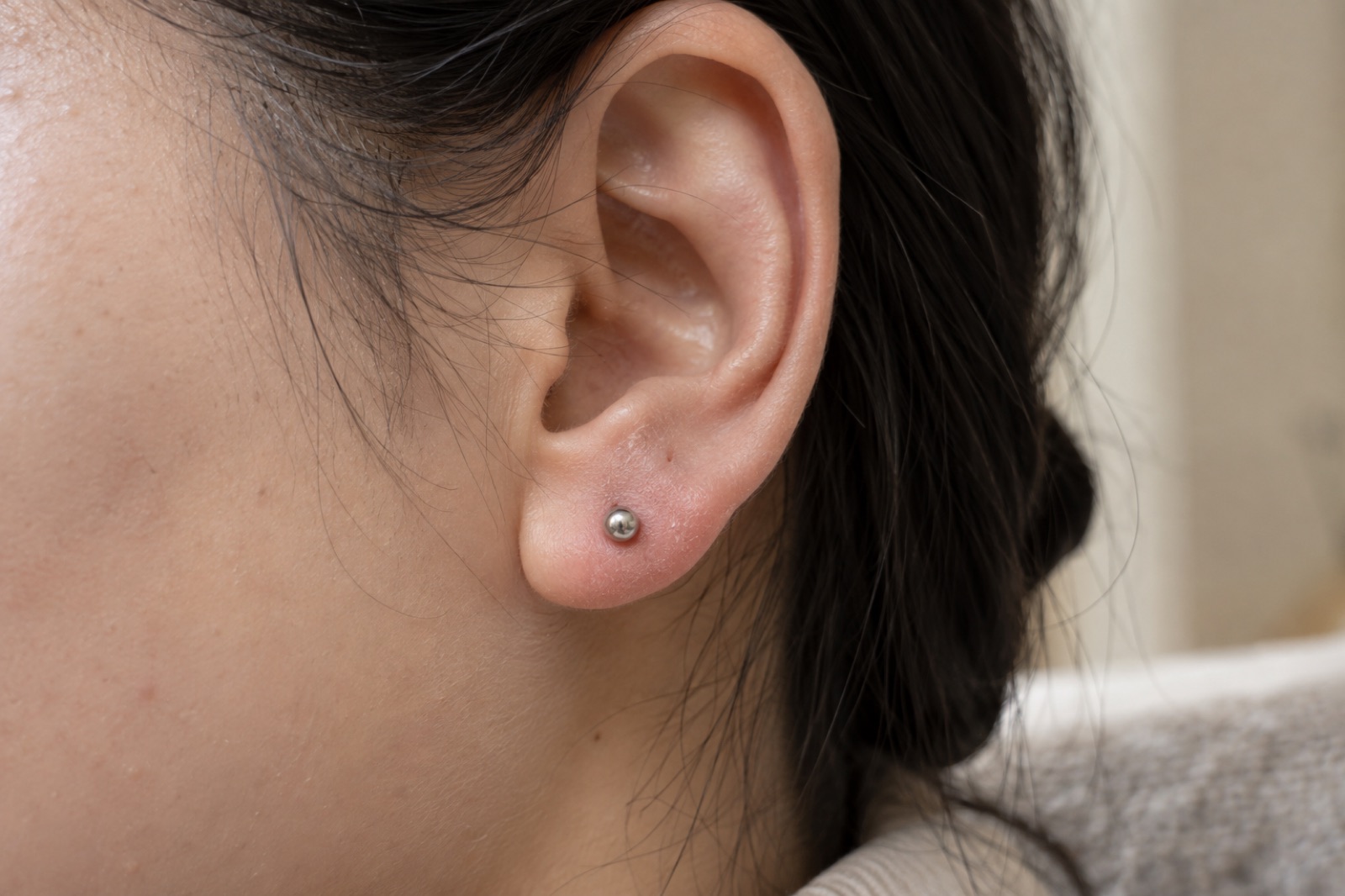
If an itchy, red rash keeps showing up where you wear earrings, consider a metal contact allergy along with acne. The American Academy of Dermatology (AAD) names nickel, found in jewelry, phones, and more, as the most common cause of contact allergy, and says these reactions can appear hours to days after contact, which makes the cause hard to find.
There is research on earrings, too. In a study of 12 people with nickel allergy, earrings and necklaces soaked in artificial sweat and similar fluids released 1.4 to 93 times the amount of nickel that triggered reactions in these allergic participants, and earrings released more than necklaces (grade A). In a randomized trial in which 60 women who tested positive for gold allergy wore earrings for 8 weeks, 12 of the 17 people with skin reactions were in the pure gold earring group. But looking only at reactions on the earlobe itself, the difference between the two groups was not significant (grade A).
Can things that touch your ears cause pimples?
The AAD says gear that rubs the skin again and again and traps heat and sweat can cause friction acne. Items that press on the same spot, such as helmets, chin straps, and backpack straps, can be the cause, and the AAD explains that it starts as tiny bumps you can feel more than see and can turn into pimples or deeper breakouts if left alone.
The AAD advises putting a clean, soft pad between gear and skin, wearing clothes that wick away sweat, and choosing loose-fitting clothes over tight ones (protective gear such as helmets should still fit properly). Items that touch your ears for long periods, such as earbuds, headphones, mask straps, and phones, can be checked the same way: do they press, rub, or trap sweat? We did not find studies on these items alone, so the practical step is to note how long you use them and where pimples keep appearing.
Can hair products and pillows cause breakouts around the ears?
The AAD says oils in hair products can cause small pimples along the hairline, on the upper forehead, and on the back of the neck. Behind the ears and around the outer ear are also places where shampoo, conditioner, and styling products run down, so you can check them the same way. The AAD explains that breakouts from hair products usually settle slowly over 4 to 6 weeks after you stop using the product.
The AAD recommends not using hair products that aren’t labeled “oil-free” or “non-comedogenic,” and washing items your hair touches, such as pillowcases, hats, and headbands, to remove product residue. Our hairline acne article covers breakouts along the hairline in more detail.

Should you pop a pimple on your ear?
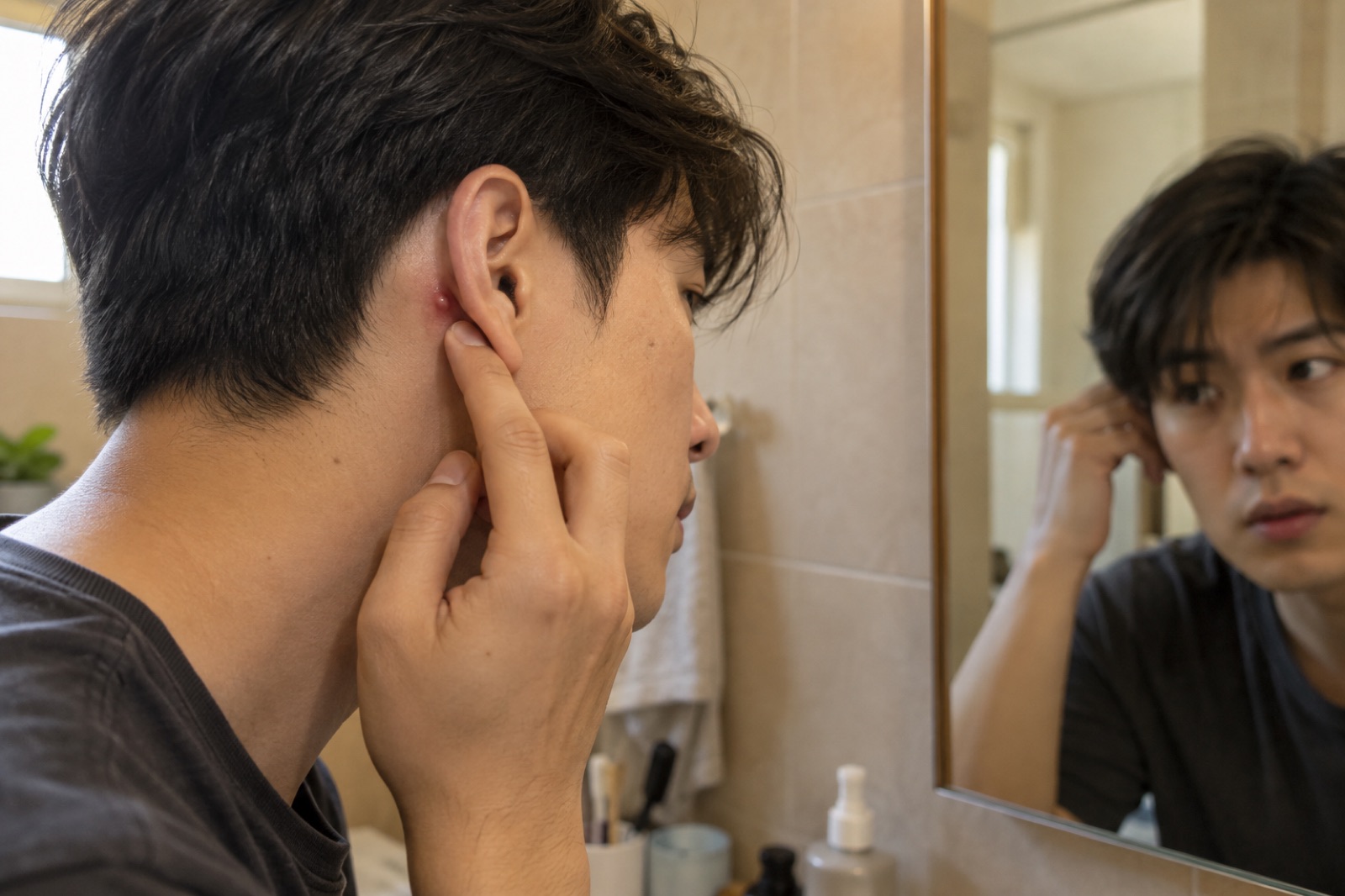
It is safer not to squeeze ear pimples either. The AAD says squeezing a pimple yourself can push its contents deeper into the skin and make inflammation worse, raise the risk of infection from germs on your hands, and leave a permanent scar. For painful, swollen pimples, it advises leaving them alone and using ice to ease pain and swelling (wrapped in a cloth, on the outer ear only).
The ear is hard to see in a mirror, so it is easy to touch it with a fingernail or cotton swab without thinking. Our can I pop my pimples? article covers why people want to squeeze and what to do instead. The AAD advises seeing a board-certified dermatologist if 4 to 6 weeks of care don’t help.
Pimple in the ear canal: ENT doctor or dermatologist?
The ear canal is hard to see yourself, and our sources had no guidance on pimples inside the ear, so it is safer to have symptoms inside the ear checked by a doctor. If the inside of your ear hurts or feels blocked, an ear, nose, and throat (ENT) doctor can look directly inside the ear. For breakouts that keep coming back on the skin of the earlobe, outer ear, or behind the ear, a dermatologist is the practical first stop.
If you suspect a contact allergy, such as a rash where you wear earrings, a dermatologist can use a patch test to find the trigger.

Checklist: what to note when ear pimples keep coming back
| What to check | How to note it | Why it matters |
|---|---|---|
| Location | Earlobe / outer ear / behind the ear / inside the ear | Inside the ear is hard to see, so have it checked by a doctor |
| Things that touch your ears for a long time | Earbuds, headphones, helmet, mask straps, and hours of use per day | Repeated friction, heat, and sweat are friction acne factors (AAD) |
| Hair products and bedding | New shampoo or styling products, how often you wash pillowcases | Hair product oils and residue (AAD) |
| Earrings | New earrings, hours worn, whether it settles when you take them out | Metal contact allergy, such as nickel |
| Look and feel | White dot / red and painful / itchy rash | Clues to whether it is acne or a contact reaction |
| Touching | Whether you squeezed it or poked it with a swab or fingernail | Squeezing raises scar and infection risk (AAD) |
When to see a doctor
- If the inside of your ear hurts or feels blocked, leaks fluid, or you can’t hear well, see an ENT doctor.
- If a pimple on your earlobe or outer ear gets very swollen and painful, or keeps coming back after 4 to 6 weeks of care, talk to a board-certified dermatologist.
- If an itchy rash keeps coming back where you wear earrings, have a dermatologist check for a metal allergy.
- If there is no improvement 6 weeks after you stop using a hair product, see a dermatologist.
Frequently asked questions
Why do I get pimples on my ears?
We did not find any study in our sources that looks only at what causes acne on the ears. Health organizations explain acne as oil and dead skin cells clogging a pore and bacteria growing inside it, and the American Academy of Dermatology (AAD) says gear that rubs the skin again and again and hair products can lead to breakouts. For the ears, we use these factors as a checklist.
Why do I get pimples on my earlobe?
The sources we reviewed had no evidence on causes specific to the earlobe, but earrings that stay against the earlobe are worth a closer look. Nickel is a common cause of contact allergy, and in a lab study where earrings were soaked in artificial sweat, the nickel released was 1.4 to 93 times the level that triggered reactions in people with nickel allergy. The reaction it causes looks more like an itchy red rash than acne.
What should I do if a pimple on my ear hurts?
The AAD suggests leaving painful, swollen pimples alone and using ice to ease pain and swelling. Wrap it in a clean cloth, use it only on the outer skin, and never put it inside the ear canal. If the pain keeps getting worse, the swelling grows, or the inside of your ear hurts, see a doctor.
Should I pop a pimple in my ear?
It is safer not to. The AAD says squeezing a pimple yourself can push its contents deeper into the skin and make inflammation worse, cause infection from germs on your hands, or leave a permanent scar. In spots you can't see well, such as inside the ear, don't poke with a fingernail or a cotton swab either.
Is an itchy bump on my earlobe acne?
When itching stands out, consider a contact allergy as well as acne. The AAD explains that allergic contact reactions can show up hours to days after touching the trigger, which makes the cause hard to find. If it keeps happening, a dermatologist can help identify the trigger.
Sources
- NIAMS, Overview of AcneInstitutional
- NHS, Acne (reviewed 2026-09-22)Institutional
- AAD, Sports equipment can cause acneInstitutional
- AAD, Hair care products that cause acneInstitutional
- AAD, Contact dermatitis: CausesInstitutional
- AAD, Pimple popping: Why only a dermatologist should do itInstitutional
- Allergic contact dermatitis to nickel: bioavailability from consumer products and provocation threshold (1988, PMID 3170796)A
- Exposure to metallic gold in patients with contact allergy to gold sodium thiosulfate (2000, PMID 11140385)A
We never use YouTube videos or community posts as evidence for facts. Editorial policy
Product information related to this article
Product information from the site operator (KW Cosmetic, maker of the SKIN9HARI brand).
Centella Rescue Spot Ampoule
₩22,000 (KRW)
No study looks at ear acne alone, and neither the AAD guidance nor the earring studies cited here tested this ampoule. Centella Rescue Spot Ampoule is a 15 ml spot ampoule with alcohol-extracted Centella asiatica extract as its main ingredient; there is no data on use on the earlobe, outer ear or ear canal, and because it contains alcohol it may sting. Its product page says to apply 1–2 drops where needed after cleansing, and to try a small, unnoticeable area first if your skin is sensitive. For the step where you keep your hands off and add a drop or two after cleansing, the product we suggest is Centella Rescue Spot Ampoule.
- Ampoule with alcohol-extracted Centella asiatica extract as the main ingredient, 15 ml
- Also contains Aloe Phytoplacenta, Greenol and Campanula callus extract
- Contains alcohol, so it may sting; try it on a small area first
- Low-irritation formula
Product details
- Type and size
- Fast-absorbing gel ampoule, 15 mL (0.5 fl oz)
- Step in routine
- Spot care, layered any time
- How to use
- Use the dropper to apply a small amount directly to the area of concern. Pat gently until absorbed. Layer it at any step of your routine — before or after your regular toner, ampoule, or cream.
- Before you use
- Contains ethanol and natural bergamot oil, which may cause a slight tingling sensation on very sensitive or freshly irritated skin — patch test first if unsure. If redness, swelling or itching occurs, stop using and consult a dermatologist.
Based on the official product page, checked 2026-10-02
Cosmetics do not diagnose, treat, cure or prevent any disease. Test results apply only to the stated conditions.