Maskne: Why Breakouts Show Up on Your Cheeks and Chin (4 Causes)
The cheeks and chin under a mask are where pressure, rubbing, trapped moisture, and heat all overlap, and in studies, breakouts were more common the longer people wore masks.
In this article6 sections
| Topic | What the evidence says | Source |
|---|---|---|
| How common | In a meta-analysis of 37 observational studies (29,557 people), 55% of mask wearers had facial skin problems: acne 31%, itching 30%, and pressure injury 31% | Environmental factor research summary · A |
| Wear time | In the same meta-analysis, how long people wore masks was the most significant risk factor, and in 16 studies of health care workers, wearing masks for more than 6 hours was linked with more skin reactions | Environmental factor and irritant contact dermatitis research summaries · A |
| Where | In a survey of 200 university students, breakouts were most common on the cheeks (51%) and chin (45.5%) | Environmental factor research summary · B |
| Skin changes | After 20 people wore masks 6 hours a day for 2 weeks, skin temperature, redness, and water loss (TEWL) went up, and so did the number of lesions (no control group) | Environmental factor research summary · B |
| Contact irritation | In a survey across 12 Korean hospitals, the most common problems were new contact dermatitis (33.94%), new acne (16.97%), and worsening of existing acne (16.97%) | Irritant contact dermatitis research summary · B |
Why do breakouts show up on the cheeks and chin?
Because the cheeks and chin are exactly where a mask presses and rubs. That’s cause 1: pressure and friction. A review of face protection used by health care workers found that skin irritation from pressure and friction is common on the cheeks and the bridge of the nose. A study of 14 health care workers who wore masks all the time found more inflamed lesions where the cheek meets the jaw than on the forehead, and the outer skin layer there was thinner (19.56 vs 24.25 μm).
Keep in mind that these are observational studies that looked at links. Taken together, the studies do not support saying outright that masks cause acne, because daily routines, sweating, and stress also change during periods of mask wearing.
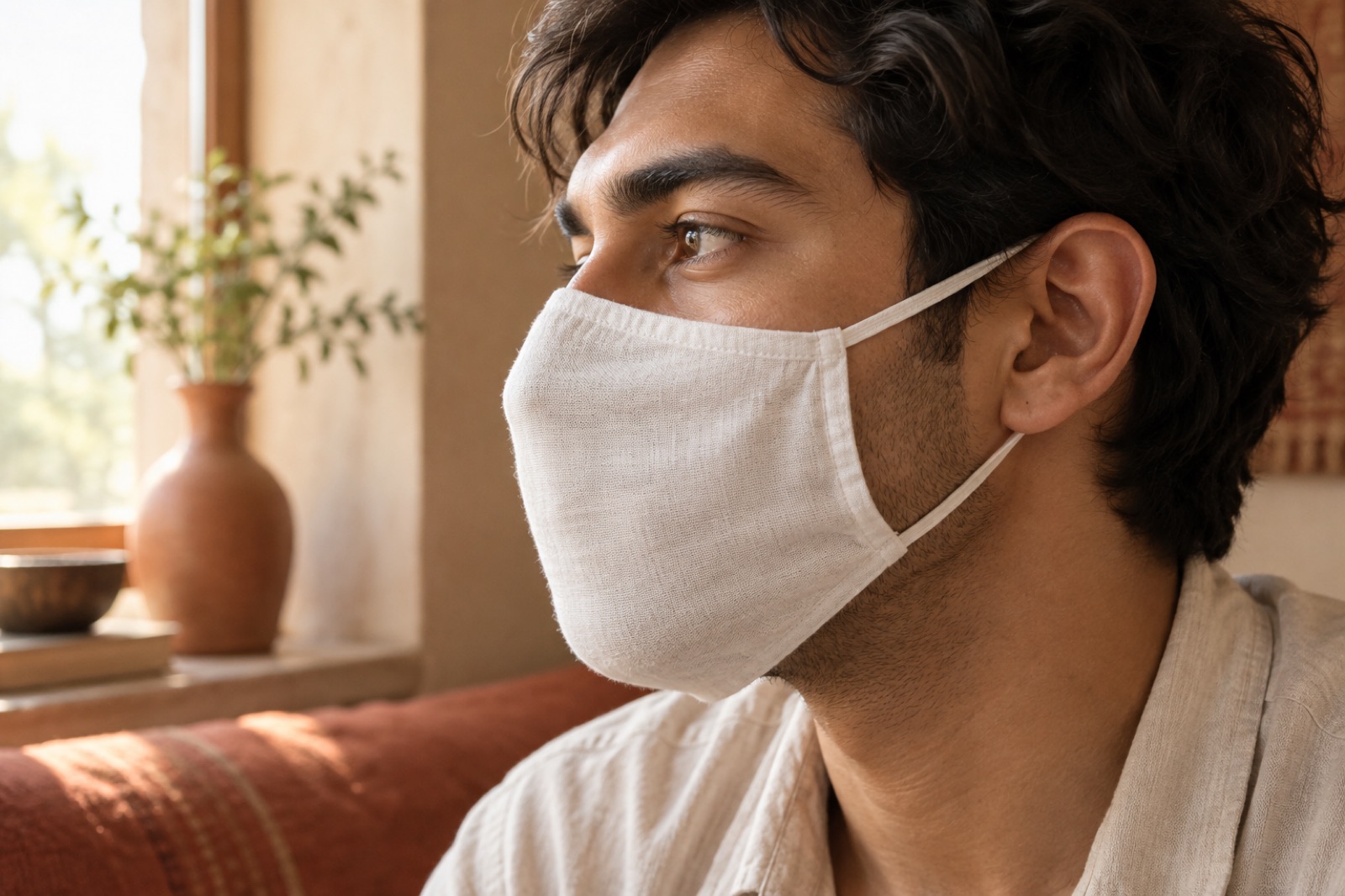
What changes when heat and moisture get trapped?
Cause 2 is the moisture and heat trapped inside the mask. In a study where 20 people wore masks 6 hours a day for 2 weeks, skin temperature, redness, and water loss (TEWL) rose right after 6 hours of wear, and after 2 weeks the number of lesions went up. It was a small study without a control group, so the finding is only preliminary.
In a survey of university students, bacteria and yeast in cheek skin samples increased while masks were being worn, and 81.1% of participants didn’t know how to use a mask properly. If your mask often gets damp from breath and sweat, this cause is worth suspecting first.
Are breakouts more common if you wear it longer and change it less?
Cause 3 is wear time and how often you change your mask. In the meta-analysis of 37 studies, wear time was the most significant risk factor for facial skin problems. In the 12-hospital Korean survey, wearing a mask for more than 6 hours a day was linked with flare-ups (P=0.04), and in the survey of 200 university students, long wear (p=0.001) and changing masks less often (p=0.01) were linked with breakouts. A survey of 227 health care workers also found wear time to be a risk factor.
Can mask materials and straps irritate your skin?
Cause 4 is contact with mask materials and parts. The review of face protection named elastic bands, adhesives, formaldehyde-releasing substances, and nickel as causes of allergic contact reactions. A review that gathered 954 mask-related reactions found itching (38.8%) was the most common, with 44 reports of acne flare-ups and 14 of rosacea flare-ups.
That means rough bumps where your mask sits may be an irritation reaction rather than acne. A study from rural India saw irritant contact reactions as the main cause of so-called maskne and highlighted moisturizers and regular mask breaks as key parts of care. Results by mask type (cloth, N95, and surgical masks) differ from study to study.
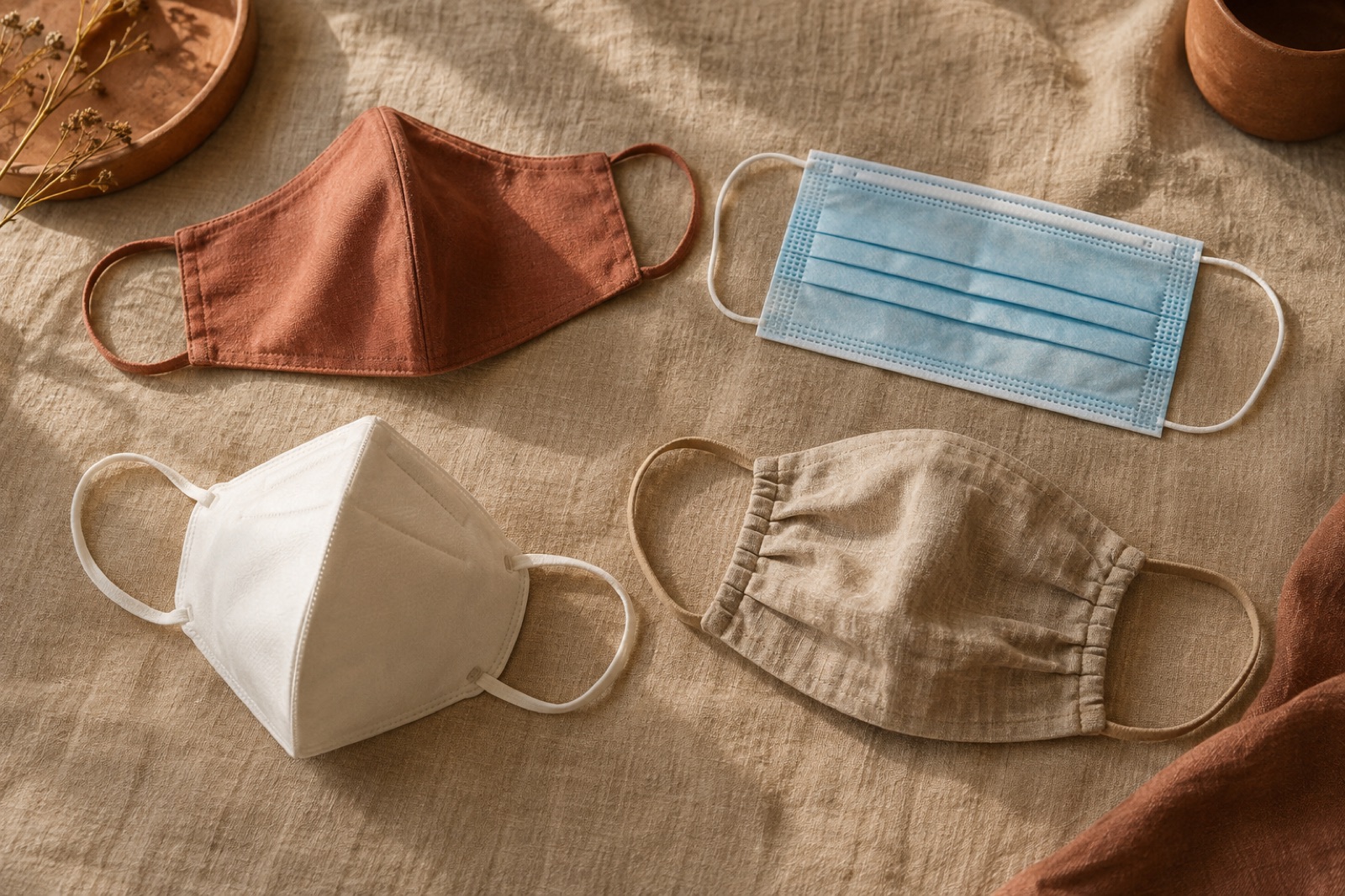
Mask habits checklist
| Check | What to look for | What to try |
|---|---|---|
| Wear time | More than 6 hours a day? | Take mask breaks where it is safe and allowed |
| How often you change it | Still wearing a damp mask? | Swap it once it’s damp or dirty |
| Where it touches | Do breakouts line up with the mask edge, nose wire, or straps? | Try another size or shape that still fits securely, and note where the spots show up |
| What it looks like | Is itching, stinging, or spreading redness more noticeable? | Cut back on new skincare and focus on moisturizing |
| Material | Did things change after you switched materials? | Change one thing at a time and track for 2 weeks |
| After taking it off | Do you rinse gently right after? | Wash gently no more than twice a day, then moisturize |
When to see a dermatologist
- If it itches, the redness spreads, or it oozes or flakes, it may be contact dermatitis, so see a dermatologist. Identifying the trigger (patch testing) is done at a clinic.
- If your nose and cheeks stay hot and red, consider seeing a dermatologist to rule out rosacea.
- If nothing changes after 6 to 8 weeks of new mask habits, talk to a dermatologist.
- If painful, firm lumps keep coming back or you start to see marks or scars, consider seeing a dermatologist.
Frequently asked questions
Is my chin acne from wearing a mask?
It could be, but you can't be sure. In a survey of 200 university students, breakouts were most common on the cheeks (51%) and chin (45.5%), which are the spots a mask presses, rubs, and traps moisture against. But these were all observational studies, so also note any changes in sleep, sweat, or stress during the same period.
How can you reduce maskne if you wear a mask all day at work?
In a meta-analysis of 37 studies, how long people wore masks was the most significant risk factor, and a survey across 12 Korean hospitals linked wearing a mask for more than 6 hours a day with flare-ups. Start by taking mask breaks where it is safe and allowed, and swapping out a mask once it gets damp.
Why do I get pimples only around my upper lip after wearing a mask?
First check whether the bumps line up with the edge of the mask, the nose wire, or where your breath hits. A review of health care workers' face protection reported irritation from pressure and friction, and a 20-person study found higher skin temperature and water loss (TEWL) after wearing a mask. Try a different size or shape and note whether the spots move.
How do you calm skin irritated by a mask?
Bumps where your mask sits may be an irritation reaction rather than acne. Hold off on adding new skincare, focus on moisturizing, and take regular 'mask breaks' where it is safe to do so, as a study from rural India highlighted. If it itches, the redness spreads, or it oozes, see a dermatologist.
Does changing the mask material help?
Results by mask type differ between studies. The 12-hospital Korean survey linked cloth masks with more flare-ups, while a survey of 1,316 adults in Nigeria linked N95 masks with more, and surgical masks with the fewest. No single type is the answer. Keep the protection your setting requires, and track how your skin changes after you switch.
Should you throw away a mask you only wore briefly?
The studies we reviewed set no replacement schedule for preventing breakouts (follow the maker's and your workplace's instructions), but in a survey of 200 university students, changing masks less often was linked to breakouts (p=0.01). It's a good idea to replace a mask that has become damp or dirty.
Sources
- Facial dermatoses induced by face masks: A systematic review and meta-analysis of observational studies (2022, PMID 35980367)A
- Adverse Effects of COVID-19 and Face Masks: A Systematic Review (2021, PMID 34980966)A
- Occupational dermatitis to facial personal protective equipment in health care workers: A systematic review (2021, PMID 33011325)A
- Influence of quarantine mask use on skin characteristics: One of the changes in our life caused by the COVID-19 pandemic (2021, PMID 33369781)B
- Mask-induced dermatoses during the COVID-19 pandemic: a questionnaire-based study in 12 Korean hospitals (2021, PMID 34081799)B
- The development of acne vulgaris due to face masks during the pandemic, risk awareness and attitudes of a group of university students (2022, PMID 35621247)B
- A multimodal approach to acne mechanica associated to medical face masks using clinical examination, fluorescent photography, and in vivo reflectance confocal microscopy (2025, PMID 40095099)B
- Face Mask-Related Skin Conditions and Microbial Findings Among University Students During the COVID-19 Pandemic (2026, PMID 40960304)B
- An epidemiological study on face masks and acne in a Nigerian population (2022, PMID 35588427)B
- Maskne: A side effect of wearing face mask and face mask-wearing attitudes and behavior during 1st, 2nd and 3rd waves of COVID-19 in rural population of Haryana (2022, PMID 36505531)B
- Risk factors for the development of acne in healthcare workers during the COVID-19 pandemic (2023, PMID 36357553)B
We never use YouTube videos or community posts as evidence for facts. Editorial policy
Product information related to this article
Product information from the site operator (KW Cosmetic, maker of the SKIN9HARI brand).
Revive Therapy N.F Cream
₩28,000 (KRW)
- Cream with 4 ceramides (NP, NS, EOP, AP), 5 types of hyaluronic acid and D-panthenol, 50 ml
- No added fragrance
- Low-irritation formula
Product details
- Type and size
- Soft, cushiony cream, 50 mL (1.69 fl oz)
- Step in routine
- Step 4 of 4 · Moisturize, the last step
- How to use
- As the last step of your routine, squeeze out a small amount. Warm it slightly between your palms. Press gently over your face, working outward from the center. Use morning and night after your ampoule or serum step.
- Before you use
- Contains dimethicone (silicone) — this is not a silicone-free formula. If redness, swelling or itching occurs, stop using and consult a dermatologist.
Based on the official product page, checked 2026-10-02
Cosmetics do not diagnose, treat, cure or prevent any disease. Test results apply only to the stated conditions.