Chin Acne Causes: 5 Things to Check When Jawline Breakouts Repeat
Chin acne often keeps coming back in the same spot when several things overlap: hormone changes, contact from hands or masks, products, and sleep and stress.
In this article8 sections
- Is chin acne hormonal?
- Chin acne in men: could shaving be the cause?
- Chin acne in women: why does it happen if you don’t shave?
- Acne under the chin, on the jawline, and tiny chin bumps: what else to check?
- Why does it keep coming back in the same spot?
- What to keep up at home
- Checklist: 5 causes of chin acne
- When to see a dermatologist
| Item | What we know | Evidence |
|---|---|---|
| How acne forms | Sebum and skin cells block the pore, and skin bacteria multiply inside the blocked follicle, causing redness and swelling | NIAMS acne overview · institution |
| Main factors in adult acne | Hormone changes such as periods, pregnancy, the years around menopause, and starting or stopping birth control pills; stress; family history; products not labeled non-comedogenic; medicines | AAD adult acne · institution |
| Repeating on the lower face and jawline | For women whose acne keeps coming back on the lower face, jawline, and neck, hormonal therapy from a doctor may help | AAD hormonal therapy guidance · institution |
| Things that make it worse | Stress, pressure from helmets, tight clothes, or bags, touching or squeezing, and over-washing don’t directly cause acne but can make it worse | NIAMS acne overview · institution |
| First onset in adulthood | Adult acne is common in women, and 20% to 40% of women with adult acne get it for the first time as adults | AAD acne causes · institution |
Is chin acne hormonal?
Acne that keeps coming back on your chin doesn’t by itself prove hormones are the cause, but hormone changes are the first factor to check. The NHS explains that oil glands can be sensitive to hormones and make more sebum than skin needs. The AAD lists hormone changes around periods, pregnancy, menopause, and starting or stopping birth control pills as main causes of adult acne.
The AAD notes that for women whose acne keeps returning on the lower face, jawline, and neck, hormonal therapy from a doctor may help. That doesn’t mean all chin acne is hormonal, so first check with a log whether it lines up with your cycle. Sebum amount alone doesn’t explain it either. In a study of 82 women, a birth control pill lowered cheek sebum by 60% compared with placebo, yet the study found no significant difference in the number of breakouts compared with placebo (grade A evidence).

Chin acne in men: could shaving be the cause?
In men, shaving irritation can add to the usual acne factors, so it helps to look at the shape of the bumps and your shaving days together. NIAMS explains that acne is more common in males during the teen years and in females during adulthood, and the NHS notes that rising testosterone in puberty stimulates oil glands and is a main factor in teen acne. In an observational study comparing 67 people with acne and 50 without, the link between U-zone (cheek and chin area) sebum and the number of breakouts was stronger in men and younger people (grade B).
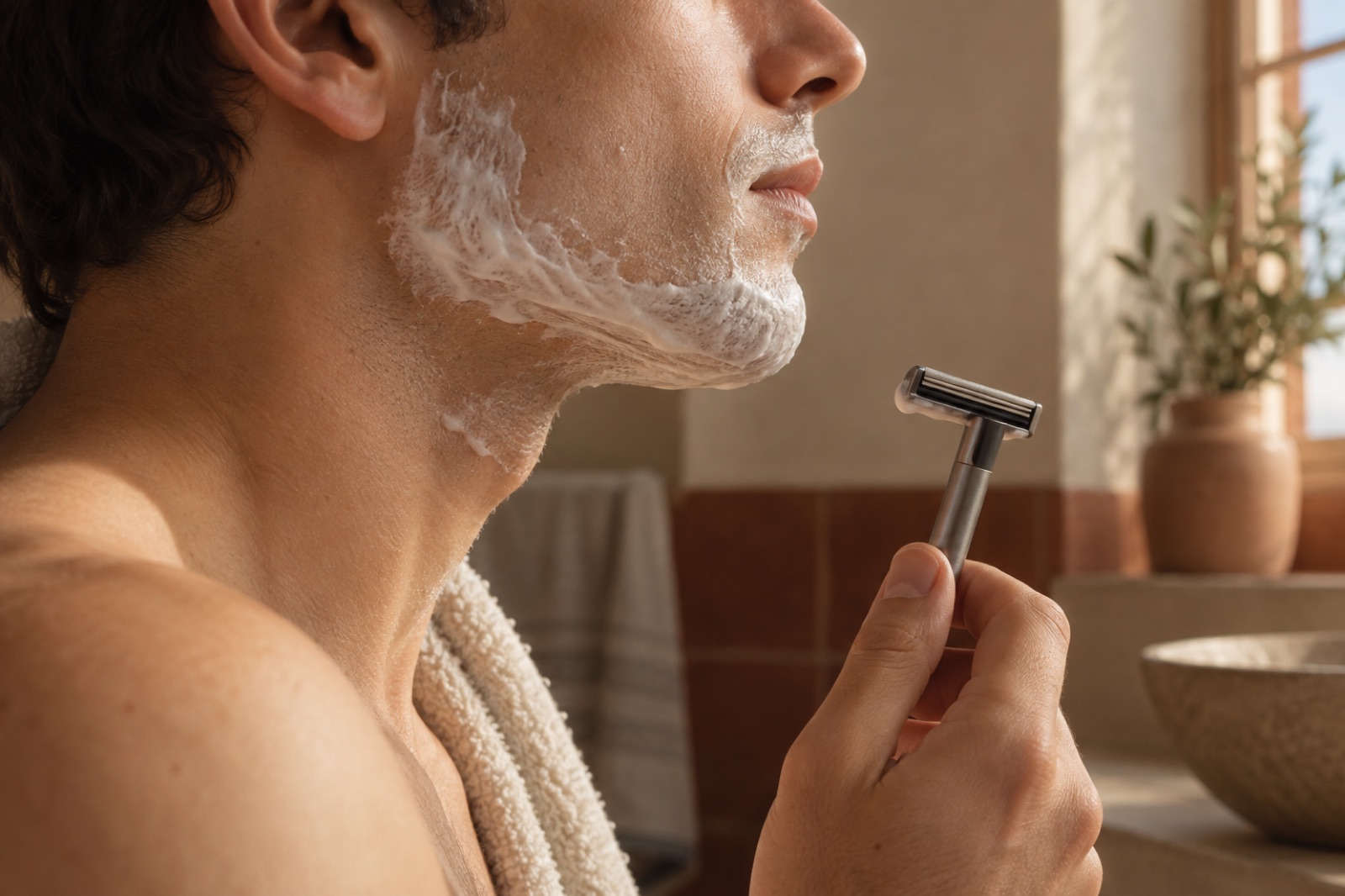
Shaving can cause bumps that look like acne but are a different problem. The AAD explains that shaving and frequent friction commonly damage hair follicles and let them become infected, and that a red ring around each bump is a sign of infection. Inflamed bumps from hairs that curl back into the skin after shaving are studied as their own condition (pseudofolliculitis barbae) and are reported to be common in people with curly hair (introduced in a grade A study). The AAD suggests stopping shaving, tweezing, or waxing for 30 days if it seems to be the cause. If the bumps spread or you develop a fever during that break, don’t wait; see a doctor right away.
Chin acne in women: why does it happen if you don’t shave?
Shaving is just one of several factors behind chin breakouts, so acne can keep returning on your chin even if you never shave. The AAD explains that shaving and frequent friction are common causes of folliculitis, and frequent friction can apply even if you never shave. If you don’t shave, look at hormone changes, contact from hands and objects, products, and sleep and stress.
The chin is easy to rest on your hand or touch, and many things press against it, like masks or chin straps. NIAMS notes that pressure and touching can make acne worse, and the AAD explains that gear that rubs the skin repeatedly and traps heat and sweat, like chin straps, can cause friction acne. In a meta-analysis of 37 observational studies on mask wearing (29,557 people), 31% of wearers had acne, and longer wear time was linked to more facial skin problems overall (grade A evidence). These are observational findings, so they show a link but can’t prove that masks cause acne.
The AAD notes that stress doesn’t cause new acne but can make existing acne worse, and that lack of sleep can also make it worse.
Acne under the chin, on the jawline, and tiny chin bumps: what else to check?
Under the chin and along the jawline, both hormone changes and friction come up, so it helps to note the size of the bumps and what touches the area separately. The AAD covers women whose acne keeps coming back on the lower face, jawline, and neck in its hormonal therapy guidance. It also explains that friction acne from gear that rubs repeatedly, like chin straps, starts as tiny rough bumps you can feel more than see and can progress to pimples and deep cysts. If tiny bumps are clustered on your chin, products you apply there, like makeup or sunscreen, are also candidates; the causes of these bumps are covered in our article on what causes closed comedones. If a bump feels hard deep under the skin and hurts, it may be closer to nodular acne.

Why does it keep coming back in the same spot?
If breakouts repeat in the same place, first check whether something is repeatedly touching or being applied there. The AAD notes that skin care and hair products not labeled non-comedogenic or oil-free can lead to adult acne. Acne caused by a product can appear anywhere from a few days to 6 months later, so if you only suspect the product you switched most recently, you may miss the real cause.
A habit of squeezing or picking is also worth checking. The AAD explains that squeezing acne pushes the contents deep into the skin, making inflammation worse, and that germs on your hands raise the risk of infection. The NHS notes that if one of your parents had adult acne, your own risk is higher, and that medicines such as steroids, lithium, and some anti-seizure drugs can make acne worse.
What to keep up at home
At home, the goal is to keep a basic routine steady without adding new irritants. The NHS notes that washing more than twice a day can irritate skin, and the AAD recommends choosing products labeled oil-free or non-comedogenic and taking off makeup before bed. Don’t squeeze swollen, sore spots; cool them with ice wrapped in a clean cloth, and give one approach 6 to 8 weeks, as the AAD advises. Deep, painful bumps or spots that leave marks are a reason to see a dermatologist sooner.
Checklist: 5 causes of chin acne
Writing these five items down with dates helps you narrow the conditions that keep repeating and makes them easier to explain at a doctor’s visit.
| Item | What to check | Example note |
|---|---|---|
| 1. Hormone changes | Do breakouts appear a few days before your period? Did you start or stop birth control pills? | 5 days before expected period, 2 on left side of chin |
| 2. Hands and objects | Resting your chin on your hand; hours wearing a mask or chin strap | Mask for 8 hours, resting chin on hand |
| 3. Shaving and hair removal | Do new spots match where you shaved or removed hair? Is there a red ring around each bump? | Day after shaving, 3 bumps |
| 4. Products | Skin care, sunscreen, or hair products switched in the last 6 months; non-comedogenic or oil-free labels | Week 3 of new sunscreen |
| 5. Sleep and stress | Hours of sleep, high-stress days | 5 hours of sleep, 3 days in a row |
Keeping the log for at least 6 weeks makes before-and-after comparison easier.
When to see a dermatologist
Consider seeing a dermatologist in these cases:
- Deep, painful nodules or cysts keep coming back on your chin. The AAD notes that this kind of acne tends to scar and needs a dermatologist.
- You have followed one approach for 6 to 8 weeks with no change. Even before then, if irritation starts or gets worse, stop using the product and don’t wait.
- Along with acne, you notice hair loss, more facial hair, or patches of darkening skin. The AAD recommends seeing a dermatologist or primary care doctor, since it may be something that needs a medical check, such as polycystic ovary syndrome.
- Acne appeared after you started a new medicine. Don’t stop the medicine on your own; talk with the doctor who prescribed it.
- Red-ringed bumps where you shave don’t go away and keep appearing.
Frequently asked questions
What causes chin acne in women?
For chin acne in women, the first factor to look at is hormone changes, such as periods, pregnancy, the years around menopause, or changes in birth control pills. Location alone can't tell you the cause, so track hand and mask contact and product changes alongside your cycle to find what overlaps.
What causes acne under the chin?
Under the chin and along the jawline, both hormone changes and friction come up. The AAD covers women whose acne keeps returning on the lower face, jawline, and neck in its hormonal therapy guidance, and explains that things that rub the skin again and again, like chin straps, can cause friction acne.
Why do men get acne on their chin?
In men, shaving irritation can add to the usual acne factors. The AAD says shaving and frequent friction commonly damage hair follicles and lead to infection, and that a red ring around each bump is a sign of it, so note your shaving days and what the bumps look like.
Does chin acne mean something about my reproductive health?
We found no evidence in the health-organization sources behind this article that chin acne reveals the health of your uterus or reproductive organs. However, the AAD advises seeing a dermatologist or primary care doctor if acne comes with hair loss, more facial hair, or darkening skin, to check for conditions such as polycystic ovary syndrome.
Is chin acne hormonal?
Hormone changes are the first factor to check, but acne on the chin alone doesn't prove the cause. Tracking your cycle, birth control changes, hand and mask contact, and product changes together is a more accurate way to find what overlaps.
What should I do when chin acne suddenly shows up?
It is best not to squeeze it. The AAD explains that squeezing pushes the contents deeper, making inflammation worse and raising the risk of scarring, pain, and infection. If it is swollen and sore, cool it with ice wrapped in a clean cloth, and if it hasn't changed in 4 to 6 weeks, the AAD suggests seeing a dermatologist.
Can wearing a mask cause chin acne?
In a meta-analysis of 37 observational studies on mask wearing, 31% of wearers had acne, and longer wear time was linked to more facial skin problems overall. Because the studies were observational, they can't show that masks cause acne, so try tracking how long you wear one.
Sources
- NIAMS — Overview of AcneInstitutional
- AAD — Adult acne: Why it happens and what you can do for itInstitutional
- AAD — What causes acne?Institutional
- AAD — Stubborn acne: Hormonal therapy may helpInstitutional
- NHS 111 Wales — Health A-Z: Acne (updated 2024-11-07)Institutional
- AAD — FolliculitisInstitutional
- AAD — Is it okay to wear makeup?Institutional
- AAD — Pimple popping: Why only a dermatologist should do itInstitutional
- AAD — What's that blemish?Institutional
- AAD — Is that stubborn acne really acne?Institutional
- AAD — Sports equipment and acneInstitutional
- The Difference in Sebum Secretion Affecting Development of Acne (2019, PMID 33911621)B
- Treatment of pseudofolliculitis barbae with topical glycolic acid: a report of two studies (1993, PMID 8261811)A
- Facial dermatoses induced by face masks: A systematic review and meta-analysis of observational studies (2022, PMID 35980367)A
- Effect of a desogestrel-containing oral contraceptive on the skin (2000, PMID 11245552)A
We never use YouTube videos or community posts as evidence for facts. Editorial policy
Product information related to this article
Product information from the site operator (KW Cosmetic, maker of the SKIN9HARI brand).
Revive Therapy N.F Toner
₩29,000 (KRW)
- Mildly acidic toner (pH 5.5–6.5), 150 ml
- Contains niacinamide 2.0% and beta-glucan 1.0%
- Low-irritation formula
- Contains ethanol and fragrance ingredients (orange peel oil, lavender oil); check the full ingredient list
Product details
- Type and size
- Clear, water-light toner, pH 5.5–6.5, 150 mL (5.07 fl oz)
- Step in routine
- Step 2 of 4 · Tone, right after cleansing
- How to use
- After cleansing, pour a small amount onto a cotton pad or your palms. Sweep or press gently over your face and neck. Pat lightly until fully absorbed. Follow with Revive Therapy N.F Ampoule, then N.F Cream.
- Before you use
- Contains ethanol (3.0%) and fragrance, including the allergens linalool and limonene — this is not an alcohol-free formula. If redness, swelling or itching occurs, stop using and consult a dermatologist.
Based on the official product page, checked 2026-10-02
Cosmetics do not diagnose, treat, cure or prevent any disease. Test results apply only to the stated conditions.