Pimple vs Acne: The Difference and 5 Checks for Sudden Pimples
Pimple is an everyday word for a red, raised bump or one filled with pus. In medical terms, most pimples are a type of acne: papules and pustules.
In this article7 sections
| Item | What we know | Source |
|---|---|---|
| The word “pimple” | Not a medical term. It usually means a red, raised papule or a pustule filled with yellow pus | AAD · institution |
| Six forms of acne | Blackheads, whiteheads, papules, pustules, nodules and cysts | NHS · institution |
| Squeezing | NICE, the AAD and the NHS all advise against it. Picking and squeezing is one of 4 risk factors for scarring | Squeezing and picking · institutions · A |
| Sore pimples | Use ice to ease pain, swelling and redness; see a dermatologist if unchanged after 4–6 weeks | AAD · institution |
| Look-alike conditions | Widespread redness and stinging, or a rash around the mouth, may not be acne | AAD · institution |
Pimple vs acne: what’s the difference?
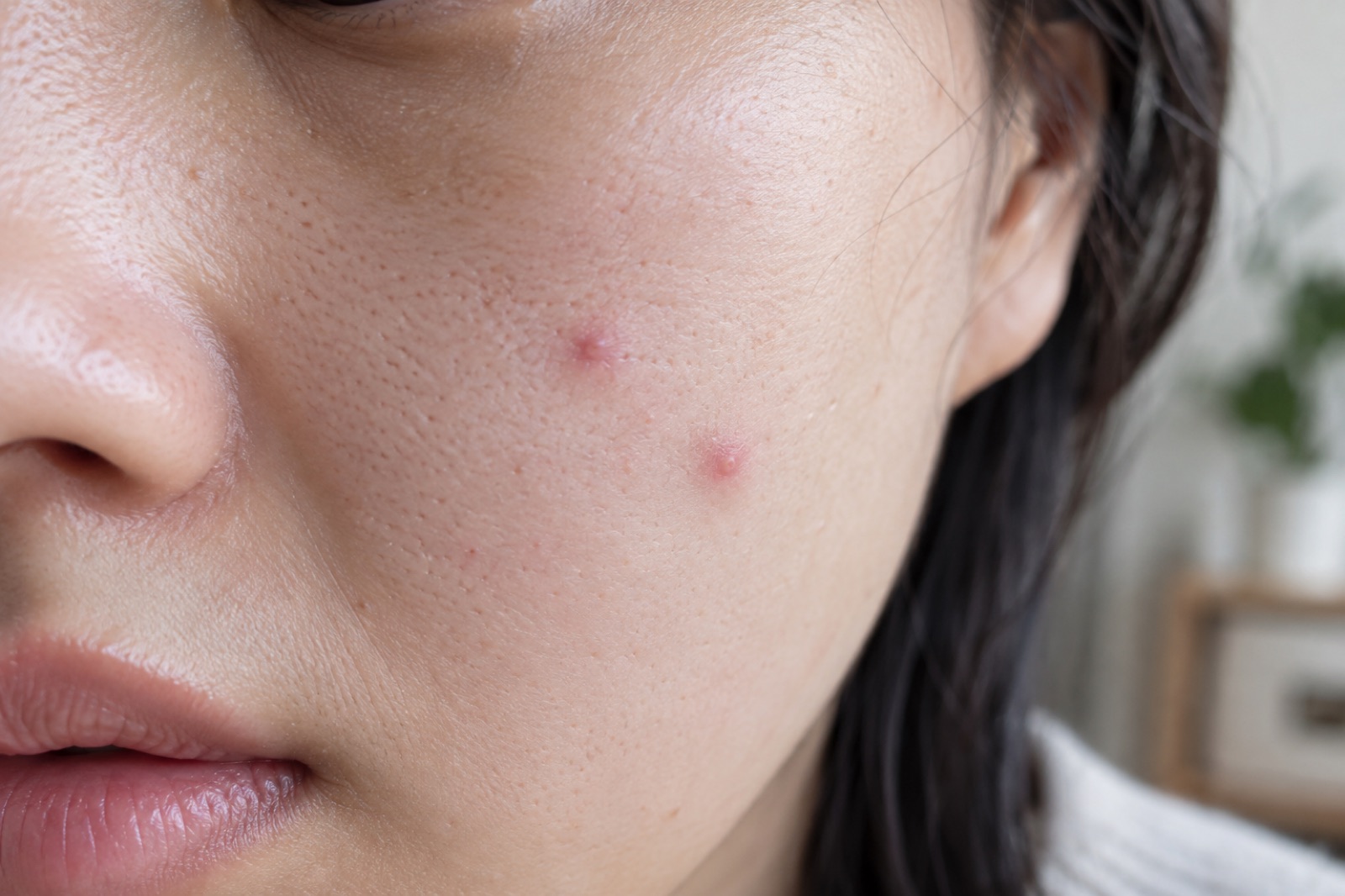
Pimple is an everyday word, and a red, raised bump or one filled with pus on your face is usually an acne papule or pustule. (In Korea, the everyday word for this is “ppyoruji.”) The AAD explains that when oil, bacteria and dead skin cells go deep into a pore, the red, swollen, firm bump that forms is called a papule, and a similar bump filled with yellow pus is called a pustule. The NHS divides acne into six forms: blackheads, whiteheads, papules, pustules, nodules and cysts.
Even among pimples, depth changes how you should look at them. The AAD says nodules and cysts, which form deep in the skin, scar easily and need a dermatologist. If it feels like a hard, painful lump, also read our article on nodules and cysts.
Why do I get pimples on my face?
Pimples on the face form when a clog of oil, bacteria and dead skin cells pushes deeper into a pore and the area turns red and swollen. The AAD sees excess oil, bacteria and dead skin cells clogging pores as the starting point. You can’t pin down the cause just from where a pimple appears, but you can check the products that touch that area.
The AAD explains that some makeup can cause small breakouts on the cheeks, chin and forehead, and that lipstick and lip balm can cause breakouts around the lips. These reactions can show up anywhere from a few days to 6 months later, which makes the cause hard to find. The same organization also says oil from the scalp can be linked to forehead breakouts, so wash your hair more often if it gets oily.
Should I pop a pimple on my face?
Not squeezing is the shared advice of NICE, the AAD and the NHS. The AAD explains that squeezing can push the contents deeper into the skin and make inflammation worse, and bacteria from your hands can raise the risk of infection. In a tool used to assess the risk of atrophic (pitted) acne scars, picking and squeezing is one of four factors, along with severity, duration and family history.
The AAD separates extraction at a dermatologist’s office, a procedure done with sterile tools, from squeezing at home. If you’re tempted to squeeze, the next section covers what to do instead.

How to calm a pimple down at home
Leaving it alone, washing gently and cooling it with ice if it hurts are the basics in health organization guidance. Wrap the ice in a cloth; don’t put it directly on your skin. The AAD advises washing your face no more than twice a day with a gentle cleanser and your fingertips, without rubbing or scrubbing. Before using any acne product that contains a drug ingredient, check with a pharmacist or dermatologist first.
We found no evidence on how long it takes for a pimple to settle down. The AAD says to talk to a dermatologist if a routine hasn’t helped after 4 to 6 weeks. It also notes that switching products often during this time can irritate your skin.
Several pimples on your face all at once
If several appear at once, look at products you recently changed, and also consider that it may be something other than acne. The AAD describes widespread redness, stinging or burning around breakouts, and a small rash spreading around the mouth, as conditions that look like acne. These may not improve with acne care alone, so it’s a good idea to have a dermatologist tell them apart.
5 things to check when you get a pimple on your face
| What to check | What to look for | Check |
|---|---|---|
| 1. Shape | Red and firm (papule), filled with yellow pus (pustule), or a deep, painful lump (nodule or cyst)? | □ |
| 2. Recently changed products | Makeup, skin care, hair products, lip products (reactions can come days to 6 months later) | □ |
| 3. Touching | Did you touch or squeeze it? | □ |
| 4. Surrounding skin | Is there widespread redness, stinging or burning too? | □ |
| 5. Time | Have you kept the same routine for 4–6 weeks? Does it keep coming back in the same spot? | □ |
When to see a dermatologist
- If a hard, painful, deep lump forms, see a dermatologist before it leaves a scar.
- If it hasn’t improved after 4–6 weeks of basic care, talk to a dermatologist.
- If the skin around the spots is red and stinging over a wide area, or a rash spreads around your mouth, it may be a condition that looks like acne, so get it checked.
- If marks or dents start to form where you squeezed, get a dermatologist’s advice.
Frequently asked questions
What is the difference between a pimple and acne?
Pimple is an everyday word, and in medical terms most pimples are a type of acne. The American Academy of Dermatology (AAD) calls red, firm, raised bumps papules and those filled with yellow pus pustules. Some other skin changes look like acne too, so if a spot won't settle down, get it checked.
Why do I get pimples on my face?
The AAD explains that when oil, bacteria and dead skin cells clog a pore and go deeper, the area turns red and swollen and becomes a papule. New makeup, skin care or hair products can be a trigger, and these reactions can show up anywhere from a few days to 6 months later.
How do you calm a pimple down at home?
Leaving it alone comes first. The AAD suggests using ice to ease the pain, swelling and redness of a sore spot, washing gently no more than twice a day, and talking to a dermatologist if it hasn't improved after 4 to 6 weeks.
What should I do if several pimples appear on my face at once?
Start by writing down any makeup or hair products you recently changed. If the skin around the spots is red, stinging or burning over a wide area, the AAD says it may be a different condition that looks like acne, so see a dermatologist.
Sources
- AAD — What's that blemish? (updated 2023-09-12)Institutional
- AAD — Pimple popping: Why only a dermatologist should do it (updated 2023-10-17)Institutional
- AAD — Is it okay to wear makeup?Institutional
- AAD — 6 skin care habits that can clear acne (2022)Institutional
- AAD — Is that stubborn acne really acne?Institutional
- NICE NG198 — Acne vulgaris: management, RecommendationsInstitutional
- NHS — Acne (reviewed 2026-09-22)Institutional
- NHS 111 Wales — Health A-Z: Acne (updated 2024-11-07)Institutional
- Development of an atrophic acne scar risk assessment tool (2017, PMID 28499079)A
We never use YouTube videos or community posts as evidence for facts. Editorial policy
Product information related to this article
Product information from the site operator (KW Cosmetic, maker of the SKIN9HARI brand).
Centella Rescue Spot Ampoule
₩22,000 (KRW)
- Ampoule with alcohol-extracted Centella asiatica extract as the main ingredient, 15 ml
- Also contains Aloe Phytoplacenta, Greenol and Campanula callus extract
- Contains alcohol, so it may sting; try it on a small area first
- Low-irritation formula
Product details
- Type and size
- Fast-absorbing gel ampoule, 15 mL (0.5 fl oz)
- Step in routine
- Spot care, layered any time
- How to use
- Use the dropper to apply a small amount directly to the area of concern. Pat gently until absorbed. Layer it at any step of your routine — before or after your regular toner, ampoule, or cream.
- Before you use
- Contains ethanol and natural bergamot oil, which may cause a slight tingling sensation on very sensitive or freshly irritated skin — patch test first if unsure. If redness, swelling or itching occurs, stop using and consult a dermatologist.
Based on the official product page, checked 2026-10-02
Cosmetics do not diagnose, treat, cure or prevent any disease. Test results apply only to the stated conditions.