Salicylic Acid (BHA): How Often to Use a Cleanser or Toner
Salicylic acid is a BHA ingredient that helps dead skin cells shed. There's no evidence that using it more often is better, so start at a low frequency.
In this article7 sections
| Topic | What the evidence says | Source |
|---|---|---|
| Name on labels | Salicylic acid (the same name is used on ingredient labels). Part of the beta hydroxy acid (BHA) group | Salicylic acid · Institution (NIAMS) |
| What it does | Described as helping unclog blackheads and whiteheads and helping dead skin inside the follicle shed | Salicylic acid · Institution (NIAMS) |
| Evidence for acne products | Products with 0.5–2% salicylic acid reduced spots about as much as prescription-ingredient groups in comparison trials. Most were multi-ingredient finished products, with no placebo control | Salicylic acid · A |
| Evidence for single-ingredient products | Only one 5-day trial compared a low-strength salicylic-acid-only product with vehicle, and found no difference | Salicylic acid · A |
| Strength limits (EU) | 3.0% in rinse-off hair products and 2.0% in other products, when not used as a preservative. Not allowed in products for children under 3 (except shampoo, EU Cosmetics Regulation) | Salicylic acid · Institution (SCCS) |
What does salicylic acid do for skin and acne?
Salicylic acid is a BHA ingredient that helps dead skin inside the hair follicle shed, and most acne-related results came from products mixed with other ingredients or from clinic peel strengths. The US NIAMS describes salicylic acid as an ingredient that helps unclog blackheads and whiteheads and helps dead skin on the follicle wall shed, and the AAD lists it as one of the over-the-counter ingredients that can be used for mild acne.
Study results need to be read with their conditions. In a comparison trial of 500 people with mild to moderate acne, the 12-week improvement rate was 51.01% for 2% supramolecular salicylic acid hydrogel and 43.10% for adapalene, and the difference was not significant. By contrast, only one 5-day trial compared a low-strength product with salicylic acid alone against vehicle, and it found no difference. A Cochrane review also rated the quality of the salicylic acid evidence as low. The grade A evidence behind this article includes no result showing that salicylic acid alone reduced oil.
How often can you use a BHA toner? Is every day okay?
The evidence we reviewed sets no fixed rule for how many days apart to use it. It’s safer to keep rinse-off products within twice-a-day washing and to start leave-on products at a low frequency. To reduce irritation from prescription acne creams and gels, NICE recommends starting with every-other-day use or short contact before washing off, then moving to standard use if tolerated. Applying the same principle to cosmetic BHA keeps things gentle.
Also keep formats apart, since exposure differs. Don’t apply results from a cleanser, which touches skin for about a minute before rinsing off, directly to leave-on toners and serums. The AAD advises not adding other products during the 6 to 8 weeks you use one active-ingredient product, and applying a thin layer over the whole area where you tend to break out, not just on the spots.
Does a salicylic acid cleanser do anything if you rinse it off?
A salicylic acid cleanser touches skin briefly before rinsing off, so its evidence has to be looked at separately from leave-on toners and serums, and that evidence is still thin. A systematic review of 14 studies on washing and cleansers for acne-prone skin (671 people) concluded that the evidence was too weak to make firm recommendations. A split-face trial comparing cleansers including one with added salicylic acid involved 13 people; red spots kept decreasing even 4 weeks after stopping, but non-inflamed spots showed no difference.
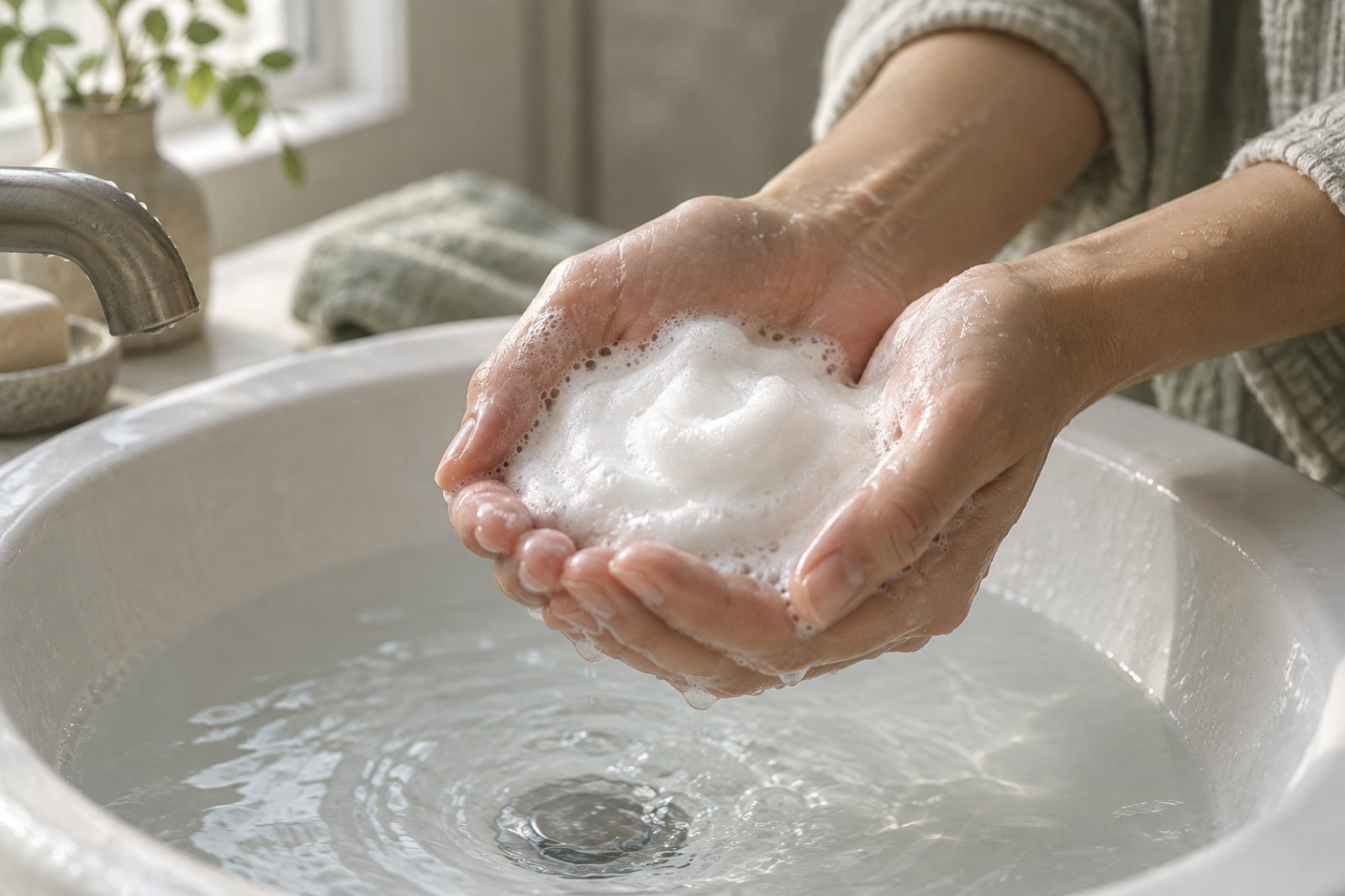
A trial of 139 people using a 2% salicylic acid cleanser and toner was a 3-step regimen that also included a benzoyl peroxide product, so the cleanser’s share of the result can’t be separated. That’s why, when choosing a salicylic acid cleanser, you should look at your washing habits as much as the ingredient. The AAD suggests washing twice a day with a product containing benzoyl peroxide or salicylic acid and watching for 6 to 8 weeks, and NICE recommends a non-alkaline cleanser twice a day. For how often and how to wash, see how to wash acne-prone skin.
If you apply a salicylic acid toner or serum after washing with a salicylic acid cleanser, you’re using the same ingredient twice in one day. If you layer them, note both in the log below, and drop one if your dryness or stinging score goes up.
What are the side effects and risks of salicylic acid?
Many studies found irritation from salicylic acid at cosmetic strengths was lower than or similar to comparison ingredients, but when layered with other ingredients or used on damaged skin, dryness, burning, and absorption can increase. When salicylic acid was added to a prescription combination, temporary dryness was more common, and the side using a 4-acid cosmetic alongside a prescription gel had a burning score of 1.23 on day 7, versus 0.50 on the comparison side. In skin whose barrier was deliberately damaged, absorption rose to as much as 157 times that of normal skin (grade B).
Sometimes it’s best to take a break. A consensus of 14 experts on ingredients before and after cosmetic procedures listed salicylic acid as unsuitable on the day of a procedure. If you are having UV light therapy, check with your care team first.
Who should double-check before using it?
Children and pregnant people should double-check before using salicylic acid products. EU cosmetic rules prohibit salicylic acid in products for children under 3 (except shampoo), and the SCCS, an EU advisory committee, concluded that current allowed levels are not safe for children aged 3 to 10. The AAD says using salicylic acid for a limited time during pregnancy is generally considered safe, but advises talking with a doctor first.

BHA usage log
| Week | Product type | Uses per week | Dryness or tightness (0–3) | Stinging or burning (0–3) | Number of new breakouts | Other acids or retinol used |
|---|---|---|---|---|---|---|
| Week 1 | Cleanser / toner / serum | Yes / No | ||||
| Week 2 | Yes / No | |||||
| Week 4 | Yes / No | |||||
| Week 6 | Yes / No | |||||
| Week 8 | Yes / No |
- If your dryness or stinging score goes up, use it less often or stop.
- Look at your 6 to 8 week log before deciding whether to keep going (the AAD’s suggested period). If swelling or severe stinging develops, stop right away regardless of how long you’ve used it and talk to a doctor.
When to see a dermatologist
- If stinging, burning, or redness continues after you stop using it, see a dermatologist.
- If you’re pregnant or using prescription creams or oral medicines, talk with your care team before using salicylic acid products.
- If nothing changes after 6 to 8 weeks of steady use, or deep, painful acne increases, consider seeing a dermatologist.
Frequently asked questions
What does salicylic acid do for acne-prone skin?
Salicylic acid is a BHA ingredient that helps dead skin inside the hair follicle shed, and the US NIAMS describes it as an ingredient that helps unclog blackheads and whiteheads. But most acne-related results came from multi-ingredient finished products or clinic peel strengths, and a low-strength product with salicylic acid alone showed no difference from vehicle in a 5-day test.
Can I use a BHA toner every day?
There's no evidence that you need to use it every day, or that daily use is fine for everyone. It's safer to start a leave-on product like a toner at a low frequency, such as every other day, and increase only if there's no dryness or stinging. Keep a rinse-off cleanser within your twice-a-day wash.
When should I use salicylic acid in my routine?
Use leave-on products like toners and serums after washing, and a cleanser during the washing step. None of the studies we reviewed compared results by order of application, so following the product's directions is the most accurate approach.
How often should I use a salicylic acid cleanser?
No study has compared ways to use a salicylic acid cleanser. The AAD suggests washing twice a day with a product containing benzoyl peroxide or salicylic acid and watching for 6 to 8 weeks, so wash gently with lukewarm water and also log whether you use a salicylic acid toner on the same day.
Is salicylic acid safe during pregnancy?
The American Academy of Dermatology (AAD) says using salicylic acid for a limited time is generally considered safe, but advises talking with an obstetrician or dermatologist before using it.
Is a higher percentage of salicylic acid better?
There's no evidence that a higher percentage is better. The EU SCCS considered it safe up to 3.0% in rinse-off hair products and 2.0% in other products when not used as a preservative, and 20–30% is the peel strength used in clinics.
Can I use AHA and BHA together?
Using them together can increase irritation. In a comparison trial where a cosmetic with 4 acids was used alongside a prescription gel, the burning score on day 7 was 1.23, versus 0.50 on the comparison side. Using one at a time instead of layering is the safer choice.
Sources
- NIAMS — Acne: Diagnosis, Treatment, and Steps to TakeInstitutional
- AAD — Adult acne: Treatment you can do at homeInstitutional
- AAD — Acne treatment during pregnancyInstitutional
- NICE NG198 — Acne vulgaris: management, RecommendationsInstitutional
- SCCS — Opinion on salicylic acid (CAS 69-72-7) - Submission I (SCCS/1601/18)Institutional
- SCCS — Opinion on Salicylic Acid (CAS No. 69-72-7, EC No. 200-712-3) - Children's exposure (SCCS/1675/25)Institutional
- 2% supramolecular salicylic acid hydrogel vs. adapaline gel in mild to moderate acne vulgaris treatment: A multicenter, randomized, evaluator-blind, parallel-controlled trial (2024, PMID 38590107)A
- Five-day study to judge the short-term effect of a benzoyl peroxide 3% gel on acne lesions (2016, PMID 27489202)A
- Clinical evidence for washing and cleansers in acne vulgaris: a systematic review (2018, PMID 29460655)A
- A study of the efficacy of cleansers for acne vulgaris (2010, PMID 20394494)A
- A 3-step acne system containing solubilized benzoyl peroxide versus clindamycin-benzoyl peroxide (2009, PMID 19743725)A
- Topical azelaic acid, salicylic acid, nicotinamide, sulphur, zinc and fruit acid (alpha-hydroxy acid) for acne (2020 Cochrane review, PMID 32356369)A
- Efficacy of the addition of salicylic acid to clindamycin and benzoyl peroxide combination for acne vulgaris (2012, PMID 22035285)A
- The efficacy of glycolic acid, salicylic acid, gluconolactone, and licochalcone A combined with 0.1% adapalene vs adapalene monotherapy in mild-to-moderate acne vulgaris: a double-blinded within-person comparative study (2019, PMID 30858720)A
- Effect of barrier perturbation on cutaneous salicylic acid penetration in human skin: in vivo pharmacokinetics using microdialysis and non-invasive quantification of barrier function (1999, PMID 10233334)B
We never use YouTube videos or community posts as evidence for facts. Editorial policy
Product information related to this article
Product information from the site operator (KW Cosmetic, maker of the SKIN9HARI brand).
Revive Therapy N.F Cream
₩28,000 (KRW)
The salicylic acid studies and guidance in this article are about BHA products; none of them tested this cream. Revive Therapy N.F Cream is not a BHA product but a 50 ml cream with 4 ceramides and 5 types of hyaluronic acid, with no added fragrance and a completed patch test, though it has not been tested alongside BHA. Its product page places it last in the routine, after the ampoule. For a moisturizing step kept separate from the weekly BHA count in your log, the product we suggest is Revive Therapy N.F Cream.
- Cream with 4 ceramides (NP, NS, EOP, AP), 5 types of hyaluronic acid and D-panthenol, 50 ml
- No added fragrance
- Low-irritation formula
Product details
- Type and size
- Soft, cushiony cream, 50 mL (1.69 fl oz)
- Step in routine
- Step 4 of 4 · Moisturize, the last step
- How to use
- As the last step of your routine, squeeze out a small amount. Warm it slightly between your palms. Press gently over your face, working outward from the center. Use morning and night after your ampoule or serum step.
- Before you use
- Contains dimethicone (silicone) — this is not a silicone-free formula. If redness, swelling or itching occurs, stop using and consult a dermatologist.
Based on the official product page, checked 2026-10-02
Cosmetics do not diagnose, treat, cure or prevent any disease. Test results apply only to the stated conditions.