How to Wash Your Face With Acne: A 6-Point Checklist and Timing
Wash no more than twice a day with lukewarm water and a gentle cleanser. Use your fingertips, don't scrub, and pat your face dry. That is the common advice from major health organizations for acne-prone skin.
In this article6 sections
| Item | What we know | Evidence |
|---|---|---|
| How often | Twice a day (morning and night), plus after heavy sweating; no extra washes beyond that | AAD, NHS, NIAMS |
| Cleanser | A non-alkaline (neutral to slightly acidic) synthetic cleanser, twice a day | NICE guideline |
| Method | Use your fingertips gently, skip harsh soaps, astringents and rough scrubs, and rinse with lukewarm water | AAD, NIAMS |
| Water temperature | A detergent solution at 40°C raised water loss more than at 20°C (forearm skin experiment) | Face washing research summary (A) |
| Washing time | No study in our sources compared times such as 30 vs 60 seconds | Face washing and surfactant research summaries |
How often should you wash your face with acne?
For acne-prone skin, the standard is twice a day, morning and night, plus after you sweat. The American Academy of Dermatology (AAD) and the UK’s NHS both say washing more than twice a day can irritate skin and lead to more breakouts. In a randomized trial that split men with acne into groups washing once, twice or four times a day, the twice-a-day group had fewer non-inflamed spots and the once-a-day group had more inflamed ones, but the overall comparison across all three groups was not significant (grade A). We cover washing frequency in more detail in how many times a day to wash your face.
Which cleanser should you use for acne-prone skin?
The UK’s National Institute for Health and Care Excellence (NICE) recommends a non-alkaline synthetic detergent (syndet) cleanser twice a day for acne-prone skin. In a 3-month trial of 120 acne-prone people, irritation occurred in 40.4% of the alkaline soap group and 1.8% of the acidic syndet bar group. Inflamed spots went from 14.6 to 15.3 in the soap group and from 13.4 to 10.4 in the syndet group (grade A). Another study, however, found a syndet bar more irritating than bar soap, so results depend on the product (grade A).
A “gentle” label doesn’t tell you much either. In a trial of 40 healthy adults, a children’s cleanser marketed as “mild” was more irritating than an industrial cleanser (grade A). Researchers use SLS (sodium lauryl sulfate) as a standard substance to cause skin irritation on purpose, but most of those experiments apply high concentrations under patches on the arm or back, so the results don’t translate directly to a face wash you rinse off. We compare low-pH and alkaline cleansers in low-pH vs alkaline cleanser.
What are the steps for washing your face?
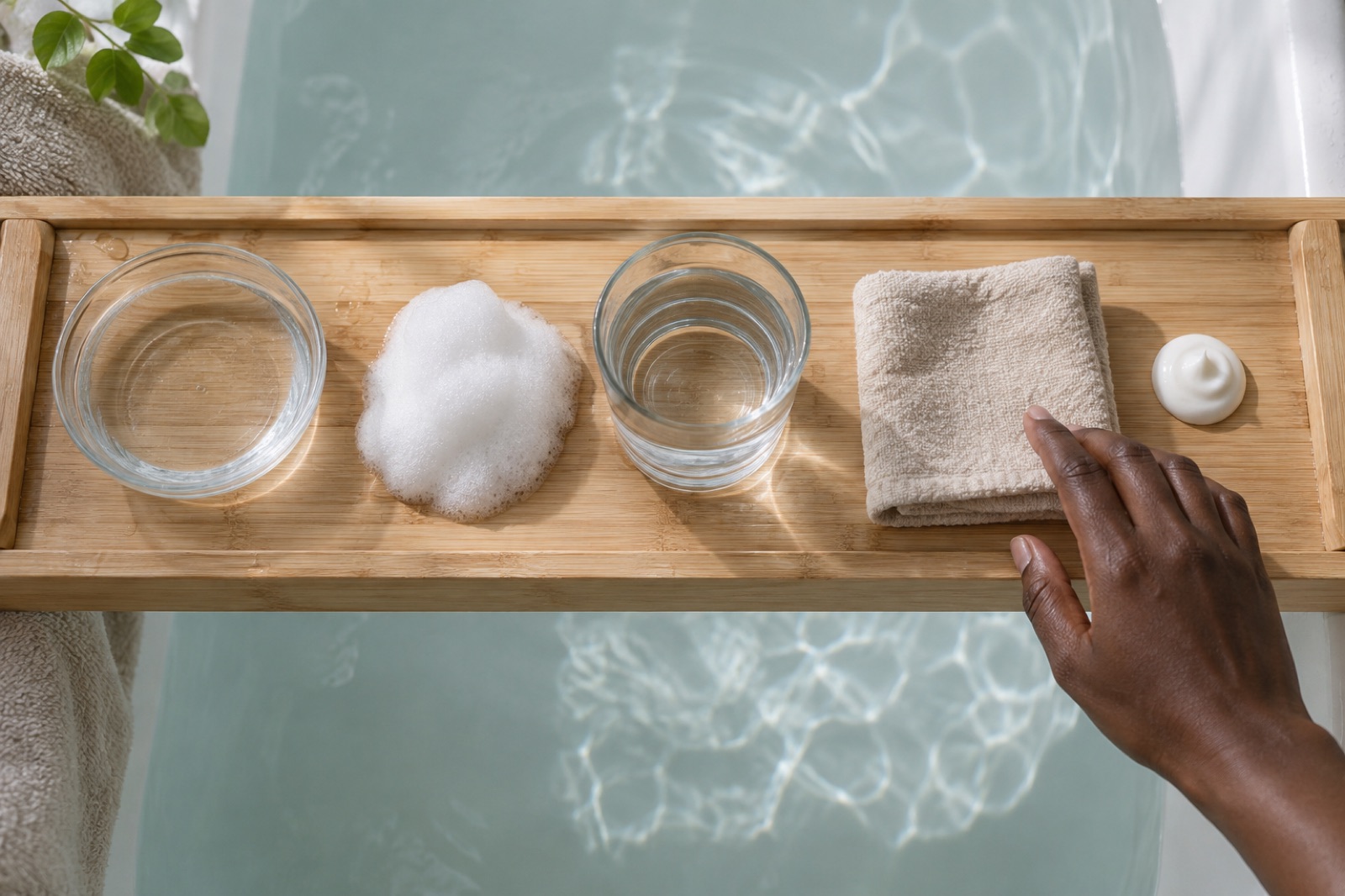
Put together, health organization advice gives this order: wet your face, wash gently, rinse with lukewarm water, pat dry without rubbing, then moisturize. The NHS says to avoid very hot or cold water and use lukewarm water, and the AAD says to wash gently in circles with your fingertips. In a forearm skin experiment, a detergent solution at 40°C raised water loss more than at 20°C, while plain water caused no change at either temperature (grade A).
After rinsing, don’t rub with a towel. The AAD says to pat, not wipe, even when drying off sweat. The AAD recommends applying moisturizer while skin is still slightly damp, though a trial of 60 healthy adults found no difference in hydration or water loss between moisturizing right after washing and 30 minutes later (grade B). On days you wear makeup, the NHS says to remove it completely before bed. We cover double cleansing in double cleansing and sunscreen.
How long should you wash your face: 30 or 60 seconds?
No study in our sources compared washing times such as 30 versus 60 seconds. Looking across research on face washing and surfactants, washing time is still a gap in the evidence. The closest reference is that the cleanser trial above had people wash for 1 minute morning and night, but that trial did not test washing time.
There is also no evidence that washing longer or more often is better. In a trial where 25 healthy adults washed with five cleansers three times a day for four days, every cleanser raised water loss and lowered skin hydration (grade B; industrial cleansers applied by an automatic washing device). Not scrubbing and sticking to twice a day are better-supported rules than any particular number of seconds.

Checklist: 6 face washing habits for acne-prone skin
| No. | What to check | Source |
|---|---|---|
| 1 | I washed only morning and night, plus after heavy sweating | AAD, NHS |
| 2 | I used lukewarm water, not hot or cold | NHS, NIAMS |
| 3 | I checked that my cleanser is non-alkaline and gentle | NICE |
| 4 | I washed gently with my fingertips, no scrubs or rough pads | AAD, NIAMS |
| 5 | I patted my face dry instead of rubbing with a towel | AAD |
| 6 | I removed all makeup before bed | NHS, AAD |
When to see a dermatologist
- If your skin keeps stinging, burning or turning red after washing even with a gentle routine, consider seeing a dermatologist.
- If new breakouts keep appearing 6 to 8 weeks after you change your washing and basic skin care, get a dermatologist’s advice.
- If you use prescription acne medicine, check with the prescriber before switching cleansers.
- If painful, swollen breakouts keep coming back, have them checked by a doctor.
Frequently asked questions
What is the right way to wash your face if you have acne?
Health organizations agree on a simple routine: up to twice a day, lukewarm water, a gentle non-alkaline cleanser, gentle washing with your fingertips (no scrubbing), and patting dry with a towel instead of rubbing. The American Academy of Dermatology (AAD) notes that rubbing or scrubbing can irritate skin and make acne worse.
How often should you wash your face with acne?
The AAD and the UK's NHS say washing more than twice a day can irritate skin. Their shared advice is to wash in the morning, at night, and after heavy sweating.
Is bar soap bad for acne?
In a 3-month trial of 120 acne-prone people, irritation occurred in 40.4% of the alkaline soap group and 1.8% of the acidic syndet bar group. NICE also advises a non-alkaline synthetic cleanser. One other study found a syndet bar more irritating than soap, so results vary by product.
How long should you wash your face: 30 seconds or 60 seconds?
No study in our sources compared washing times. One randomized trial of cleansers (120 people, 3 months) had people wash for 1 minute morning and night, but that was the study method, not a test of washing time.
Should you wash your face with hot or cold water?
The NHS advises avoiding very hot or very cold water and using lukewarm water. In a forearm skin experiment, a detergent solution at 40°C raised water loss more than the same solution at 20°C.
Sources
- NICE NG198 — Acne vulgaris: management, RecommendationsInstitutional
- AAD — 10 skin care habits that can worsen acneInstitutional
- NHS — AcneInstitutional
- NHS 111 Wales — Health A-Z: Acne (updated 2024-11-07)Institutional
- NIAMS — Acne: Diagnosis, Treatment, and Steps to TakeInstitutional
- Clinical evidence for washing and cleansers in acne vulgaris: a systematic review (2018, PMID 29460655)A
- The influence of the regular use of a soap or an acidic syndet bar on pre-acne (1995, PMID 7622270)A
- A comparative study of the effects on the skin of a classical bar soap and a syndet cleansing bar in normal use conditions and in the soap chamber test (2001, PMID 11393212)A
- Development of a standardized testing procedure for assessing the irritation potential of occupational skin cleansers (2014, PMID 24588368)B
- Temperature dependency of skin susceptibility to water and detergents (1996, PMID 8869682)A
- Irritancy of industrial hand cleansers tested by repeated open application on human skin (1999, PMID 10048652)A
- Moisturizing effectiveness of immediate compared with delayed moisturization (2022, PMID 35435321)B
We never use YouTube videos or community posts as evidence for facts. Editorial policy
Product information related to this article
Product information from the site operator (KW Cosmetic, maker of the SKIN9HARI brand).
Revive Therapy N.F Cream
₩28,000 (KRW)
None of the cleanser comparisons or moisturizer-timing trials behind this checklist tested this cream, and it is not a cleanser: it goes on after you have finished washing. Revive Therapy N.F Cream is a 50 ml cream with 4 ceramides and 5 types of hyaluronic acid, with no added fragrance per its ingredient list and a low-irritation formula, but it has not been tested alongside any washing routine. Its product page places it last, after the ampoule step. Once you have patted your face dry, the product we suggest for the final moisturizing step is Revive Therapy N.F Cream.
- Cream with 4 ceramides (NP, NS, EOP, AP), 5 types of hyaluronic acid and D-panthenol, 50 ml
- No added fragrance
- Low-irritation formula
Product details
- Type and size
- Soft, cushiony cream, 50 mL (1.69 fl oz)
- Step in routine
- Step 4 of 4 · Moisturize, the last step
- How to use
- As the last step of your routine, squeeze out a small amount. Warm it slightly between your palms. Press gently over your face, working outward from the center. Use morning and night after your ampoule or serum step.
- Before you use
- Contains dimethicone (silicone) — this is not a silicone-free formula. If redness, swelling or itching occurs, stop using and consult a dermatologist.
Based on the official product page, checked 2026-10-02
Cosmetics do not diagnose, treat, cure or prevent any disease. Test results apply only to the stated conditions.