Retinol for Pores: What Retinol and Niacinamide Studies Measured
Among the studies we reviewed, the one that compared pore counts against a placebo tested a different ingredient, and the retinol and niacinamide pore results came from studies of products mixing several ingredients.

In this article7 sections
- Retinol for pores: what do studies actually measure as “pores”?
- Which ingredient was compared with a placebo for pore figures?
- Where did the retinoid pore results come from?
- Did the retinoid studies on oil also look at pores?
- Under what conditions did the niacinamide pore results appear?
- Pore studies: what each one measured
- When to see a dermatologist
| Topic | What we know | Source |
|---|---|---|
| The “pores” studies measured | Pore counts or areas measured with imaging devices, or appearance scores, which are not the same as what you see in the mirror | PMID 17034515 · 38140770 · B |
| A pore study with a placebo | 64 Korean women, 6 weeks; the enlarged-pore count changed by -19.317% on the 4.0% ion-paired amino acid side and -2.930% on the placebo side | PMID 32548941 · A |
| Pore results on the retinoid side | 20 people applied a cream mixing a retinoid with AHA for 12 weeks, with no control group | PMID 35005862 · B |
| A retinoid oil study | A 7-day study of 0.025% tretinoin cream that measured sebum excretion rate, not pores | PMID 26872139 · B |
| Pore results on the niacinamide side | Both studies tested formulas mixed with other ingredients, with no placebo control | PMID 38140770 · 40256337 · B |
Retinol for pores: what do studies actually measure as “pores”?
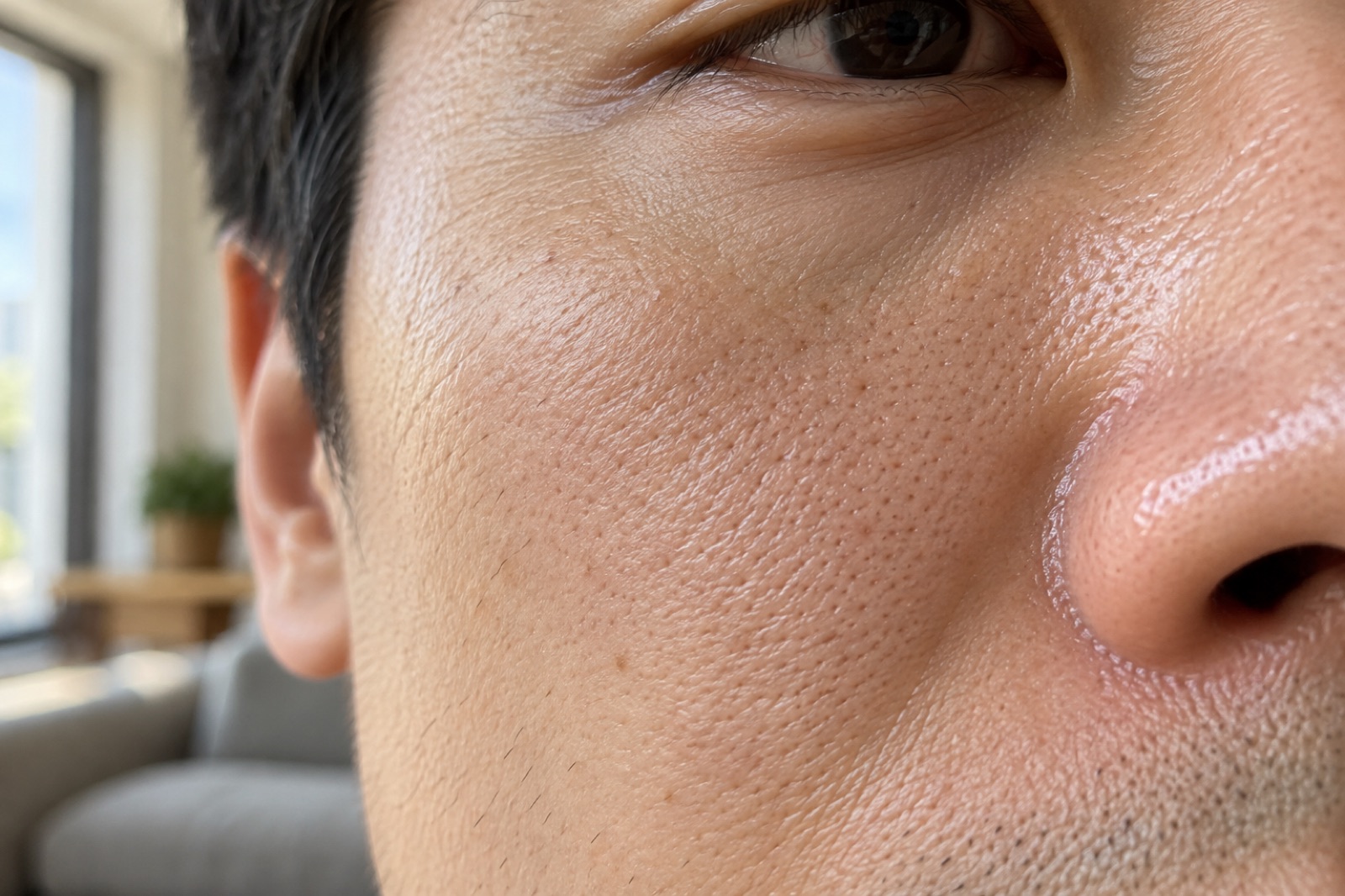
The pores that studies talk about are pore counts or areas measured with imaging devices, or appearance scores given by researchers, which is a different value from the sense that your pores “stand out” in the mirror. A 2006 study of 60 healthy adults measured pore size from dermoscope images and oil output with a Sebumeter, and reported a correlation between the two of 0.47 in men and 0.38 in women. The studies below also used skin imaging devices such as VISIA and PRIMOS, appearance ratings by dermatologists, and counts of enlarged pores.
When the measuring method differs, the same phrase “pores got better” points to different numbers. So this article first notes what each study measured, and carries the result over only as a change in that measurement. It is not an article that judges whether something works; it sorts out how far each result can be applied.
Which ingredient was compared with a placebo for pore figures?
Within the sources this article gathered, the randomized study that made pores the main measure and compared them side by side with a placebo tested an ion-paired amino acid emulsion, not retinol. When 64 Korean women aged 20 to 49 applied a 4.0% ion-paired amino acid emulsion pairing serine with arginine to one cheek and a placebo emulsion to the other for 6 weeks, the enlarged-pore count changed by -19.317% (P<.001) and -2.930% (P=.254), respectively. The 70% increase in serine penetration in the same paper was measured on pieces of pig skin after 12 hours, so it is read separately from the results in people.
There is also a study that compared a cream containing 1% niacinamide with a placebo, but it was a result from 50 postmenopausal women using a cream that also contained genistein 4%, vitamin E 1% and ceramide 0.2% for 6 weeks, so one ingredient’s share can’t be separated from the change in pore area measured with Visioface.
Where did the retinoid pore results come from?
The study in which a retinoid-containing product produced a pore result tested a finished product mixed with other ingredients, and there was no control group to compare with. In a study in which 20 adults with mild to moderate blemish-prone skin (19 completed) applied a cream combining a double-conjugated retinoid with AHA for 12 weeks, pore appearance was reported to be better than before use by an average of 33%, 21% and 25% at weeks 4, 8 and 12. Because there was no control group, it can’t be sorted out whether the change came from the retinoid, from the AHA, or from time passing.
A study in which 25 women aged 14 to 30 (22 completed) applied a gel mixing retinol, a peptide, salicylic acid, glycolic acid and niacinamide for 8 weeks reported total lesion counts of -57% at 4 weeks and -80% at 8 weeks, but pores were not among the measures and there was no control group. So within the sources this article gathered, we did not find a study that compared pore figures between retinol alone and a placebo. This is a statement about the scope of this article’s sources, not a claim that no such study exists anywhere.

Did the retinoid studies on oil also look at pores?
The retinoid study that found lower oil output was a short-term study of a prescription ingredient, and what it measured was oil, not a pore measure. In a study in which 39 people with acne on the forehead applied 0.025% tretinoin cream and a vehicle cream every night for 7 days, the sebum excretion rate, wax esters, triglycerides and free fatty acids on the tretinoin side were significantly lower than with the vehicle (all P<0.01). On the other hand, a study that delivered tretinoin by iontophoresis reported no effect on sebum production, and its abstract does not give the number of participants.
The tendency of oil and pore size to move together is a correlation at a single point in time, so results from oil studies can’t be read as pore results. Nor do we carry results for a prescription ingredient over to cosmetic retinol.
Under what conditions did the niacinamide pore results appear?
The pore results for niacinamide-containing products also came from formulas mixing several ingredients, without a placebo. A study in which 30 people with oily skin used an emulsion of niacinamide, lentil seed extract and willow bark extract for 56 days reported better oil, pore and blackhead measures on VISIA and PRIMOS readings and dermatologist ratings, but it only compared before and after use. An open-label study in which 50 Japanese women aged 16 to 34 (46 assessed at 8 weeks) applied a serum adding lactic acid, phytic acid, salicylic acid and others to niacinamide 2% twice a day for 8 weeks also reported better lesion counts and skin texture judged by pore size, but it did not use a placebo.
Neither study shows the share of niacinamide on its own, so a result comparing pores between niacinamide alone and a placebo is not in this article’s sources. Irritation by strength and oil studies are covered separately in the niacinamide article.

Pore studies: what each one measured
The table below does not rank ingredients; it lines up how each study measured pores and how it was designed.
| Study (ingredient · formula) | People · duration | How pores were measured | Reported result | Design (control group) | What it can tell you about retinol for pores |
|---|---|---|---|---|---|
| 4.0% ion-paired amino acid emulsion | 64 Korean women · 6 weeks | Enlarged-pore count | -19.317%, placebo side -2.930% | Randomized by cheek · placebo-controlled | Evidence comparing pore figures with a placebo, but not retinol |
| Double-conjugated retinoid + AHA cream | 20 adults with blemish-prone skin · 12 weeks | Pore appearance rating | 33%, 21%, 25% at weeks 4, 8, 12 | No control group | The retinoid’s share can’t be separated |
| Five-ingredient gel including retinol | 25 women with mild acne · 8 weeks | Not measured | Total lesion count -57% (4 weeks), -80% (8 weeks) | No control group | No result that applies to the pore question |
| 0.025% tretinoin cream | 39 people with forehead acne · 7 days | Not measured (sebum excretion rate) | Sebum excretion rate lower than vehicle (P<0.01) | Vehicle-controlled | An oil result for a prescription ingredient, separate from pores and cosmetic retinol |
| Niacinamide combination emulsion | 30 people with oily skin · 56 days | VISIA, PRIMOS, dermatologist rating | Oil, pore and blackhead measures improved | No control group | The share of niacinamide alone is unknown |
| Niacinamide 2% + multi-acid serum | 50 Japanese women (46 assessed) · 8 weeks | Skin texture judged by pore size | Lesion counts and texture improved | Open-label · no placebo | The share of niacinamide alone is unknown |
When you read the table, read the result column together with the three columns for people, duration and design. The people in the six studies lean toward women or oily and blemish-prone skin, the durations ran from 7 days to 12 weeks, and only one study, which was not on retinol, compared pores with a placebo. Retinol strength, the order of application, and how skin reacts when you first start are covered in the retinol article.
When to see a dermatologist
- If red, swollen or pus-filled bumps keep coming back, see a dermatologist first rather than looking for more ingredient studies.
- If stinging, redness or flaking lasts for several days after you start a new product, stop using it, and if it still doesn’t settle, consider seeing a dermatologist.
- If you use a prescription cream or take medicine by mouth, ask the clinic that prescribed it whether you can add a retinol or niacinamide product before you do.
Frequently asked questions
Is niacinamide good for pores?
Some studies report better pore measures, but every one of them tested niacinamide mixed with other ingredients, and none had a control group. Examples are a combination emulsion used for 56 days by 30 people with oily skin and a 2% multi-acid serum applied for 8 weeks by 50 Japanese women. This article's sources include no study that compared pore figures between niacinamide alone and a placebo, so we don't judge whether it helps.
Does retinol change how oily your skin gets?
This article's sources include no study that compared cosmetic retinol with a placebo for oil output. The result of a lower sebum excretion rate than the vehicle cream came from a study in which 39 people with forehead acne applied 0.025% tretinoin cream, a prescription ingredient, for 7 days, and another study that delivered tretinoin by iontophoresis reported no effect on sebum production. These are short-term results for a prescription ingredient, so we don't carry them over to cosmetic retinol.
Does niacinamide help with blackheads and whiteheads?
This article's sources give no basis for saying they go away. The study that looked at a blackhead measure had 30 people with oily skin use an emulsion combining niacinamide with two plant extracts for 56 days; it reported that the measure improved, but it only compared before and after use. No niacinamide study gathered here counted whiteheads separately.
What skincare is good for large pores?
This article does not pick products or ingredients. What the studies showed is that pore counts, pore area or appearance scores measured with imaging devices changed over several weeks, and the only study that made pores its main measure and compared that change side by side with a placebo was one on a 4.0% ion-paired amino acid emulsion (64 people, 6 weeks). If a product description lists pore figures, check which device measured them and whether there was a comparison group, using the columns of the table below.
I have large pores and want to try retinol. Should I also look for a non-comedogenic label?
The two answer different questions. The studies in this article measured the number, area or appearance of pores, while non-comedogenic is a label that comes from a separate test of whether comedones form. Pore size studies can't tell you whether comedones form, so check what that label means in the article on non-comedogenic ingredients.
My pores look the same after using retinol cream for a while. Should I switch to a stronger retinol?
This article's sources include no data on whether pore figures change more at a higher strength. The retinoid studies reviewed here did not compare strengths, and the one with a pore result followed a cream that mixed a retinoid with AHA for 12 weeks with no control group. Stinging and flaking that can come with a higher strength need to be weighed separately, so see the retinol article for how strength relates to irritation.
Is retinol right for very oily skin with large pores and acne?
This article's sources include no study that can say it is. Among the studies reviewed here, those in people with oily or blemish-prone skin had 30 and 20 participants, and the only one containing a retinoid was a cream mixed with AHA. If red, pus-filled bumps keep coming back, consider seeing a dermatologist before choosing ingredients.
Is it true that retinol is the fastest, most direct option for pores?
This article's sources don't support saying so. The study that compared pore figures against a placebo tested an ion-paired amino acid emulsion, not retinol, and the pore results for the retinoid cream had no control group, so their speed or size can't be compared with other ingredients. No study in this article's sources compared pore results between ingredients side by side either, so we don't rank them.
What ingredients clog pores?
The studies in this article measured the size and number of pores, so they don't answer which ingredients clog pores. Whether pores clog and comedones form is checked with a different method, the comedogenicity test, which this article does not cover. Ingredient-by-ingredient details are in the separate article on non-comedogenic ingredients.
Sources
- Reduction of enlarged facial pore using ion-paired amino acid through enhancement in skin permeation and exfoliation: A placebo-controlled in vivo study (2021, PMID 32548941)A
- Efficacy and Tolerability of a Double-Conjugated Retinoid and Alpha Hydroxy Acid Cream in Subjects With Mild to Moderate Blemish-Prone Skin (2022, PMID 35005862)B
- Efficacy and safety of a new topical gel formulation containing retinol encapsulated in glycospheres and hydroxypinacolone retinoate, an antimicrobial peptide, salicylic acid, glycolic acid and niacinamide for the treatment of mild acne: preliminary results of a 2-month prospective study (2020, PMID 32869963)B
- A Topical Medication of All-Trans Retinoic Acid Reduces Sebum Excretion Rate in Patients With Forehead Acne (2017, PMID 26872139)B
- Effect of topical retinoid therapy on seborrhea using iontophoresis (2003, PMID 15022582)B
- The clinical efficacy of a new emulsion for acne and conspicuous facial pore amelioration (2024, PMID 38140770)B
- Evaluation of a Dermocosmetic Serum Containing a Multi-acid Complex and Niacinamide in Japanese Women with Mild Acne (2025, PMID 40256337)B
- Sebum output as a factor contributing to the size of facial pores (2006, PMID 17034515)B
- Efficacy and Safety of the Genistein Nutraceutical Product Containing Vitamin E, Vitamin B3, and Ceramide on Skin Health in Postmenopausal Women: A Randomized, Double-Blind, Placebo-Controlled Clinical Trial (2023, PMID 36835861)A
We never use YouTube videos or community posts as evidence for facts. Editorial policy
Product information related to this article
Product information from the site operator (KW Cosmetic, maker of the SKIN9HARI brand).
Revive Therapy N.F Ampoule
₩31,000 (KRW)
None of the six studies this article reviewed looked at people using this ampoule, and there is no test data from imaging devices on skin after it was applied. Revive Therapy N.F Ampoule is a 30 ml ampoule with betaine and panthenol, with no added fragrance, ethanol or silicones based on its full ingredient list, and a low-irritation formula. Its product page places it after toner and before cream. After sorting out what the studies cover, and separately from choosing ingredients, the product we suggest for the hydrating step after toner is Revive Therapy N.F Ampoule.
- Ampoule with vegan rice PDRN (listed as Sodium DNA), betaine and panthenol, 30 ml
- No added fragrance, essential oils, ethanol, colorants or silicones (based on the full ingredient list)
- Low-irritation formula
Product details
- Type and size
- Clear, lightweight ampoule, 30 mL (1.01 fl oz)
- Step in routine
- Step 3 of 4 · Ampoule, after toner and before cream
- How to use
- After toner, use the dropper to dispense 2–3 drops into your palm or directly onto your face. Press gently into skin until absorbed. Follow with Revive Therapy N.F Cream to seal in moisture.
- Before you use
- Patch test on your inner arm before first use if you have very reactive skin. If redness, swelling or itching occurs, stop using and consult a dermatologist.
Based on the official product page, checked 2026-10-02
Cosmetics do not diagnose, treat, cure or prevent any disease. Test results apply only to the stated conditions.