Retinol for Acne: What the Evidence Shows, Side Effects, and Early Breakouts
In some studies, retinol improved fine-line measurements, but the evidence for acne is weak, and irritation was more common at higher strengths. Start low and watch how your skin reacts.

In this article7 sections
- What does retinol do? What studies have confirmed
- Can retinol cause acne at first? Why skin seems to break out
- Does retinol help acne and closed comedones?
- Retinol cream: how to read the strength and where to start
- How to use retinol: order, and can you use it every day from the start?
- Log: your first 4 weeks on retinol
- When to see a dermatologist
| Topic | What the evidence says | Source |
|---|---|---|
| What retinol is | A vitamin A–family cosmetic ingredient. It is different from prescription retinoids such as tretinoin, adapalene, and tazarotene | Retinol research summary · A |
| Changes in the skin | After 1.6% retinol was applied under occlusion for 4 days, the outer skin layer thickened similarly to retinoic acid, with no significant difference in redness from the vehicle | 1995 PMID 7561157 · A |
| Evidence for acne | Most large randomized trials that reduced acne lesions tested prescription retinoids. There is no grade A placebo-controlled evidence for cosmetic retinol alone | Retinol research summary |
| Strength and irritation | In a 26-week trial of 0.075%, 3 of 57 people stopped due to irritation; 0.04% caused minimal irritation | 2009 PMID 20078381 · A |
| Safety limit | The SCCS considered up to 0.3% RE in face creams and 0.05% RE in body lotions safe | SCCS · Institution |
What does retinol do? What studies have confirmed
Topical retinol causes changes in the skin similar to retinoic acid, and some studies found improved fine-line measurements, but there is also an assessment that research on retail retinol cosmetics is low quality. When 1.6% retinol was applied to normal skin under occlusion for 4 days, the outer skin layer thickened about as much as with retinoic acid. In a study where middle-aged Japanese women used a 0.075% retinol cream for 26 weeks, 50% saw fine lines improve, higher than the 24% who used the vehicle.
There is also evidence pointing the other way. In a review of 9 randomized trials comparing retail retinol cosmetics with a vehicle, 4 found no significant difference, and the other 5 had flaws in their methods. In a study using a 1.1% retinol-type formula for 24 weeks, markers of retinoid response went up, but procollagen mRNA did not change, so the evidence doesn’t back the claim that retinol “builds collagen.”
Topical retinol is also distinct from oral vitamin A. When 28 women of childbearing age applied 0.30% retinol all over their bodies for 21 days, blood levels of retinol and retinoic acid did not change. We look at the evidence for acne separately below.
Can retinol cause acne at first? Why skin seems to break out
Increased dryness, redness, flaking, and stinging in the first few weeks have been reported again and again with the retinoid family, but studies that measured this directly with cosmetic retinol are rare. In studies of prescription topicals, these reactions clustered in the first 1 to 2 weeks, were mostly mild to moderate, and tended to lessen over time.
A temporary increase in breakouts is also recorded in studies of prescription medicine. In people with mild acne, the rate of temporary flare-ups was higher with tretinoin alone than with the vehicle, and it did not appear in people with moderate to severe acne. But this is a result for a prescription ingredient, and you can’t tell by looking whether new bumps are an early reaction or irritation. The evidence doesn’t support the idea of “it’s just purging, so keep going no matter what.”
Does retinol help acne and closed comedones?
The evidence that cosmetic retinol reduces acne lesions is still weak. Studies that used retinol with other ingredients either had no vehicle control (sample size not reported), did not publish their numbers (97 people), or had only 21 people finish. Results showing fewer raised, non-inflamed bumps like closed comedones came from studies of prescription products such as tretinoin lotion.
So if closed comedones last a long time, it fits the evidence better to ask a doctor whether you need a prescription retinoid than to step up your cosmetic retinol. The American Academy of Dermatology (AAD) advises applying topical acne medicine in a thin layer, using it steadily for at least 6 to 8 weeks, and not switching products every few days.
Retinol cream: how to read the strength and where to start
Results repeatedly showed more irritation at higher strengths, so starting low matches the direction of the evidence. A 0.247% cream caused redness more often than 0.104%, and in another study, water loss through the skin went up 20.7% at week 4 in the 0.5% retinol group (p=0.0002). In one study, labeled strengths of 0.1% and 0.3% measured 0.104% and 0.247%, so it’s hard to take the label number as exact.
The formula also affects irritation. Although this was a study of prescription tretinoin, not cosmetic retinol, 25 adult women with acne applied a lotion and a cream with the same ingredient (different products) to each cheek; after 2 weeks, redness, flaking, and dryness were 122–144% worse on the cream side. No study has compared irritation by formula for cosmetic retinol creams, so don’t assume a cream is gentle; start with a low strength and low frequency. The EU’s SCCS considered up to 0.3% RE in face creams and similar products to be within the safe range.
Derivatives such as retinaldehyde, retinyl retinoate, and retinyl palmitate are not the same ingredient as retinol, so results for one shouldn’t be applied to another.
How to use retinol: order, and can you use it every day from the start?
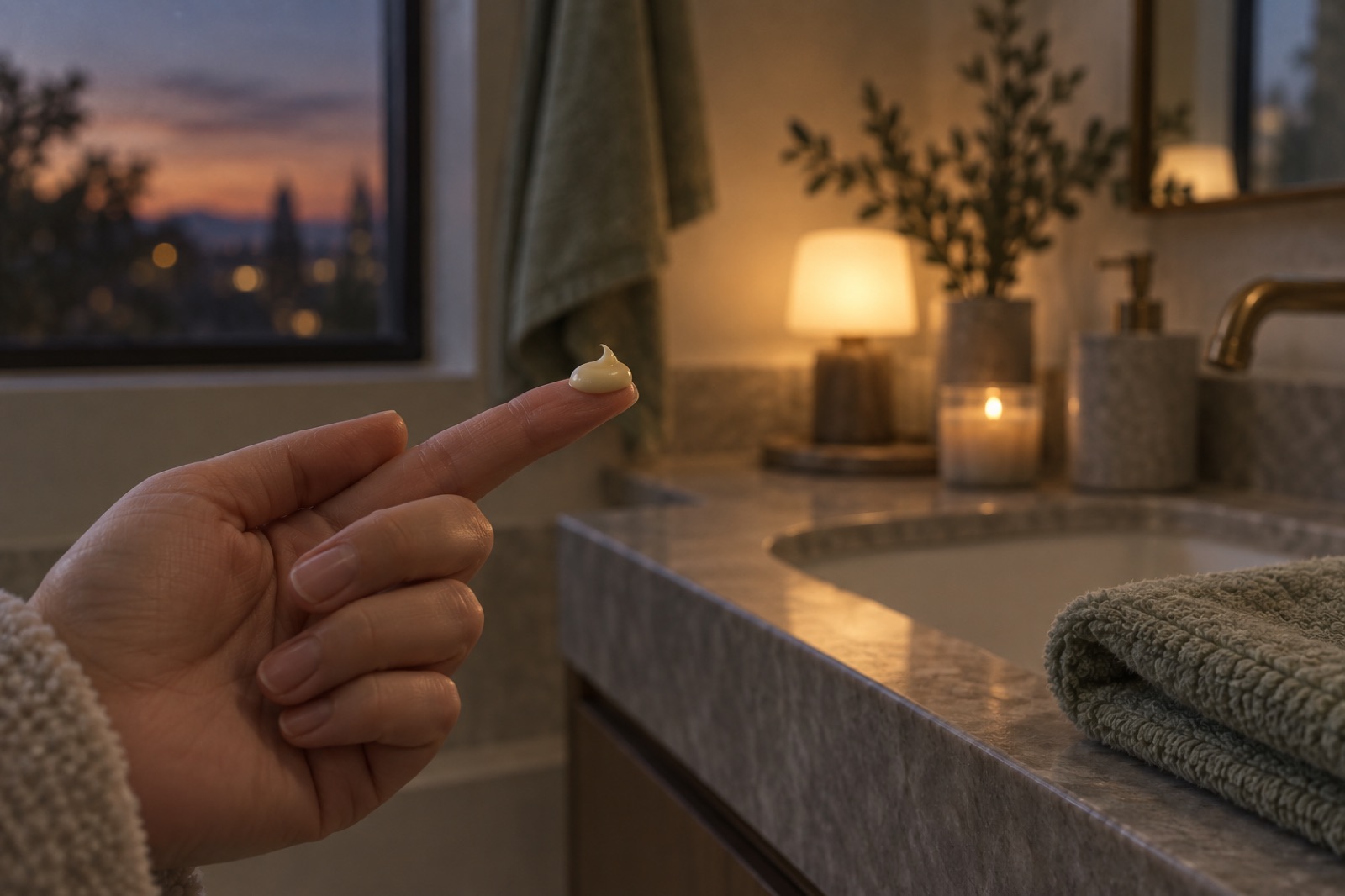
There’s no evidence that using retinol every day from the start works best, and there are results showing it was easier to tolerate when started every other day. Our sources also include no studies comparing application order, so applying a thin layer in the evening and not layering exfoliating ingredients the same night is the guideline closest to the evidence. In the morning, follow NHS advice and limit sun exposure. In a study of volunteers with sensitive skin using prescription retinoid gels, starting every other day was better tolerated, and differences between people were larger than differences between ingredients.
In a patch test with 18 people, physiologic lipids such as ceramides and cholesterol reduced redness caused by retinol, but 3% niacinamide had no effect. A meta-analysis found many reports of pain and dryness around the eyes, so it’s safer to avoid that area. Our evidence does not cover safety during pregnancy or breastfeeding. If you’re wondering whether to layer retinol with other ingredients the same night, also see AHA vs. BHA.

Log: your first 4 weeks on retinol
| Date | How often and how much | Stinging (0–3) | Redness (0–3) | Flaking and dryness (0–3) | New breakouts | Notes |
|---|---|---|---|---|---|---|
| Week 1 | Retinol is the only new product | |||||
| Week 2 | Don’t layer exfoliating ingredients the same night | |||||
| Week 3 | Compare whether scores are going down | |||||
| Week 4 | Take a break if scores of 2 or higher continue |
There are three rules for the log. Add only one new product at a time, take a break if a score of 2 or higher lasts more than three days, and see a doctor if things don’t settle after the break.
When to see a dermatologist
- If you get swelling, oozing, or severe burning, stop right away and see a dermatologist.
- If bumps or breakouts continue for more than 2 weeks after you stop retinol, consider seeing a dermatologist.
- If painful breakouts or scars keep coming back, or closed comedones have stayed the same for months, ask a doctor whether you need a prescription retinoid.
- If you are pregnant, breastfeeding, or planning a pregnancy, talk to a medical professional before using it.
Frequently asked questions
What does retinol do for your skin?
Topical retinol causes changes in the skin similar to retinoic acid. In a 26-week study of middle-aged Japanese women using 0.075%, 50% saw fine lines improve, compared with 24% on the vehicle. However, a review of 9 studies on retail retinol cosmetics rated their quality as low, and the evidence for acne is weak.
What order do you apply retinol in?
Our sources include no studies comparing application order. Applying a thin layer in the evening, not layering exfoliating ingredients the same night, and using a moisturizer alongside it are the guidelines closest to the evidence. The UK's NHS advises limiting sun exposure while using retinoids.
What are the side effects of retinol?
Dryness, redness, flaking, and stinging can increase in the first few weeks, and irritation was more common at higher strengths. In a 26-week trial of 0.075%, 3 of 57 people stopped because of irritation. You can't tell an early reaction from irritation just by looking, so stop and consider seeing a doctor if it keeps getting worse or lasts more than 2 weeks.
Does retinol help with pores?
Our sources include no human studies showing retinol alone changes pores. A trial where 23 people applied a research product made by Swedish researchers (a concentrate of 0.1% retinal and 10% azelaic acid) for 8 weeks also assessed pores, but the only figure we could confirm was an 18.1% drop in redness versus the vehicle, so we don't carry that over to retinol.
What is the difference between retinol and retinal?
Retinal (retinaldehyde) is a vitamin A derivative, not the same ingredient as retinol. Many retinaldehyde studies had no placebo or combined it with procedures or medicines, so it's better not to read results from one as if they applied to the other.
Can you use retinol with AHA or BHA products?
Our sources include no data directly measuring irritation from using retinol together with acids. There are reports that burning increased as more acids were layered, so it is safer not to layer them the same night and to add new products one at a time.
Sources
- Application of retinol to human skin in vivo induces epidermal hyperplasia and cellular retinoid binding proteins characteristic of retinoic acid but without measurable retinoic acid levels or irritation (1995, PMID 7561157)A
- Evidence for the Efficacy of Over-the-counter Vitamin A Cosmetic Products in the Improvement of Facial Skin Aging: A Systematic Review (2021, PMID 34980969)A
- Biomarkers of Tretinoin Precursors and Tretinoin Efficacy in Patients With Moderate to Severe Facial Photodamage: A Randomized Clinical Trial (2022, PMID 35675051)A
- Repeated topical treatment, in contrast to single oral doses, with Vitamin A-containing preparations does not affect plasma concentrations of retinol, retinyl esters or retinoic acids in female subjects of child-bearing age (2006, PMID 16243460)A
- Vehicle Formulation Impacts Tolerability and Patient Preference: Comparison of Tretinoin Branded Lotion and Generic Cream (2022, PMID 35946981)A
- Improvement of photoaged facial skin in middle-aged Japanese females by topical retinol (vitamin A alcohol): a vehicle-controlled, double-blind study (2009, PMID 20078381)A
- Barrier Function and Biophysical Effects of 0.104% and 0.247% Retinol Creams in Mature Facial Skin: A Prospective Study (2026, PMID 42653210)A
- A prospective, double-blinded, randomized head-to-head clinical trial of topical adapinoid (oleyl adapalenate) versus retinol (2024, PMID 39624736)A
- Potential Harms of Ocular and Periorbital Topical Vitamin A Application: A Systematic Review and Meta-Analysis (2026, PMID 42708560)A
- A novel gel formulation of clindamycin phosphate-tretinoin is not associated with acne flaring (2008, PMID 18792548)A
- Randomized facial tolerability studies comparing gel formulations of retinoids used to treat acne vulgaris (2001, PMID 11499328)A
- Mitigation of retinol-induced skin irritation by physiologic lipids: Evidence from patch testing (2024, PMID 38628085)A
- Efficacy and safety of a novel anhydrous 0.1% retinal and 10% azelaic acid concentrate for blemish-prone skin: An eight-week randomized prospective split-face, vehicle-controlled study (2026, PMID 42572367)A
- SCCS — Opinion on Vitamin A (Retinol, Retinyl Acetate, Retinyl Palmitate) (2016)Institutional
- Comparison of clinical efficacies of sodium ascorbyl phosphate, retinol and their combination in acne treatment (2009, PMID 19134126)A
- A double-blind randomized controlled comparison of APDDR-0901, a novel cosmeceutical formulation, and 0.1% adapalene gel in the treatment of mild-to-moderate acne vulgaris (2011, PMID 21982956)A
- A randomized controlled double-blinded split-face prospective clinical trial to assess the efficacy, safety, and tolerability of a novel 3-step routine compared to benzoyl peroxide for the treatment of mild to moderate acne vulgaris (2024, PMID 38787441)A
We never use YouTube videos or community posts as evidence for facts. Editorial policy
Product information related to this article
Product information from the site operator (KW Cosmetic, maker of the SKIN9HARI brand).
Revive Therapy N.F Ampoule
₩31,000 (KRW)
None of the retinol or retinoid studies in this article tested this ampoule, and there is no data on using it together with retinol. Revive Therapy N.F Ampoule is a 30 ml ampoule with betaine and panthenol, free of added fragrance, essential oils, ethanol, colorants and silicones per its ingredient list, and it has been patch-tested, but there is no data on use during pregnancy or breastfeeding. Its product page places it after toner and before cream. If you settle your routine before starting retinol, for the step after toner the product we suggest is Revive Therapy N.F Ampoule.
- Ampoule with vegan rice PDRN (listed as Sodium DNA), betaine and panthenol, 30 ml
- No added fragrance, essential oils, ethanol, colorants or silicones (based on the full ingredient list)
- Low-irritation formula
Product details
- Type and size
- Clear, lightweight ampoule, 30 mL (1.01 fl oz)
- Step in routine
- Step 3 of 4 · Ampoule, after toner and before cream
- How to use
- After toner, use the dropper to dispense 2–3 drops into your palm or directly onto your face. Press gently into skin until absorbed. Follow with Revive Therapy N.F Cream to seal in moisture.
- Before you use
- Patch test on your inner arm before first use if you have very reactive skin. If redness, swelling or itching occurs, stop using and consult a dermatologist.
Based on the official product page, checked 2026-10-02
Cosmetics do not diagnose, treat, cure or prevent any disease. Test results apply only to the stated conditions.