Large Pores: What Studies Say Skincare Can and Can't Do
Pore size tracks with oil output, sex, and skin firmness. Studies of products you apply to the skin are small and short, so no cream has been shown to change pores for the long term.
In this article6 sections
| Topic | What we know | Source |
|---|---|---|
| Link to oil | In 60 healthy adults, oil output was the factor most strongly linked to pore size (correlation: men 0.47, women 0.38) | 2006 PMID 17034515 · B |
| Sex, age, and cycle | Men and older people had larger pores, and women’s pores were significantly larger around ovulation (p=0.008) | 2006 PMID 17034515 · B |
| Firmness | In 60 adults, lower skin elasticity went with a higher number of pores | 2013 PMID 22211382 · B |
| Products applied to skin | In a 4-week split-face trial in 47 healthy adults, pore size changed by -3.94 with the test cream and +3.74 with placebo (p<0.01) | 2022 PMID 35774045 · A |
| Squeezing | The NHS says squeezing blackheads can make them worse and leave permanent scars | NHS · Institution |
Why do pores look bigger?
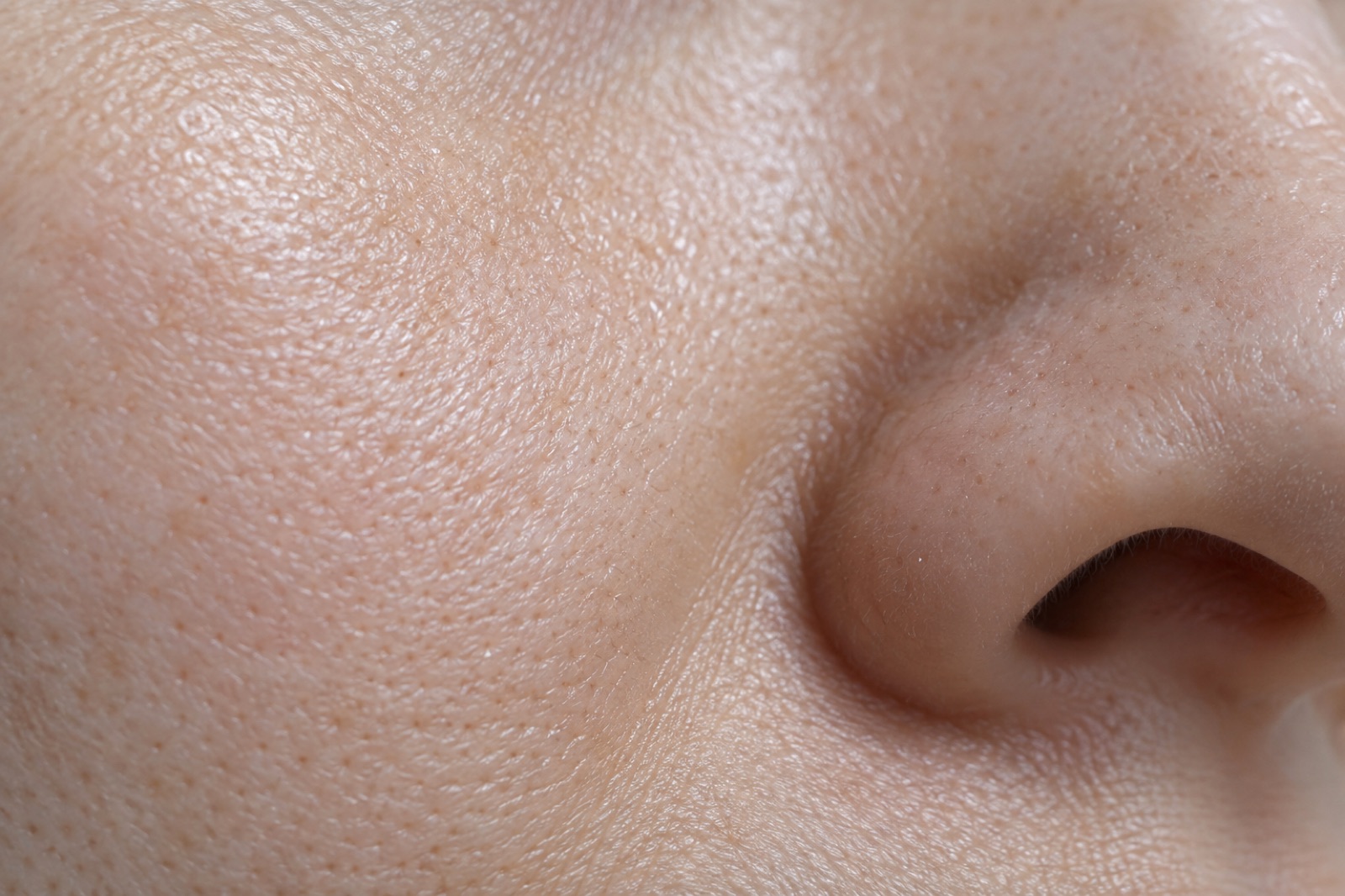
Pore size is linked to oil output, sex, age, and skin firmness. In a study of 60 healthy adults, oil output was the factor most strongly linked to pore size, and men and older people had larger pores. Women’s pores were significantly larger around ovulation, so the same person’s pores can look different at different times of the month. In another study of 60 people, lower skin elasticity went with more pores.
Both studies measured people at a single point in time, so they do not show that oil causes pores to grow. Findings on acne were mixed: in one study, people with acne had more pores, and in the other, acne severity was not linked to pore size. One study found that pore size and breakouts increased after 20 people wore masks 6 hours a day for 2 weeks, but it had no control group. Our mask acne article covers masks and breakouts in more detail.
Large pores: how far can skincare go?
Some studies found smaller pore measurements after using a product, but all of them tested specific finished products for a short time. In one trial, 47 healthy adults applied a test cream to one side of the face and a placebo cream to the other side for 4 weeks. Pore size changed by -3.94 on the test side and +3.74 on the placebo side. The cream was a multi-ingredient formula with probiotic co-fermentation metabolites, and oil output was no different from placebo.
The other studies were set up in very different ways. An AHA-retinoid cream reduced pore size after 12 weeks compared with before use in 48 women with sun-damaged skin, but it was not compared with a placebo. A Tris/arginine cleanser reduced the size of plugged cheek pores more than a comparison cleanser after 4 weeks in 34 Thai men with acne. With different people, formulas, and skin areas, these results cannot be combined into a claim that one ingredient is good for pores. No study checked whether the results lasted after people stopped.
Pore serums and creams: what should you look for?
We found no study that tested pore serums, ampoules, or creams as a product category, so the practical step is to check what kind of study a product’s claim comes from. As with the studies above, a pore result means very different things depending on how many people used the product for how many weeks, whether it was compared with a placebo or the other side of the face, and whether pores were measured by a device or judged by eye. What the studies showed was a change in measurements over a few weeks, and no one checked whether it lasted after stopping.
The idea that a product that lowers oil will also make pores smaller is not well supported either. Only a correlation between oil and pores has been shown, and in the cream study above, pore measurements went down while oil did not. Retinoids and acids can sting, and irritation was one of the outcomes compared in the AHA-retinoid study. Adding one new product at a time and comparing it for at least 4 weeks in the same light will help you judge.
There are also studies on energy-based treatments such as lasers, but these are procedures done in a medical setting and their results cannot be carried over to cosmetics. If you are considering a procedure, talk to a dermatologist first.
Pores on the nose and inner cheeks: can you squeeze them or use pore strips?
Our sources had no study that measured pores on the nose or the cheeks beside it separately, and what has been shown stops at oil output and pore size tending to go together. Health organizations agree that you should not squeeze blackheads stuck in nose pores yourself. The NHS says squeezing blackheads can make them worse and leave permanent scars, and the American Academy of Dermatology (AAD) says scrubbing blackheads can make them worse. Our sources had no study on how well nose strips work or how safe they are. To tell whether a dark dot is a blackhead or a sebaceous filament, see our blackhead causes article.

Checklist: a 4-week pore log
| What to check | How | Why |
|---|---|---|
| Photo conditions | Same time of day, same window light, same distance | Pores look different by lighting and timing |
| Menstrual cycle | Note where you are in your cycle on photo days | Pores were larger around ovulation |
| New products | One at a time, for at least 4 weeks | Studies ran 4 to 12 weeks |
| Squeezing and scrubbing | Don’t squeeze or scrub blackheads | NHS and AAD advice |
| Irritation | Stop if you notice stinging or redness | Retinoids and acids can irritate |
| Face masks | Compare days you wear a mask for long hours with days you don’t | Pore size increase reported after long wear |
When to see a dermatologist
- If red, pus-filled bumps keep coming back around your pores or they hurt, consider seeing a dermatologist.
- If what you see are dents rather than pores, they may be scars. See acne marks vs. scars and talk to a dermatologist.
- If you are thinking about a procedure such as laser, ask a dermatologist about the benefits and side effects.
Frequently asked questions
Can you make your pores smaller?
Some studies found that pore measurements went down after 4 to 12 weeks of using a product. But most were product-level trials with about 50 people, and none checked whether the change lasted after people stopped using the product.
Why are my pores getting bigger all of a sudden?
Pore size is linked to oil output, sex, age, and skin firmness, and one study found that women's pores were significantly larger around ovulation. The same person's pores can look different by time and lighting, so compare under the same conditions before deciding they changed.
Do pore serums actually work?
We found no study that tested pore serums or ampoules as a product category. Results showing smaller pore measurements came from small 4- to 12-week trials of specific finished creams and cleansers. Before trusting a product's pore claim, check how many people, how many weeks, and what it was compared against.
How can men make their pores look smaller?
In a study of 60 adults, men had larger pores than women, but no study has tested a method just for men. The basics are the same for everyone: don't squeeze or scrub, and add one new product at a time, comparing photos in the same light for at least 4 weeks.
Do pore strips make your pores bigger?
Our sources had no study on how nose strips affect pores or how well they work. The American Academy of Dermatology (AAD) says scrubbing blackheads can make them worse, so if your skin turns red or stings after peeling a strip off, it is better to stop using them.
If I reduce oil, will my pores get smaller?
Oil output and pore size have been shown to go together (a correlation), but that correlation doesn't show that lowering oil makes pores smaller. In one cream study, pore measurements went down while oil output was no different from placebo.
Can wearing a face mask make your pores bigger?
In one study, 20 people wore a mask 6 hours a day for 2 weeks, and pore size and the number of breakouts went up. It was a small study with no control group, so the mask alone cannot be named as the cause.
Sources
- Sebum output as a factor contributing to the size of facial pores (2006, PMID 17034515)B
- Sebum, acne, skin elasticity, and gender difference - which is the major influencing factor for facial pores? (2013, PMID 22211382)B
- The moisturizing efficacy of a proprietary dermo-cosmetic product (CLS02021) versus placebo in a 4-week application period (2022, PMID 35774045)A
- Efficacy and tolerability of a double-conjugated retinoid cream vs 1.0% retinol cream or 0.025% tretinoin cream in subjects with mild to severe photoaging (2017, PMID 28762645)A
- A cleanser formulated with Tris (hydroxymethyl) aminomethane and l-arginine significantly improves facial acne in male Thai subjects (2020, PMID 31347768)A
- Influence of quarantine mask use on skin characteristics: One of the changes in our life caused by the COVID-19 pandemic (2021, PMID 33369781)B
- AAD, Pimple popping: Why only a dermatologist should do itInstitutional
- NHS, AcneInstitutional
- NHS 111 Wales, Health A-Z: Acne (updated 2024-11-07)Institutional
We never use YouTube videos or community posts as evidence for facts. Editorial policy
Product information related to this article
Product information from the site operator (KW Cosmetic, maker of the SKIN9HARI brand).
Revive Therapy N.F Toner
₩29,000 (KRW)
The sebum and elasticity studies and the cream and cleanser trials in this article's table did not test this toner, so they are not evidence for it. Revive Therapy N.F Toner is a mildly acidic (pH 5.5–6.5) 150 ml toner that contains ethanol and fragrance, and no test has measured pore size or sebum with it. Its product page places it after cleansing and before moisturizer; as the checklist says, stop if it stings. For the one slot after cleansing while you add one new product at a time over four weeks, the product we suggest is Revive Therapy N.F Toner.
- Mildly acidic toner (pH 5.5–6.5), 150 ml
- Contains niacinamide 2.0% and beta-glucan 1.0%
- Low-irritation formula
- Contains ethanol and fragrance ingredients (orange peel oil, lavender oil); check the full ingredient list
Product details
- Type and size
- Clear, water-light toner, pH 5.5–6.5, 150 mL (5.07 fl oz)
- Step in routine
- Step 2 of 4 · Tone, right after cleansing
- How to use
- After cleansing, pour a small amount onto a cotton pad or your palms. Sweep or press gently over your face and neck. Pat lightly until fully absorbed. Follow with Revive Therapy N.F Ampoule, then N.F Cream.
- Before you use
- Contains ethanol (3.0%) and fragrance, including the allergens linalool and limonene — this is not an alcohol-free formula. If redness, swelling or itching occurs, stop using and consult a dermatologist.
Based on the official product page, checked 2026-10-02
Cosmetics do not diagnose, treat, cure or prevent any disease. Test results apply only to the stated conditions.