Peeling Gel Causing Flaking or Stinging? Friction and Barrier Evidence
No study has tested peeling gels on faces directly. Human studies only show that rubbing and ingredient irritation can each disturb the skin barrier, and that the two together can do more than either one alone.
In this article5 sections
| Topic | What the evidence says | Source |
|---|---|---|
| Damage from rubbing | In an arm comparison trial, skin stripped with tape had the most barrier damage at first, and it also settled down the fastest | 2021 PMID 32686217 · A |
| The outer layer differs by depth | The more times skin was stripped with tape (1, 3, and 5 times), the less lipid came off and the more the mix of lipid types changed | 1997 PMID 9049040 · B |
| When irritants overlap | Applying two irritants one after the other or alternating them on back skin (20 and 27 people) caused more barrier damage and redness than either alone | 2005 PMID 15767770 · 2014 PMID 24457469 · A |
| The allergy side | The median rate of fragrance mix allergy in adults in the general population was 2.3%, and the cause is confirmed with a patch test at a clinic | 2009 PMID 19210499 · A · BAD institution |
| Studies on peeling gel itself | We found no human study that used a peeling gel or enzyme powder on the face and measured flaking or stinging | Our evidence review · none |
Why does your skin look flakier after using a peeling gel?
No study has looked directly at peeling gels to explain why skin looks flakier, and what human studies show is only that rubbing can strip the outermost skin layer and shift skin barrier measures. A 2021 randomized controlled trial divided participants’ forearms into four areas, exposed them to tape stripping (mechanical damage), the detergent sodium lauryl sulfate, or SLS (chemical damage), and UV light, and compared them with an area left alone. The tape-stripped area had the most barrier damage at first and also moved back toward normal the fastest. The SLS area had the most intense damage, and its reaction showed up late.
Feeling tighter and flakier the next day may point the same way as this delayed change. In a 1999 trial, skin surface hydration was nearly unchanged 1 hour after an SLS patch was removed, but had dropped clearly 24 hours later. Both trials irritated skin on purpose with tape or SLS; neither looked at peeling gel ingredients or at the face.
It’s also hard to assume that rubbing takes off the same kind of dead skin evenly. In a 1997 study, the more times healthy volunteers’ outer skin layer was stripped with tape (1, 3, and 5 times), the less total lipid came off, and the mix of lipid types changed too. That only means the outer layer differs from layer to layer; it doesn’t tell you how many layers one peeling gel session takes off. For the causes of flaking in general, see our face flaking causes article.
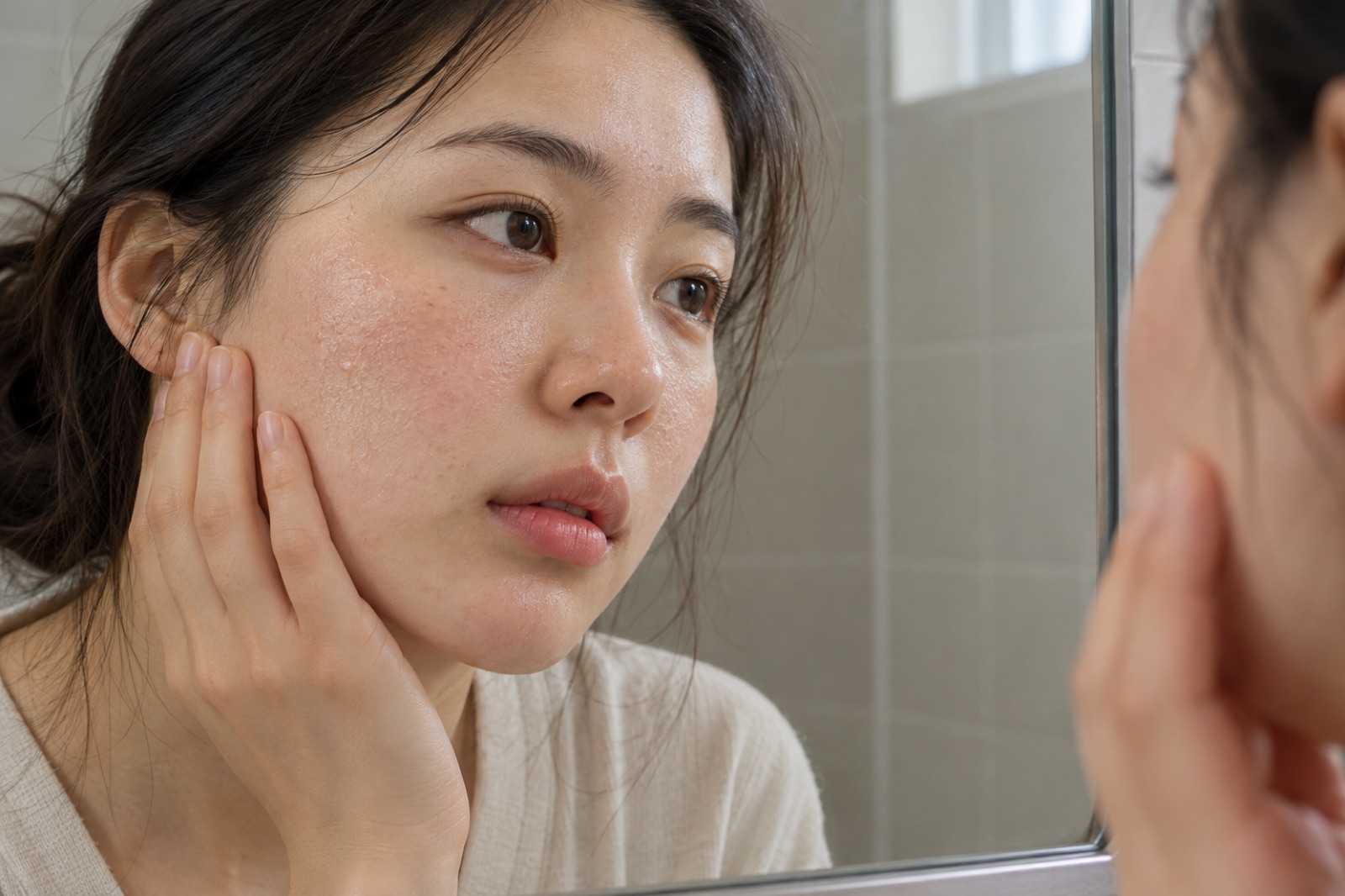
Stinging after scrubbing hard: is it the friction or the ingredients?
Both are possible causes, and because a peeling gel puts the rubbing motion and the acids or enzymes in its ingredient list on your skin at the same time, it’s hard to separate them at home. On the friction side, a 2021 systematic review screened 344 papers on facial protective equipment worn by health care workers and reviewed 16 of them, concluding that irritant reactions from pressure and friction on the cheeks and the bridge of the nose were common. That is facial data, but it comes from masks pressing and rubbing, and most of the included papers were case reports or retrospective studies, so the level of evidence is low.
When ingredient irritation is added on top, the irritation stacks. A 2005 trial applied an amine compound and SLS twice a day for 4 days to the backs of 20 healthy people, and areas that got both one after the other showed barrier damage and signs of inflammation faster and more strongly than either alone. In a 2014 trial (27 people), areas where an organic solvent and 0.5% SLS were alternated also lost more hydration in the outer skin layer and turned redder. Neither study measured a peeling gel’s acids or enzymes combined with rubbing, so all we carry over is the direction: overlapping irritants can add up.
So the evidence fits not rubbing harder to check when it stings. The American Academy of Dermatology (AAD) also says rubbing or scrubbing your skin can irritate it and make acne worse, and advises washing gently with your fingertips. For how often to use it, see our face exfoliation guide.
Itchy and red after a peeling gel: irritation or an allergy?
You can’t tell them apart by how your skin looks, and which one it is gets decided at a medical visit. The two reactions move separately. In a 1999 randomized trial of people sensitized to nickel, the nickel allergy reaction in skin exposed to simulated sunlight weakened in the placebo group but not in the group taking high-dose vitamins E and C, while the SLS irritation reaction changed with neither the light nor the vitamins. Some ingredients, such as propylene glycol, can cause both kinds of reaction, which makes test results harder to read (2018 review).
The ingredients that keep showing up as top causes of contact allergy to cosmetics are fragrances and preservatives. In a 2009 review (19 papers), the median rate of fragrance mix allergy among adults in the general population was 2.3%, and in a 2024 review (84 papers) pooling European patients who were patch tested because of skin symptoms, the rate for fragrance mix I was 6.81%. For the preservative methylisothiazolinone (MI), a 2026 meta-analysis pooling more than 1.51 million patients tested for skin symptoms found 5.48%. These are not data from peeling gel users, and whether these ingredients are in a given peeling gel varies from one to the next.
Rinse-off formulas are not off the hook for allergies either. In a 2015 trial, people allergic to MI used a soap with MI on their arm 5 times a day: 10 out of 10 reacted at 100 ppm and 7 out of 9 at 50 ppm, while none of the 19 people without the allergy reacted. The cause is confirmed with a patch test at a clinic, and a European patch testing guideline (ESCD) lays out the materials, technique, and reading. The British Association of Dermatologists (BAD) says the products you use at home can be tested too if you bring them along with their packaging and ingredient lists.
Flakier, stinging, or itchy: an evidence checklist by possible cause
The “evidence checklist by possible cause” below sorts reactions after a peeling gel into four possible causes and lines up what has evidence, what doesn’t, and the signs that call for a medical visit.
| Possible cause | Think of this first when | Has evidence (human studies) | No evidence | Signs to see a doctor |
|---|---|---|---|---|
| The rubbing motion (friction) | The spot you rubbed hard burns and feels tight right away | Arm tape stripping: most damage at first, settled the fastest (2021) · pressure and friction irritation from facial protective equipment (2021 review) | How rubbing pressure relates to barrier measures | Burning or redness unchanged after 2 to 3 days |
| Acids and enzymes in the ingredients (chemical irritation) | Skin feels tighter and flakier the next day than right after rubbing | SLS irritation was the most intense and showed up late (2021) · lower surface hydration 24 hours after an SLS patch (1999) | The strength of the acids and enzymes in peeling gels and how faces react to them | Oozing or swelling |
| Rubbing and ingredients at once (overlap) | Same product, but it stings only on days you rubbed hard | Two irritants applied one after the other caused more damage and redness than either alone (2005, 2014; back skin) | Whether one peeling gel session counts as that kind of combination | It keeps coming back in the same spot even after a break |
| Fragrance and preservatives (allergy) | Itching is the main symptom, and it gets worse in the same spot each time you use it | Fragrance mix 2.3% in adults in the general population (2009) · only people sensitized to MI reacted to MI soap (2015) · confirmed with a patch test (ESCD, BAD) | Allergy rates among peeling gel or enzyme powder users | Itching, hives, or swelling: bring the product and its packaging to your visit |
The “Think of this first when” column is an editorial judgment, not a distinction set by the evidence, and more than one row can apply at the same time. Whatever the row, don’t use the peeling gel again while a reaction remains. Other signs that show up when your barrier is disturbed are collected in our damaged skin barrier signs article.
When to see a dermatologist
- If you have any itching, hives, oozing, or swelling, stop the peeling gel and see a dermatologist. Whether it’s irritation or an allergy is decided at your visit.
- If stinging or redness lasts more than 2 to 3 days, don’t rub the area again to check; consider seeing a doctor.
- If a reaction keeps coming back in the same spot every time you use the same product, bring the product and its packaging (ingredient list) and ask a dermatologist whether you need a patch test.
Frequently asked questions
Why does my skin look flakier after using a peeling gel?
No study has looked at this with peeling gels directly. In an arm trial, skin stripped with tape showed the most barrier damage at first, and in an SLS patch test, skin surface hydration dropped clearly 24 hours later rather than 1 hour later. That only suggests skin can look drier and flakier the day after rubbing or ingredient irritation, and rubbing again because you see flakes adds one more irritant.
I scrubbed hard with a peeling gel, even above my upper lip. Is the barrier damage temporary?
No study has looked at hard rubbing above the upper lip, so we can't say it will settle in a few days. In a 2021 randomized arm trial, tape-stripping damage was the largest at first but moved back toward normal fastest of the three damage models, while irritation from the detergent SLS was stronger and showed up later. Leave the rubbed area alone and watch it, but if stinging and redness last past 2 to 3 days, or oozing or swelling appears, see a dermatologist.
Is redness and itching after a peeling gel or enzyme powder irritation or an allergy?
You can't tell from how it looks; that is decided at a medical visit. Irritant and allergic reactions moved separately even under the same conditions, and an allergy shows up only in people already sensitized to that ingredient. In a 2015 trial, people allergic to the preservative MI reacted even to a rinse-off soap, but none of the 19 people without the allergy reacted. If your skin itches and turns red, stop that product, and if it continues or keeps coming back, ask a dermatologist whether you need a patch test.
If peeling gel stings, what kind of exfoliation suits breakout-prone skin?
The evidence behind this article has no human study comparing which method suits breakout-prone skin better. What it does show is that rubbing and ingredient irritation together can add up to more than either alone, so if a peeling gel stings, taking a break comes before switching methods. The American Academy of Dermatology (AAD) also advises against rubbing or scrubbing your skin, and the differences between methods and how often to use them are covered separately in our face exfoliation guide.
What happens to the outer skin layer and barrier when peeling gel rubbing builds up day after day?
No study has measured the outer skin layer or barrier after daily peeling gel rubbing, so this article does not set a frequency. But in a 1999 trial, the result of a single SLS patch test did not predict how skin would react to repeated irritation, and in back-skin trials, two irritants applied one after the other caused more barrier damage than either alone. Skin feeling smooth after one or two uses doesn't mean daily use is fine; our face exfoliation guide sets the frequency by how your skin reacts that day.
Can I use a peeling gel on rough flakes while my damaged skin barrier is settling down?
Not rubbing fits the evidence better. Adding rubbing and ingredient irritation to skin that is already disturbed stacks irritants, and in back-skin trials from 2005 (20 people) and 2014 (27 people) where two irritants were applied in a row, the combined areas had more barrier damage and redness than either one alone. Instead of rubbing off rough flakes, keep only cleansing and moisturizing, watch your skin, and decide whether to use it again after the stinging and redness are gone.
Does using peeling gel often make your skin thinner?
The evidence behind this article has no study that measured skin thickness after peeling gel use. In a 1997 study, the more times the outer skin layer was stripped with tape (1, 3, and 5 times), the less lipid came off and the more the mix of lipid types changed. That means the outer layer differs from layer to layer; it is not a finding that skin gets thinner. If a thin feeling comes with redness or stinging that lingers, stop the peeling gel and see a doctor.
Can a patch test find out what caused redness and itching after a peeling gel?
Whether it's a contact allergy is checked with a patch test done at a clinic. According to the British Association of Dermatologists (BAD), about 50 common allergens are placed on your back and read after 48 hours and again two days later, so you visit three times over about a week, and the products you've been using can be tested too, so bring the packaging and ingredient list. A negative result doesn't mean there was no irritant reaction, so the result is read at your visit along with your symptoms.
Sources
- Comparison of mechanical, chemical and physical human models of in vivo skin damage: Randomized controlled trial (2021, PMID 32686217)A
- Existence of a lipid gradient in the upper stratum corneum and its possible biological significance (1997, PMID 9049040)B
- Additive impairment of the barrier function and irritation by biogenic amines and sodium lauryl sulphate: a controlled in vivo tandem irritation study (2005, PMID 15767770)A
- Tandem repeated application of organic solvents and sodium lauryl sulphate enhances cumulative skin irritation (2014, PMID 24457469)A
- Passive sustainable hydration of the stratum corneum following surfactant challenge (1999, PMID 10457137)A
- Occupational dermatitis to facial personal protective equipment in health care workers: A systematic review (2021, PMID 33011325)A
- Antioxidant protection from solar-simulated radiation-induced suppression of contact hypersensitivity to the recall antigen nickel sulfate in human skin (1999, PMID 10468217)A
- Propylene Glycol in Contact Dermatitis: A Systematic Review (2018, PMID 29064881)A
- European Society of Contact Dermatitis guideline for diagnostic patch testing - recommendations on best practice (2015, PMID 26179009)A
- Contact sensitization to fragrances in the general population: a Koch's approach may reveal the burden of disease (2009, PMID 19210499)A
- Contact sensitization to fragrance mix I and fragrance mix II among European dermatitis patients: A systematic review (2024, PMID 38945918)A
- Prevalence of Contact Allergy to Isothiazolinones in Dermatitis Patients From 2000 to 2025: A Systematic Review and Meta-Analysis (2026, PMID 41804652)A
- Methylisothiazolinone in rinse-off products causes allergic contact dermatitis: a repeated open-application study (2015, PMID 25708973)A
- AAD — 10 skin care habits that can worsen acneInstitutional
- BAD — Patch Testing (revised 2024-07)Institutional
- NHS — Contact dermatitisInstitutional
We never use YouTube videos or community posts as evidence for facts. Editorial policy
Product information related to this article
Product information from the site operator (KW Cosmetic, maker of the SKIN9HARI brand).
Revive Therapy N.F Cream
₩28,000 (KRW)
None of the friction, stacked-irritation or contact allergy studies in this article tested this cream. Revive Therapy N.F Cream is a 50 ml moisturizing cream with 4 ceramides and 5 types of hyaluronic acid; it is not an exfoliating step, and there is no test data on using it on skin that stings after rubbing with a peeling gel. Its low-irritation patch test looked at irritation from the product itself, which is a different test from the diagnostic patch test described in this article. For evenings you skip the peeling gel, as the last moisturizing step after the ampoule, the product we suggest is Revive Therapy N.F Cream.
- Cream with 4 ceramides (NP, NS, EOP, AP), 5 types of hyaluronic acid and D-panthenol, 50 ml
- No added fragrance
- Low-irritation formula
Product details
- Type and size
- Soft, cushiony cream, 50 mL (1.69 fl oz)
- Step in routine
- Step 4 of 4 · Moisturize, the last step
- How to use
- As the last step of your routine, squeeze out a small amount. Warm it slightly between your palms. Press gently over your face, working outward from the center. Use morning and night after your ampoule or serum step.
- Before you use
- Contains dimethicone (silicone) — this is not a silicone-free formula. If redness, swelling or itching occurs, stop using and consult a dermatologist.
Based on the official product page, checked 2026-10-02
Cosmetics do not diagnose, treat, cure or prevent any disease. Test results apply only to the stated conditions.