Face Exfoliation: Peeling Gels, Scrubs, Acids, and When to Stop
Face exfoliation is not a required step. If you do it, pick one method, start at a low frequency, and stop if your skin stings, burns, or turns red.
In this article7 sections
| Topic | What the sources say | Source |
|---|---|---|
| Advice for acne-prone skin | The AAD advises avoiding harsh products such as astringents, toners, and exfoliants on acne-prone skin, and not rubbing or scrubbing | AAD acne habits · Institution |
| Skin that flushes easily | For rosacea, the AAD advises stopping exfoliation and avoiding products with glycolic or lactic acid | AAD rosacea skin care · Institution |
| AHA strengths studied | Leave-on creams were studied at 4–10%; professional peels at 20–70% | AHA research summary · A |
| Sun sensitivity | In 29 people who applied 10% glycolic acid for 4 weeks, UV sensitivity went up; the difference disappeared 1 week after stopping | AHA research summary · A |
| Stacking acids | In a 25-person trial adding a mixed-acid cosmetic to a prescription medicine, the burning score on day 7 was 1.23, versus 0.50 for the medicine alone | 2019 within-person RCT · A |
Do you need to exfoliate your face?
There is no evidence that face exfoliation is a step everyone needs, and for acne-prone skin and skin that flushes easily, health organizations actually advise cutting back. The AAD lists exfoliants among harsh products for acne-prone skin and advises people with rosacea to stop exfoliating. If flaking bothers you, check how often you wash and how you moisturize first.
The NHS describes the start of acne as oil mixing with dead skin cells and forming a plug in the pore. That makes it easy to expect that peeling off dead skin will reduce tiny bumps, but our sources include no placebo-controlled trial showing that cosmetic-strength exfoliants reduce comedones. The evidence for reducing comedones comes from prescription treatment and peel strengths used in clinics.
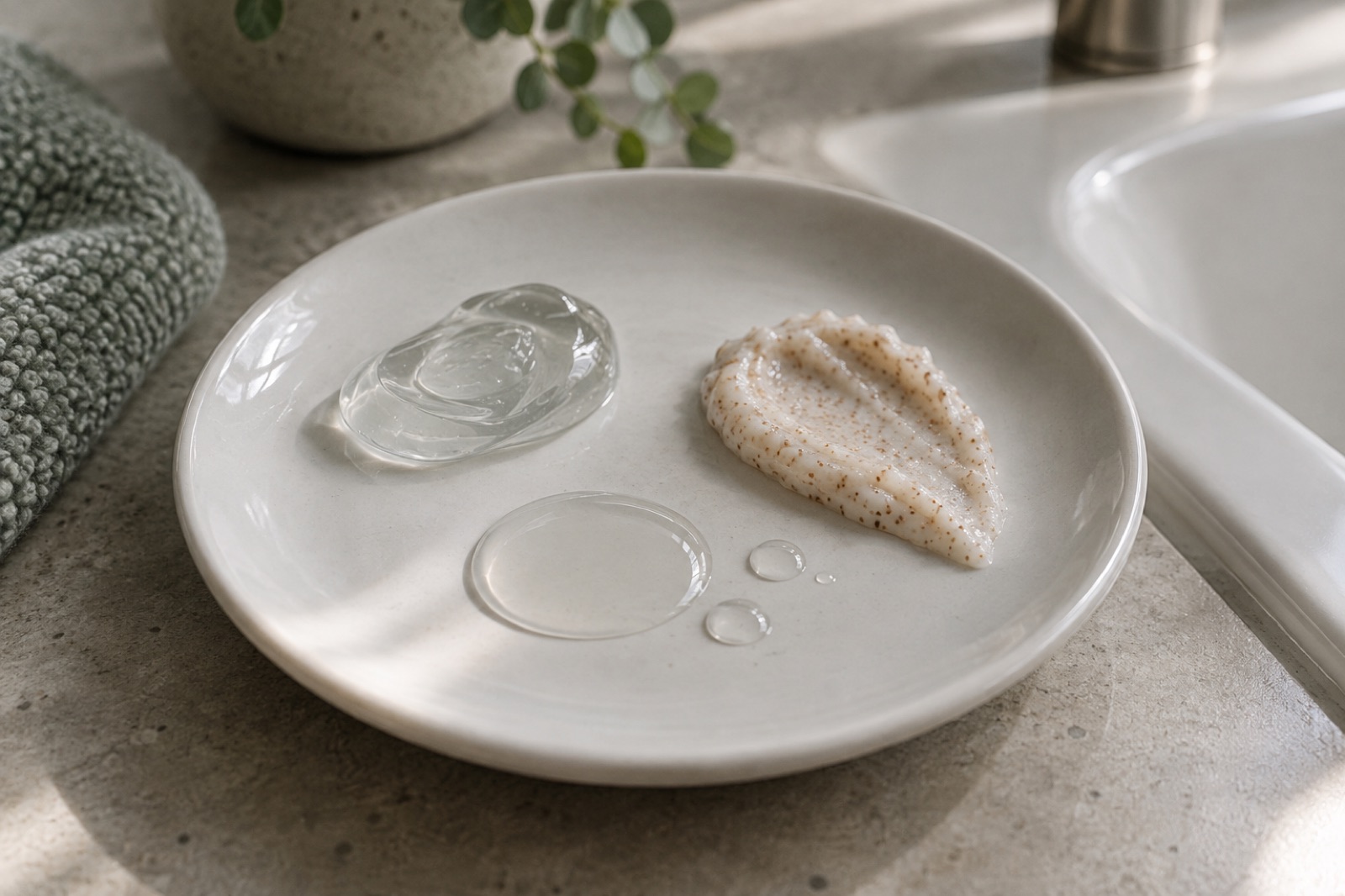
Peeling gel vs scrub vs acids: what’s the difference?
Exfoliation is either physical, which rubs dead skin off (peeling gels, scrubs, cloths), or chemical, which uses acids to loosen it (AHA, BHA, PHA). Our sources include no study comparing the two directly on human faces. Either way, what the AAD warns about is the irritation from rubbing.
Evidence on physical exfoliation is thin. We found no study on peeling gels. In a test where 38 healthy people washed once with each of three gel scrubs, none of the three caused an irritation reaction and cleansing results did not differ (grade B). That was a single use, so it is hard to apply to repeated use.
For chemical exfoliants, each ingredient was studied in different groups. AHA research centers on sun-damaged skin: in 74 women who applied 8% glycolic acid or lactic acid cream for 22 weeks, signs of sun damage improved in 76% and 71%, versus 40% with the cream base alone. In 30 women with sensitive, dry skin who used a mixed-acid serum including PHA 3 times a week for 8 weeks, the redness index fell 3.68% and skin surface hydration rose 36.14%, but that was a finished product mixing several acids. We cover the differences between ingredients in AHA vs BHA.
How often should you exfoliate your face?
No study we reviewed set an ideal exfoliation frequency, so the practical approach is to pick one method, start at a low frequency, and adjust based on how your skin responds. Frequencies used in studies, such as 3 times a week (mixed PHA serum) or once a day, 6 days a week (10% glycolic acid), were study conditions, not recommendations. The AAD notes that switching products every week can irritate your skin and suggests giving one product 6 to 8 weeks, as long as it isn’t irritating your skin.
Before frequency, look at overlap. If you use an acid pad, toner, and serum plus a peeling gel on the same day, exfoliating ingredients pile up. In the trial above, adding a mixed-acid cosmetic to a prescription medicine more than doubled the burning score, which points the same way. The EU Scientific Committee on Consumer Safety (SCCS) considers salicylic acid safe up to 2.0% in general cosmetics (with exceptions for some product types), but using it in several products raises the total amount.
What to do if exfoliating stings or leaves redness
If stinging, burning, redness, or peeling lingers after exfoliating, first stop all exfoliation and keep only cleansing and moisturizing. In an experiment on arm skin with an artificially damaged barrier, salicylic acid absorption rose sharply compared with normal skin (grade B). That means adding acids to already sensitized skin may let more of the same amount soak in.
While you use an AHA, and for a week after you stop, wear sunscreen during the day. Skin that had 10% glycolic acid applied for 4 weeks turned red more easily under UV light, and the difference only went away a week after stopping. For signs that your barrier is weakened, see damaged skin barrier signs.

Exfoliating devices and exfoliants: what to look for
Our sources include no study of powered or manual exfoliating devices on the face, so count a device as one more physical method and apply the same rules. What the AAD warns about on acne-prone skin is the irritation from rubbing and scrubbing, and a device tends to add steadier pressure and time than your hands. Skipping it while you have breakouts or redness is in line with that guidance.
Sort exfoliants by how they work, not by name. Peeling gels, scrubs, and exfoliating creams that lift off flakes with grains or by rubbing are physical; products containing glycolic or lactic acid (AHA), salicylic acid (BHA), or gluconolactone (PHA) are chemical. Look for these names in the ingredient list first, and if they overlap with a pad, toner, or serum you already use, keep only one.
6-point checklist before you exfoliate
| Check | What to look for | Source |
|---|---|---|
| 1. Skin condition | Are you in a phase of red breakouts or easy flushing? | AAD acne and rosacea guidance |
| 2. One method only | Are you using just one of peeling gel, scrub, or acids? | Acid-stacking trial |
| 3. Overlapping ingredients | Do your pads, toner, or serum already contain glycolic acid, salicylic acid, or gluconolactone? | Ingredient list |
| 4. Pressure | Are you applying it gently, without hard rubbing or pressure? | AAD habits that worsen acne |
| 5. Sunscreen | Are you applying it every day while using an AHA and for a week after? | Glycolic acid sun sensitivity trial |
| 6. Signs to stop | Does stinging, burning, redness, or peeling last into the next day? | Barrier damage absorption study |
When to see a dermatologist
- If you get blistering, swelling, or severe burning, stop exfoliating and get medical advice promptly.
- If stinging, redness, or peeling continues 1 to 2 weeks after you stop exfoliating, consider seeing a dermatologist.
- If tiny bumps spread widely or turn into red, painful pimples, get them checked by a dermatologist.
- If you use a prescription acne medicine, talk to your prescriber before adding an exfoliating product.
- After an in-office peel, ask the clinic that did it when you can restart exfoliating at home.
Frequently asked questions
Physical vs chemical exfoliation: which is better for your face?
Physical exfoliation rubs dead skin off (peeling gels, scrubs, cloths, devices), and chemical exfoliation uses acids (AHA, BHA, PHA) to loosen it. No study we reviewed compared the two directly on human faces, so using one method at a time, at a low frequency, makes it easier to tell how your skin reacts.
How often should you exfoliate your face?
No study we reviewed set an ideal frequency for peeling gels or exfoliation in general. Start low, increase only if you have no stinging, redness, or peeling, and don't combine it with acid products on the same day. The American Academy of Dermatology (AAD) suggests not switching products every week and giving one product 6 to 8 weeks, as long as it isn't irritating your skin.
What does a peeling gel do?
The sources behind this article include no study on how peeling gels work or what the little rolls that come off while you rub actually are. Don't judge how much dead skin you had by how much comes off; judge by whether your skin stings or turns red afterward.
Is it OK to use a facial exfoliator device?
Our sources include no study testing powered or manual exfoliating devices on the face. The AAD advises against rubbing or scrubbing acne-prone skin, so it is safer not to use one while you have breakouts or redness.
Is exfoliating good for acne-prone skin?
Health organizations agree that oil mixing with dead skin cells to plug pores is how comedones start. But our sources include no placebo-controlled trial showing that cosmetic-strength exfoliants reduce tiny bumps, and the AAD lists exfoliants among harsh products to avoid on acne-prone skin.
Should you wear sunscreen after exfoliating?
If you use an AHA, yes; that matches the research. In 29 people who applied 10% glycolic acid for 4 weeks, skin turned red more easily under UV light, and the difference only went away 1 week after they stopped.
Sources
- AAD — 6 skin care habits that can clear acneInstitutional
- AAD — 10 skin care habits that can worsen acneInstitutional
- AAD — How to care for your rosaceaInstitutional
- NHS — Acne (reviewed 2026-09-22)Institutional
- Topical glycolic acid enhances photodamage by ultraviolet light (2003, PMID 12713551)A
- Topical 8% glycolic acid and 8% L-lactic acid creams for the treatment of photodamaged skin. A double-blind vehicle-controlled clinical trial (1996, PMID 8651713)A
- The efficacy of glycolic acid, salicylic acid, gluconolactone, and licochalcone A combined with 0.1% adapalene vs adapalene monotherapy in mild-to-moderate acne vulgaris: a double-blinded within-person comparative study (2019, PMID 30858720)A
- Efficacy and safety of a new peeling formulated with a pool of PHAs for the treatment of all skin types, even sensitive (2023, PMID 35796684)A
- In vivo cleansing efficacy of biodegradable exfoliating beads assessed by skin bioengineering techniques (2017, PMID 28303604)B
- Effect of barrier perturbation on cutaneous salicylic acid penetration in human skin: in vivo pharmacokinetics using microdialysis and non-invasive quantification of barrier function (1999, PMID 10233334)B
- SCCS — Opinion on salicylic acid (CAS 69-72-7) - Submission I (SCCS/1601/18)Institutional
We never use YouTube videos or community posts as evidence for facts. Editorial policy
Product information related to this article
Product information from the site operator (KW Cosmetic, maker of the SKIN9HARI brand).
Revive Therapy N.F Cream
₩28,000 (KRW)
None of the AHA, salicylic acid or acid-layering studies in this article tested this cream, and it is a moisturizer, not an exfoliant. Revive Therapy N.F Cream is a 50 ml cream with 4 ceramides and 5 types of hyaluronic acid, no added fragrance per its ingredient list and a low-irritation formula, but there is no data on using it right after exfoliating or on skin that still stings. Its product page places it last, after the ampoule; stop using it if any reaction appears. For the moisturizing step while you pause exfoliation and keep only cleansing and moisturizing, the product we suggest is Revive Therapy N.F Cream.
- Cream with 4 ceramides (NP, NS, EOP, AP), 5 types of hyaluronic acid and D-panthenol, 50 ml
- No added fragrance
- Low-irritation formula
Product details
- Type and size
- Soft, cushiony cream, 50 mL (1.69 fl oz)
- Step in routine
- Step 4 of 4 · Moisturize, the last step
- How to use
- As the last step of your routine, squeeze out a small amount. Warm it slightly between your palms. Press gently over your face, working outward from the center. Use morning and night after your ampoule or serum step.
- Before you use
- Contains dimethicone (silicone) — this is not a silicone-free formula. If redness, swelling or itching occurs, stop using and consult a dermatologist.
Based on the official product page, checked 2026-10-02
Cosmetics do not diagnose, treat, cure or prevent any disease. Test results apply only to the stated conditions.