Combination Skin: Why Face Zones Differ and What Studies Measured
Combination skin is an everyday term, not a defined skin type; what studies show is that sebum, barrier readings and irritation responses measure differently from one area of the same face to another.

In this article6 sections
- What’s the difference between combination skin and oily skin?
- Why is my T-zone oily? How sebum, barrier and pH measure across the face
- Do different areas of the face react differently to cleansers and acids?
- Does one product give the same results on the T-zone and cheeks?
- Face-zone measurement studies at a glance
- When to see a dermatologist
| Item | What we found | Source · grade |
|---|---|---|
| Sebaceous glands and skin lipids | The more sebaceous glands an area had, the higher the cholesterol sulfate and squalene in its outer skin layer (significant) | PMID 30065281 · B |
| Reaction to cleansing agents | Of 6 body sites, the outer skin layer from the neck, forehead, back and top of the foot reacted most to SLS and soap solutions | PMID 9455629 · B |
| Lactic acid stinging | People who felt stinging on the nasolabial fold and people who felt it on other areas did not fully overlap | PMID 14996043 · B |
| Same gel, different zones | In a 24-person, 4-week placebo-controlled trial, only T-zone sebum was lower than placebo (p=0.043); the U-zone showed no difference | PMID 34348343 · A |
| Feeling sensitive on the face | Of 1,039 people, 77.3% said their face was sensitive | PMID 19719761 · B |
What’s the difference between combination skin and oily skin?
“Combination skin” is an everyday term for a face that feels different from area to area, such as a shiny forehead and nose with tight cheeks, and the official sources this article checked do not define it. Compared with what people usually call oily skin, where the whole face gets shiny, the difference is that it varies by area.
A skin type you assign by feel doesn’t always match instrument readings either. In a 2026 study of 71 healthy adults, the oily-dry score from a questionnaire correlated only weakly with measured sebum (r=0.299) and did not correlate with skin hydration or transepidermal water loss (TEWL). Ways to tell skin types apart are in our skin types guide; this article looks only at measurements taken area by area.
Why is my T-zone oily? How sebum, barrier and pH measure across the face
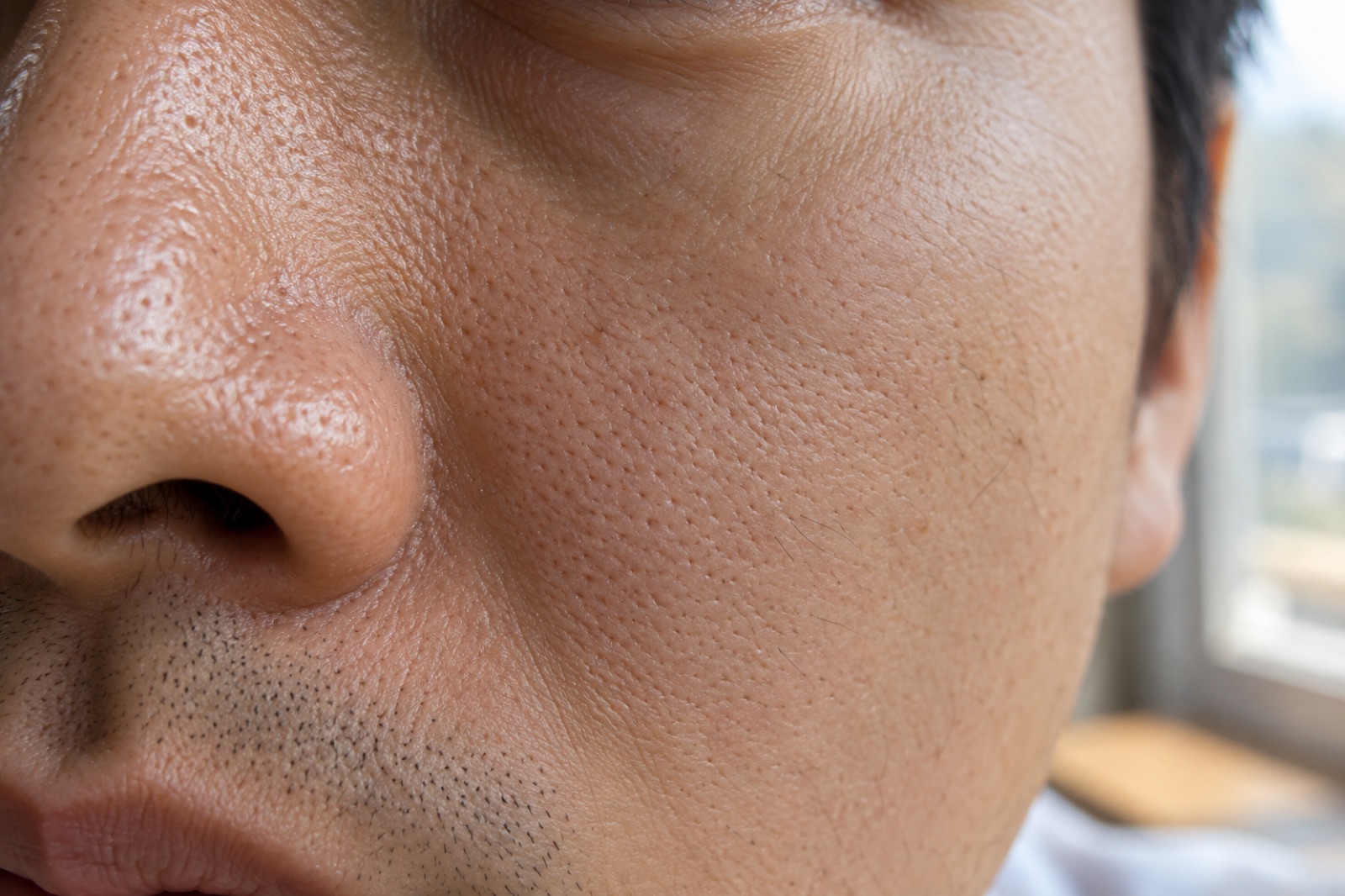
Even within one face, sebum, pH and barrier readings come out differently from area to area. A 2004 study that measured the forehead, cheeks, nose, nasolabial fold (the crease from the nose to the corner of the mouth) and chin of healthy Japanese women in winter found the most sebum and the lowest surface pH on the nose, while barrier function, judged by TEWL, was best on the cheeks and lower on the nasolabial fold and chin.
In a 2018 study that wiped sebum off the forearm, chest and forehead of 10 healthy adults and then analyzed the outer skin layer (stratum corneum), the more sebaceous glands an area had, the significantly higher its cholesterol sulfate and squalene were. The only face area in that study was the forehead, though, so it is not a direct comparison of the forehead and cheeks. What makes skin produce more oil is covered in our guide to an oily face.
Do different areas of the face react differently to cleansers and acids?
Reactions differed by area too, and the result from one area could not stand in for another. In a 1997 lab evaluation that exposed outer skin layer samples from 6 body sites of 20 young adults to water, 1% SLS and 5% soap solutions, the back of the hand and inner forearm reacted least, and the neck, forehead, back and top of the foot reacted most.
In a 2003 study that applied 10% lactic acid for 8 minutes to the nasolabial fold, forehead, chin and cheek of 45 volunteers, the people who felt stinging on the nasolabial fold and the people who felt it on other areas such as the forehead did not fully overlap, and the researchers wrote that a response on the nasolabial fold may not necessarily predict responses on other areas of the face. Both were small studies using test substances, so they may differ from how real cosmetics feel in use.

Does one product give the same results on the T-zone and cheeks?
Even in a study that applied the same gel to the whole face, the measurements split by area. In a 2022 randomized, double-blind trial, 24 adults with high facial sebum (seborrhea) applied a chitosan nanoparticle gel or a placebo twice a day for 4 weeks; at week 4, T-zone sebum was lower than with placebo (p=0.043), but the U-zone (cheeks) showed no difference, and skin hydration and TEWL showed no difference at any time point. These are readings for that one gel, and this article’s evidence includes no study comparing different products on different areas with the same product on both.
Feeling sensitive also depends on the area. In a survey of 1,039 members of the general public, 68.4% said they had some degree of sensitive skin, and the face was highest at 77.3% (self-reported). The skin care advice in the acne guideline from the UK’s National Institute for Health and Care Excellence (NICE) is addressed to people with acne and says only to use a non-alkaline (skin pH neutral or slightly acidic) synthetic detergent cleanser twice a day; it does not address face areas or combination skin separately, and it is not advice for combination skin without acne.
Face-zone measurement studies at a glance
This table lines up, study by study, which areas were measured, what was measured, and how far each result carries over to questions about combination skin. All of them involved a few dozen people or relied on self-reports.
| Study (year · people · number) | What was measured | Results by area | Design and limits | How far it applies to combination skin questions |
|---|---|---|---|---|
| 2004 · 20 Japanese women | TEWL, hydration, sebum, pH | Most sebum and lowest pH on the nose; best barrier on the cheeks | Observational, winter only | Only that readings differ within one face |
| 2018 · 10 adults | Outer skin layer lipids | Cholesterol sulfate and squalene higher where sebaceous glands are dense | Forehead was the only face area | Not a direct forehead-cheek comparison |
| 1997 · 20 young adults | Reactivity to surfactants | Neck, forehead and others reacted most; back of hand and inner forearm least | Lab test, forehead was the only face area | Hard to carry forehead results over to cheeks |
| 2003 · 45 volunteers | Stinging from 10% lactic acid | Nasolabial fold reactors and other-area reactors did not fully overlap | Subjective sensation, 8 minutes | One area can’t gauge the whole face |
| 2022 · 24 adults with high sebum | Sebum, hydration, TEWL | Only T-zone sebum lower than placebo (p=0.043) | 4-week placebo-controlled, one gel | Not a comparison of different products by area |
| 2009 · 1,039 members of the public | Perceived sensitivity | Face highest at 77.3% | Self-reported | Basis for describing complaints area by area |
When to see a dermatologist
If any of these apply, see a dermatologist instead of trying to re-guess your skin type.
- Burning and flaking on your cheeks or around your mouth has gone on for several weeks
- Painful red bumps keep coming up in the same spot even when you don’t touch them
- Red swelling or itching doesn’t settle even after you stop a cosmetic you recently started
- Your skin is keeping you from sleeping or making you avoid going out
Frequently asked questions
What's the difference between combination skin and oily skin?
'Combination skin' is an everyday term that the official sources this article checked do not define, so we found no recognized standard for where oily skin ends and combination skin begins. People usually call skin oily when the whole face gets shiny, and combination when it differs by area, such as a shiny forehead and nose with tight cheeks. Studies that measured the nose, cheeks and chin separately also got different readings for each, so the difference is best read as 'it varies by area.'
Why is only my T-zone oily?
Sebum measures differently from area to area even within one face, and in the measurement study this article looked at, the nose had the most sebum. In a 2018 study comparing the forearm, chest and forehead of 10 healthy adults, areas with more sebaceous glands had significantly more squalene, a sebum-type lipid, in the outer skin layer. These studies do not explain, though, why the gap between the T-zone and the cheeks is bigger in some people than in others.
Is it combination skin if my forehead is oily but my cheeks and temples feel normal?
Many people would call it that, but the sources this article checked contain no recognized rule for how many areas have to be a certain way for skin to count as combination. Instead of assigning a type name, the studies measured sebum, transepidermal water loss and irritation responses separately for each area. Rather than settling on a name, it is more accurate to describe what you feel in each area as it is, such as 'shiny forehead, tight cheeks.'
What are the best products for combination skin?
The sources this article checked can't answer that. There are studies that measured the face area by area, but none in this article's evidence compared using different products on the T-zone and cheeks with using the same product on both. Even in a trial that applied the same gel to the whole face, a result that differed from placebo appeared only in the T-zone, which shows how hard it is to carry the result from one area over to the whole face.
Is my skin dry or oily if my cheeks feel tight but my nose gets oily?
Studies don't judge a face like this with one word; they measure the nose and the cheeks separately with instruments. Because sebum on the nose and barrier readings on the cheeks come out differently even on the same face, putting it under either one name hides what is happening in the other area. How to gauge your skin type at home is covered separately in TroubleNote's guide to telling skin types apart.
Can combination skin change with the seasons?
The studies in this article can't settle that. The 2004 study that measured sebum and barrier function by face area did so only in winter, and the other studies looked at a single point in time or at changes within 4 weeks. The evidence includes no results from measuring the same people again in each season, so whether summer readings would match winter ones is unknown.
Why are my cheeks red when my T-zone is oily?
There are studies showing that irritation responses differ by area, but they can't pin down why one person's cheeks turn red. In a survey of 1,039 members of the general public, 77.3% said their face was sensitive, and in a 10% lactic acid stinging study, the areas that reacted differed from person to person. If redness doesn't settle easily, or burning and flaking keep coming with it, see a dermatologist to find the cause.
Why do I only have blackheads on my nose?
The studies this article looked at did not count pores or blackheads; about the nose, they only say it was the area where the most sebum was measured. How the oiliest areas relate to the areas where pores stand out is outside this article's evidence. Why pores can look more noticeable is covered separately in TroubleNote's pore care guide.
Sources
- Distinct locational differences observable in biophysical functions of the facial skin: with special emphasis on the poor functional properties of the stratum corneum of the perioral region (2004, PMID 18494917)B
- Influence of the sebaceous gland density on the stratum corneum lipidome (2018, PMID 30065281)B
- Regional differences in stratum corneum reactivity to surfactants. Quantitative assessment using the corneosurfametry bioassay (1997, PMID 9455629)B
- Facial variations in sensory responses (2003, PMID 14996043)B
- The Efficacy and Safety of Chitosan on Facial Skin Sebum (2022, PMID 34348343)A
- How do perceptions of sensitive skin differ at different anatomical sites? An epidemiological study (2009, PMID 19719761)B
- Biometric Evaluation of Baumann Skin Typing (2026, PMID 41972945)B
- NICE guideline NG198 — Acne vulgaris: management, Recommendations 1.2 Skin care adviceInstitutional
We never use YouTube videos or community posts as evidence for facts. Editorial policy
Product information related to this article
Product information from the site operator (KW Cosmetic, maker of the SKIN9HARI brand).
Revive Therapy N.F Cream
₩28,000 (KRW)
The studies in this article did not test this cream, and there is no data that measured this cream zone by zone on the face. The confirmed facts are a 50 ml size, 4 ceramides and 5 types of hyaluronic acid, no added fragrance based on the full ingredient list, and a low-irritation test completed as a patch test under set conditions, so results vary from person to person. Its Korean product page places it as the last step, after the ampoule, with a little extra pressed onto areas that feel dry. For choosing your final moisturizing step after reading how face zones measure differently, the product we suggest is Revive Therapy N.F Cream.
- Cream with 4 ceramides (NP, NS, EOP, AP), 5 types of hyaluronic acid and D-panthenol, 50 ml
- No added fragrance
- Low-irritation formula
Product details
- Type and size
- Soft, cushiony cream, 50 mL (1.69 fl oz)
- Step in routine
- Step 4 of 4 · Moisturize, the last step
- How to use
- As the last step of your routine, squeeze out a small amount. Warm it slightly between your palms. Press gently over your face, working outward from the center. Use morning and night after your ampoule or serum step.
- Before you use
- Contains dimethicone (silicone) — this is not a silicone-free formula. If redness, swelling or itching occurs, stop using and consult a dermatologist.
Based on the official product page, checked 2026-10-02
Cosmetics do not diagnose, treat, cure or prevent any disease. Test results apply only to the stated conditions.