Why Is My Face So Oily? 5 Things to Know About Excess Sebum
Most facial oil is produced inside the skin and is influenced by hormones, so how often you wash is unlikely to control how much oil your face makes.
In this article8 sections
- Why is my face so oily?
- Does more oil mean more breakouts?
- Why is my nose so oily?
- Should you wash your face more often if it is oily?
- Can you squeeze or extract oil from your face at home?
- How much can oil-control skincare do?
- Checklist: 6 things to check before managing oily skin
- When to see a dermatologist
| Topic | What we know | Source |
|---|---|---|
| Where oil comes from | 80% to 85% of the palmitate and sapienate in sebum was made fresh inside the skin, and about 20% came from the blood | 2019 PMID 31092695 · A |
| Hormones | Several studies found that prescription pills acting on hormones lowered oil, so oil output is influenced by hormones | Sebum research summary · A |
| Link to pores | In 60 healthy adults, the correlation between oil output and pore size was 0.47 in men and 0.38 in women | 2006 PMID 17034515 · B |
| Oil and breakouts | Several studies found breakouts unchanged when oil went down, or breakouts down while oil stayed the same | Sebum research summary |
| How many have oily skin | Of 1,787 Chinese women, 25.6% described their own skin as oily | 2007 PMID 17250531 · B |
Why is my face so oily?
Most facial oil is produced by the oil glands inside the skin, and the amount is influenced by hormones. In one study, 80% to 85% of the main fatty acids in sebum were made inside the skin, and only about 20% came from the blood. Several studies in which prescription pills acting on hormones lowered oil point the same way. That is why wiping the surface is unlikely to control how much oil your face makes.
There is also observational research on what tends to come with oily skin. In a survey of 1,787 Chinese women, oily skin showed up together with a history of acne, irregular periods, and sensitive skin, and there was also a link with spicy and sweet foods. But the survey looked at one point in time, so it cannot tell what causes what.
Does more oil mean more breakouts?
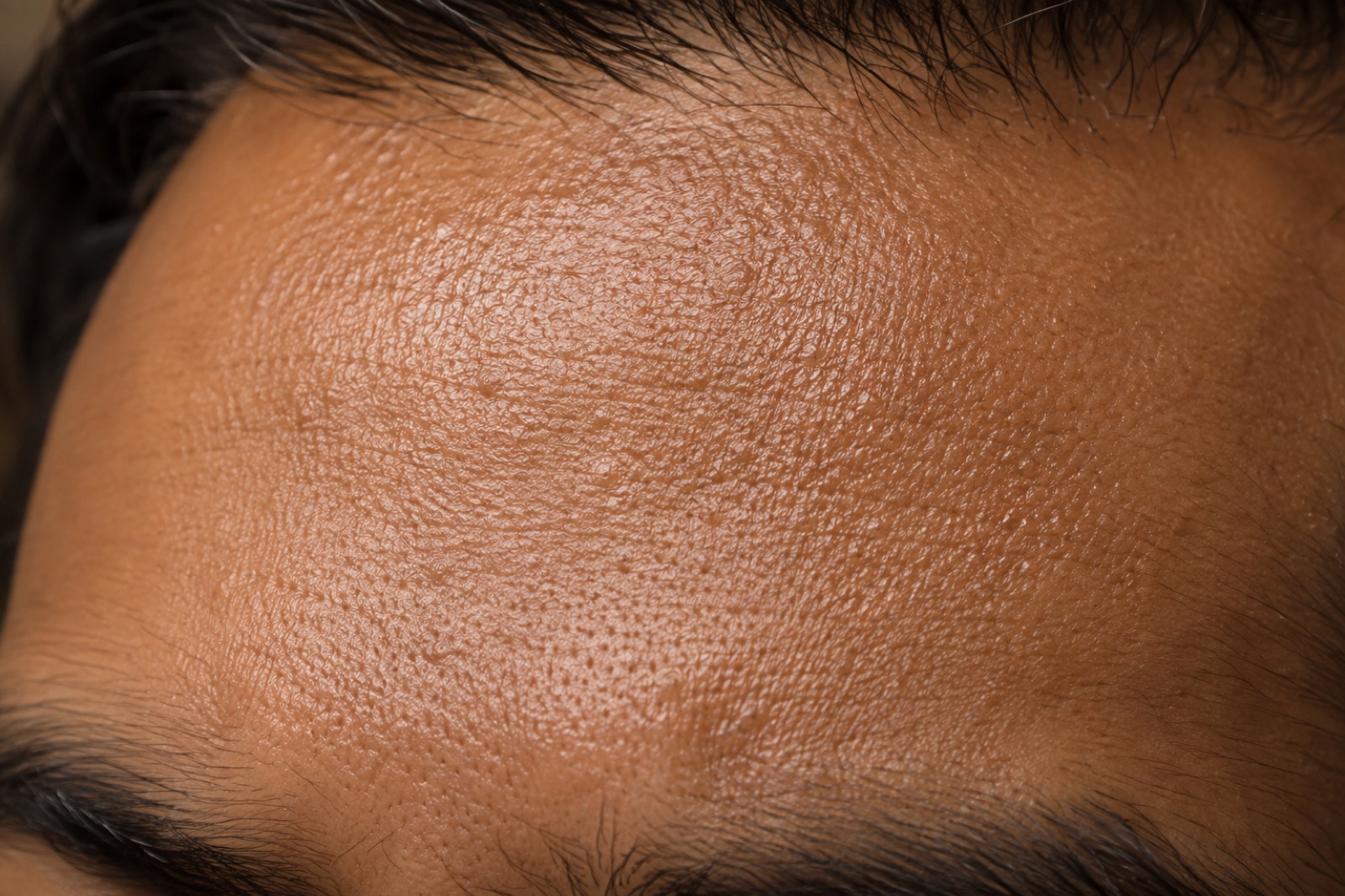
It is hard to say that having more oil alone leads to more breakouts. In a study of hormone pills, cheek oil dropped 60% more than with placebo, yet the number of breakouts was no different. Other studies found the reverse, with breakouts going down while oil stayed the same, so less oil and fewer breakouts often move separately.
Oil was linked to how large pores look. In a study of 60 healthy adults, people with more oil, and men, had larger pores, while acne severity was not linked to pore size. To tell whether a dark dot on your nose is a blackhead or a sebaceous filament, see our blackhead causes article.
Why is my nose so oily?
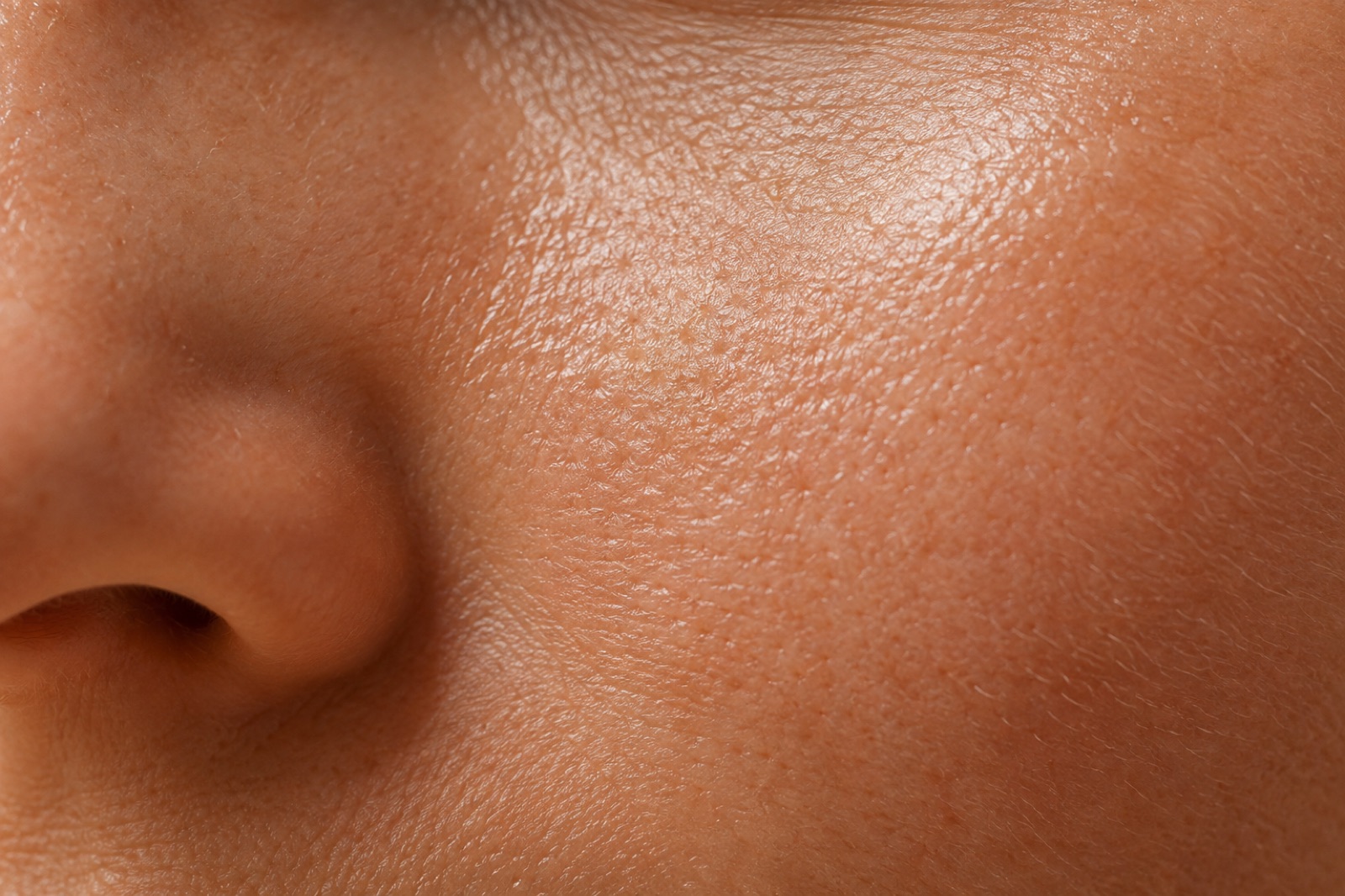
The nose is one of the oiliest parts of the face, so shine and pores show up there first. In an observational study that analyzed images of 19 people with oily skin, larger pores were more noticeable on the cheeks, and more oil on the nose. This matches the 60-person study where more oil went with larger pores, but both were small studies that looked at a single point in time.
Caring for an oily nose follows the same rules as the rest of the face. Health organizations advise washing gently up to twice a day and not squeezing or scrubbing. First figure out whether the dots on your nose are blackheads clogging pores or sebaceous filaments, and if the oil glands on your nose stand out and you are thinking about a procedure, a dermatologist can give you an accurate answer.
Should you wash your face more often if it is oily?
There is no evidence that washing more solves oily skin, and health organizations recommend washing up to twice a day. The NHS advises against washing more than twice a day and suggests lukewarm water and a gentle cleanser. In a trial where men with acne washed once, twice, or four times a day, there was no overall difference between the groups, and non-inflamed breakouts went down in the twice-a-day group.
The downside of washing too much is clearer. In a trial where 25 healthy people washed three times a day for 4 days, all five cleansers increased water loss from the skin and lowered moisture in the outer skin layer. One 21-person study found that oil went back up during a break from a strong cleanser, but it is a single study, so it is hard to draw a firm conclusion. Our how many times to wash your face article covers how often is right.
Can you squeeze or extract oil from your face at home?
Our sources had no study on how well or how safely tools that squeeze or pull oil out at home work, and health organizations advise against squeezing yourself. The NHS explains that squeezing blackheads can make them worse and leave permanent scars. The American Academy of Dermatology (AAD) explains that extracting blackheads and whiteheads is a procedure done in a dermatologist’s office with special instruments, used when other methods have not worked.
How much can oil-control skincare do?
Some studies found lower oil readings after using a product, but most were small, with 20 to 111 people using it for 4 to 12 weeks. A 2% niacinamide moisturizer lowered the oil output rate more than placebo at weeks 2 and 4 in 100 Japanese people, but in 30 white participants there was no difference in output rate, and only the amount of oil on the skin surface went down. A toner with 6% guava extract lowered oil by 13.10% on the forehead and 21.43% on the nose after 21 people with oily skin used it for 28 days.
These results apply to that product, at that strength, for that length of time, and cannot be carried over to other products with the same ingredient. It has not yet been shown whether lower oil lasts past 12 weeks of use, or whether lowering oil means fewer breakouts. Claims that a product shrinks oil glands are not backed by studies of skincare applied to the skin either. If your skin feels oily on the surface but tight underneath, see our toner for oily, dehydrated skin article.
Checklist: 6 things to check before managing oily skin
| What to check | Standard | Source |
|---|---|---|
| How often you wash | Up to twice a day, lukewarm water and a gentle cleanser | NHS · face-washing RCT |
| Scrubbing | Avoid scrubs and hard rubbing | AAD and NHS advice |
| Squeezing and tools | Don’t squeeze or extract at home | AAD and NHS advice |
| Sheet masks | Don’t leave them on too long (oil rose after 40 minutes) | 2024 PMID 38951050 |
| New products | One at a time, compared under the same conditions for at least 4 weeks (stop if it irritates) | Product studies ran 4 to 12 weeks |
| Notes | Days and areas with the most shine, and your menstrual cycle | To check for hormone effects |
When to see a dermatologist
- If you notice more breakouts along with oiliness, plus hair loss, more facial hair, or irregular periods, see a doctor. The AAD says this combination can be a sign of polycystic ovary syndrome (PCOS) and recommends an exam by a dermatologist or primary care doctor.
- If red flaking and itching keep coming back beside the nose, on the eyebrows, or on the scalp, it may be a different skin condition, so consider seeing a dermatologist.
- If painful, pus-filled breakouts keep coming back or scars start to form, consider seeing a dermatologist.
Frequently asked questions
Does washing your face more often make it oilier?
The evidence is weak. In a half-forehead study of 21 people, oil went back up 48 hours after they stopped using an SLES cleanser, but that is one small study. What is clearer is that washing three times a day increased water loss from the skin, so washing more than twice a day is not recommended.
How can I reduce sebum production on my face?
Most facial oil is produced inside the skin and is influenced by hormones, so washing or wiping alone is unlikely to control how much you make. Studies that found lower oil readings after using a product were small, with 20 to 111 people over 4 to 12 weeks, and apply only to that product at that strength.
Do I need to take care of my pores if my nose gets oily?
The nose is an oily area, and in a study of 60 people, those with more oil had larger pores. But the NHS says squeezing at home can make things worse and leave scars. Wash gently and don't scrub as your baseline, and leave blackhead extraction to a dermatologist.
Why do I break out when I use powder or blotting paper?
Our sources had no study testing whether blotting paper or powder is linked to breakouts. If you use them, pressing lightly instead of rubbing fits the American Academy of Dermatology (AAD) advice not to scrub. To see whether a product is the cause, drop one at a time and keep notes.
Does sebum cause acne?
Oil alone doesn't explain it. In one study, cheek oil fell by 60% but the number of breakouts was no different from placebo, and in other studies breakouts went down while oil stayed the same.
Does leaving a sheet mask on longer help with oil?
One study found the opposite. With all three sheet masks tested, oil went up after wearing them, most clearly after 40 minutes, and dryness became more noticeable when a purified-water mask was left on for more than 25 minutes.
Sources
- Human sebum requires de novo lipogenesis, which is increased in acne vulgaris and suppressed by acetyl-CoA carboxylase inhibition (2019, PMID 31092695)A
- Sebum output as a factor contributing to the size of facial pores (2006, PMID 17034515)B
- Effect of a desogestrel-containing oral contraceptive on the skin (2000, PMID 11245552)A
- Use of Advanced Imaging Techniques for the Characterization of Oily Skin (2019, PMID 30971936)B
- Oily skin: specific features in Chinese women (2007, PMID 17250531)B
- The effect of 2% niacinamide on facial sebum production (2006, PMID 16766489)A
- Anti-sebum efficacy of guava toner: A split-face, randomized, single-blind placebo-controlled study (2019, PMID 30964238)A
- Effect of a botanical cleansing lotion on skin sebum and erythema of the face: A randomized controlled blinded half-side comparison (2019, PMID 30022595)A
- A single-blinded, randomized, controlled clinical trial evaluating the effect of face washing on acne vulgaris (2006, PMID 17014635)A
- Short-term skin reactions and changes in stratum corneum following different ways of facial sheet mask usage (2024, PMID 38951050)A
- AAD, Pimple popping: Why only a dermatologist should do itInstitutional
- NHS, Acne (reviewed 2026-09-22)Institutional
- NHS 111 Wales, Health A-Z: Acne (updated 2024-11-07)Institutional
We never use YouTube videos or community posts as evidence for facts. Editorial policy
Product information related to this article
Product information from the site operator (KW Cosmetic, maker of the SKIN9HARI brand).
Revive Therapy N.F Toner
₩29,000 (KRW)
- Mildly acidic toner (pH 5.5–6.5), 150 ml
- Contains niacinamide 2.0% and beta-glucan 1.0%
- Low-irritation formula
- Contains ethanol and fragrance ingredients (orange peel oil, lavender oil); check the full ingredient list
Product details
- Type and size
- Clear, water-light toner, pH 5.5–6.5, 150 mL (5.07 fl oz)
- Step in routine
- Step 2 of 4 · Tone, right after cleansing
- How to use
- After cleansing, pour a small amount onto a cotton pad or your palms. Sweep or press gently over your face and neck. Pat lightly until fully absorbed. Follow with Revive Therapy N.F Ampoule, then N.F Cream.
- Before you use
- Contains ethanol (3.0%) and fragrance, including the allergens linalool and limonene — this is not an alcohol-free formula. If redness, swelling or itching occurs, stop using and consult a dermatologist.
Based on the official product page, checked 2026-10-02
Cosmetics do not diagnose, treat, cure or prevent any disease. Test results apply only to the stated conditions.