Acne in Men: 5 Shaving, Washing, and Skin Care Habits to Change
For acne in men, start with three changes: wash gently twice a day, shave only after your beard and skin are fully wet, and use a moisturizer that won't clog pores.
In this article7 sections
- What causes acne in men?
- Is your razor causing acne on your chin and around your mouth?
- How should you change the way you wash your face?
- How should men choose skin care and moisturizer for acne-prone skin?
- What else should you do on workout days?
- Men’s acne: 5 habits to change
- When to see a dermatologist
| Topic | What the evidence says | Source |
|---|---|---|
| Sex differences | More common in males during the teen years and in females in adulthood | Acne · Institution (NIAMS) |
| Male hormones | Testosterone, which rises at puberty, is a main factor in teen acne. Oil glands make more oil than needed | Sebum · Institution (NHS) |
| Shaving | Use a sharp blade and shave gently after wetting skin well with soap and water | Acne · Institution (NIAMS) |
| Washing | Up to twice a day, plus after sweating. Avoid harsh soaps, astringents, and rough scrubs | Face washing · Institution (NIAMS, NHS, AAD) |
| Oil and pores | In 60 healthy adults, pore size correlated with oil output (men r=0.47, women r=0.38). Acne severity was not related to pore size | Sebum · B |
What causes acne in men?
Acne in men is most often linked to androgens such as testosterone, which rise from puberty and increase oil production. The NHS explains that oil glands react to hormones and make more oil than the skin needs, and this oil mixes with dead skin cells and clogs hair follicles. According to NIAMS, acne is more common in males in the teen years and in females in adulthood.
Lifestyle factors matter too. The AAD says that without treatment, boys’ acne can last into the early to mid-20s, and points to studies where smokers had more acne than nonsmokers and to stress making existing acne worse. The NHS notes that if both of your parents had acne, yours is more likely to start at an earlier age and be more severe.

Is your razor causing acne on your chin and around your mouth?
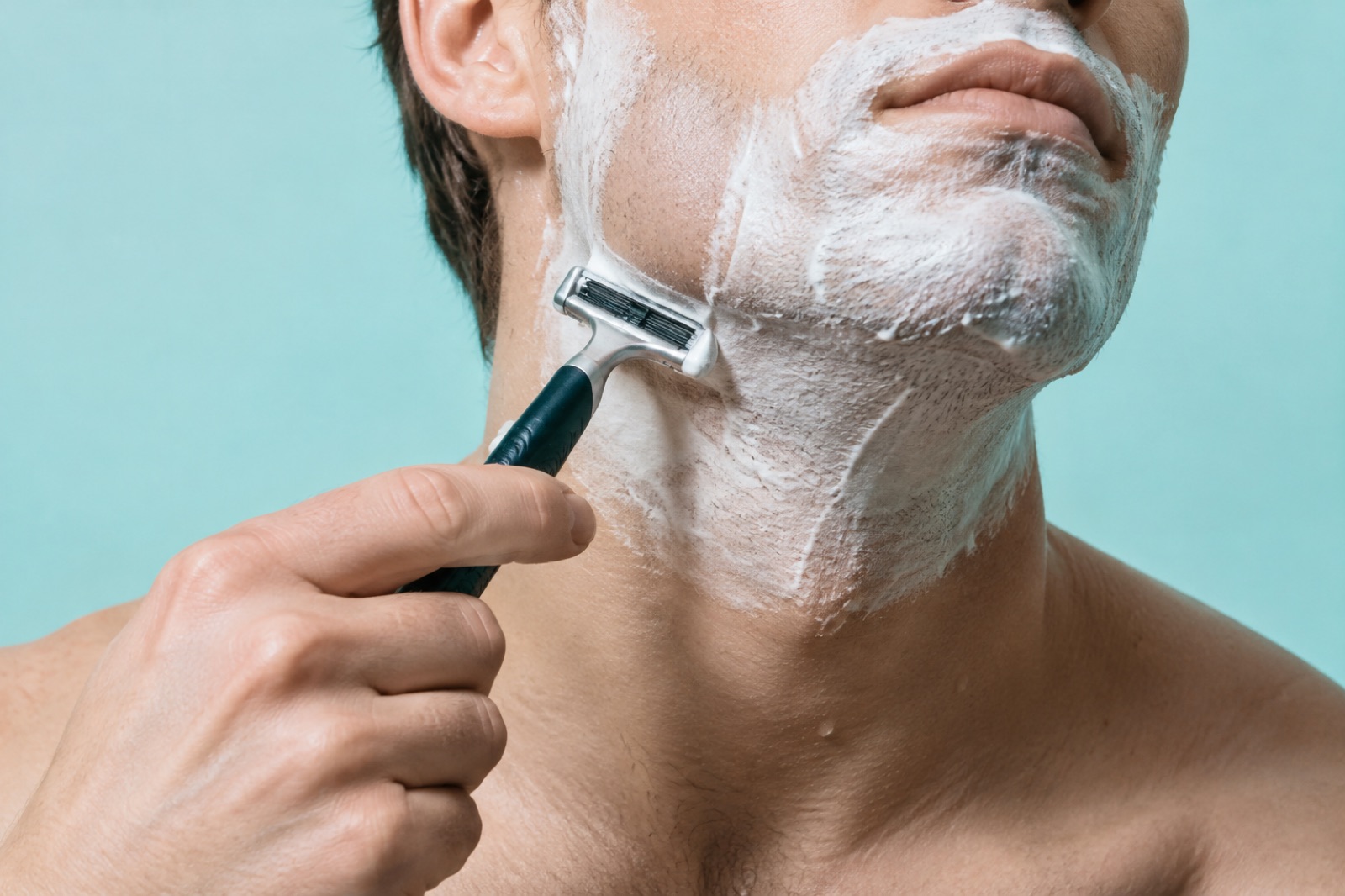
There’s no evidence that shaving is the only cause of chin acne, but shaving can irritate skin and damage follicles, so your technique is worth checking first. NIAMS advises people with acne to use a sharp blade and shave gently after wetting skin well with soap and water. Scraping over the same spot many times with a dull blade causes repeated friction there.
Bumps that pop up along the beard line after shaving may not be acne but a different problem in the hair follicle itself. The AAD says shaving is a common cause of this follicle damage and suggests pausing shaving for 30 days when shaving is causing it. If the bumps spread or you develop a fever during that break, don’t wait; see a doctor right away. Location alone can’t tell you the cause, so if it keeps coming back, use the guidance on when to see a doctor below.
How should you change the way you wash your face?
Health institutions agree: wash in the morning, at night, and after exercise, using lukewarm water, a gentle cleanser, and your fingertips. NIAMS says to avoid harsh soaps, astringents, and rough scrub pads, and the NHS explains that washing more than twice a day can actually irritate skin. NICE recommends a non-alkaline synthetic detergent (syndet) cleanser twice a day for acne-prone skin.
There’s also a trial that compared washing frequency in men with acne. The twice-a-day group had fewer non-inflamed spots, and the once-a-day group had more inflamed spots, but the overall difference among the 1, 2, and 4 times a day groups was not statistically significant. Sticking to twice a day, plus one extra wash on days you sweat, fits the evidence better than washing many times because your face feels greasy.
How should men choose skin care and moisturizer for acne-prone skin?
What matters is an oil-free, non-comedogenic label and a gentle formula, not a “for men” label. There is almost no research on cosmetics tested only in men, so we found no evidence that men’s products are a better fit. The AAD advises using alcohol-free products and avoiding harsh astringents and toners.
Skipping moisturizer is also worth rethinking. The AAD explains that when skin gets dry, it becomes irritated and the risk of acne can rise, and it recommends a moisturizer made for acne-prone skin. If large-looking pores bother you, it may help to know that in an observational study of 60 healthy adults, pore size was related to oil output but not to acne severity.
What else should you do on workout days?
After exercise, wash as soon as you can, and pat sweat away with a towel instead of rubbing. The NHS says to shower soon after exercise because sweat can irritate acne, and the AAD explains that rubbing hard with a towel is also irritating.
Your gear can play a part too. The AAD says gear that touches skin again and again, like helmets, chin straps, shoulder pads, and backpack straps, can trap heat and sweat and cause friction that leads to acne. The same organization recommends putting a clean, soft pad between the gear and your skin and wearing loose clothing that lets sweat escape.

Men’s acne: 5 habits to change
| What to change | Current habit | What institutions advise | Check |
|---|---|---|---|
| 1. Shaving | Dull blade, dry skin, many passes | Sharp blade, shave gently after wetting well (NIAMS) | □ |
| 2. Washing | 3+ times a day, harsh soap or scrubs | Twice a day plus after sweating, gentle cleanser and lukewarm water (NHS, NIAMS) | □ |
| 3. Moisturizing | Skipped because skin looks shiny | Thin layer of oil-free, non-comedogenic moisturizer (AAD) | □ |
| 4. Products | Strong alcohol-based toner or aftershave | Alcohol-free; avoid astringents (AAD) | □ |
| 5. Exercise | Just wipe off sweat and carry on | Wash as soon as you can; pad between gear and skin (NHS, AAD) | □ |
When to see a dermatologist
- If deep, painful acne keeps coming back on your chin or neck, or scars start to form, see a dermatologist.
- If bumps along your beard line keep returning even after about 30 days without shaving, have a dermatologist tell you whether it’s acne or another follicle problem.
- If it has spread beyond your face to your back or chest, consider seeing a doctor, as the NHS advises.
- If nothing changes after following the 5 habits above for 6 to 8 weeks, consider seeing a dermatologist.
Frequently asked questions
Do men need a special acne face wash?
Health organizations point to gentle products labeled oil-free and non-comedogenic, whoever they are marketed to. There is almost no cosmetics research done only in men, so we found no evidence that a 'for men' label makes a product a better fit.
Can I use face wash as shaving cream?
The evidence we used has no study comparing shaving cream with face wash. The US National Institute of Arthritis and Musculoskeletal and Skin Diseases (NIAMS) advises softening your beard with soap and water before applying shaving cream, then shaving gently with a sharp blade. What matters is being fully wet and not going over the same spot many times.
Can shaving cause acne?
There's no evidence that shaving is the only cause of chin acne, but shaving can irritate skin and damage hair follicles. Bumps that follow the beard line after shaving may be a follicle problem rather than acne, and when shaving is causing this follicle problem, the AAD suggests pausing shaving for 30 days. If the bumps are painful or spreading, see a dermatologist without waiting.
Should I shave before or after washing my face?
The evidence we used has no study comparing the order. NIAMS advises using a sharp blade and shaving gently after wetting your beard and skin well with soap and water. Shaving after you wash, while your skin is still wet, makes that advice easier to follow.
Should men moisturize their face?
The American Academy of Dermatology (AAD) explains that dry skin becomes irritated, which can raise the risk of acne. If your skin feels tight, apply a thin layer of an oil-free, non-comedogenic moisturizer, as health organizations advise.
How can men cover up acne?
Choose cover-up products by the same oil-free, non-comedogenic label, and take them off completely before bed, as the NHS and AAD advise. Cover-up techniques are covered in a separate article on makeup for breakouts.
Sources
- NIAMS — Acne: Diagnosis, Treatment, and Steps to TakeInstitutional
- NIAMS — AcneInstitutional
- NHS 111 Wales — Health A-Z: Acne (updated 2024-11-07)Institutional
- NHS — AcneInstitutional
- AAD — 10 skin care habits that can worsen acneInstitutional
- AAD — FolliculitisInstitutional
- AAD — Sports equipment and acneInstitutional
- NICE NG198 — Acne vulgaris: management, RecommendationsInstitutional
- A single-blinded, randomized, controlled clinical trial evaluating the effect of face washing on acne vulgaris (2006, PMID 17014635)A
- Sebum output as a factor contributing to the size of facial pores (2006, PMID 17034515)B
We never use YouTube videos or community posts as evidence for facts. Editorial policy
Product information related to this article
Product information from the site operator (KW Cosmetic, maker of the SKIN9HARI brand).
Revive Therapy N.F Cream
₩28,000 (KRW)
The NICE cleanser advice and the AAD guidance on alcohol-free products and moisturizing cited here did not test this cream, so they are not evidence for it. Revive Therapy N.F Cream is a 50 ml cream with four ceramides and five types of hyaluronic acid, with no added fragrance per its full ingredient list and a low-irritation formula, but it has not been tested on men specifically or on freshly shaved skin. Its product page places it after the ampoule as the last step; skip any nicks from shaving. So you don't skip moisturizer just because your skin feels oily, the product we suggest for the finishing step after shaving and washing is Revive Therapy N.F Cream.
- Cream with 4 ceramides (NP, NS, EOP, AP), 5 types of hyaluronic acid and D-panthenol, 50 ml
- No added fragrance
- Low-irritation formula
Product details
- Type and size
- Soft, cushiony cream, 50 mL (1.69 fl oz)
- Step in routine
- Step 4 of 4 · Moisturize, the last step
- How to use
- As the last step of your routine, squeeze out a small amount. Warm it slightly between your palms. Press gently over your face, working outward from the center. Use morning and night after your ampoule or serum step.
- Before you use
- Contains dimethicone (silicone) — this is not a silicone-free formula. If redness, swelling or itching occurs, stop using and consult a dermatologist.
Based on the official product page, checked 2026-10-02
Cosmetics do not diagnose, treat, cure or prevent any disease. Test results apply only to the stated conditions.