How to Take Care of Acne: 7 Home Steps and When to See a Doctor
The basics of acne care are washing gently twice a day, using non-comedogenic products, and not picking, kept up for 6 to 8 weeks before you judge the results.
In this article6 sections
| Item | What to know | Evidence |
|---|---|---|
| Washing | Twice a day (morning and night), plus after sweating; gently, with a mild cleanser | AAD, NHS, NIAMS |
| Choosing products | Look for oil-free, non-comedogenic labels; avoid harsh products | AAD, NICE, NHS |
| No picking | Squeezing and picking raise the risk of scars, dark marks, and infection | AAD, NHS |
| How long to wait | 6 to 8 weeks for one approach; often 3 to 4 months to see clear improvement | AAD |
| Strength of evidence | Few studies directly test lifestyle care such as washing or diet | 2005 and 2018 systematic reviews (A) |
How much can you do for acne at home?
Home care is about cutting back on habits that make acne worse; deeper acne is a job for a doctor. The American Academy of Dermatology (AAD) considers mild acne, such as whiteheads, blackheads, and small pimples, suitable for self-care. It also notes that deep, painful acne or acne that leaves scars is hard to manage with store-bought products. The US National Institute of Arthritis and Musculoskeletal and Skin Diseases (NIAMS) explains that diet, stress, squeezing, and over-washing do not directly cause acne but can make it worse.
Many of the ingredients the AAD mentions for self-care (adapalene, benzoyl peroxide, azelaic acid, salicylic acid) are medicine ingredients. It is safer to talk with a pharmacist or dermatologist before using them. The 7 steps below focus on everyday habits, not on using acne medicine.
Does washing your face more often help acne?
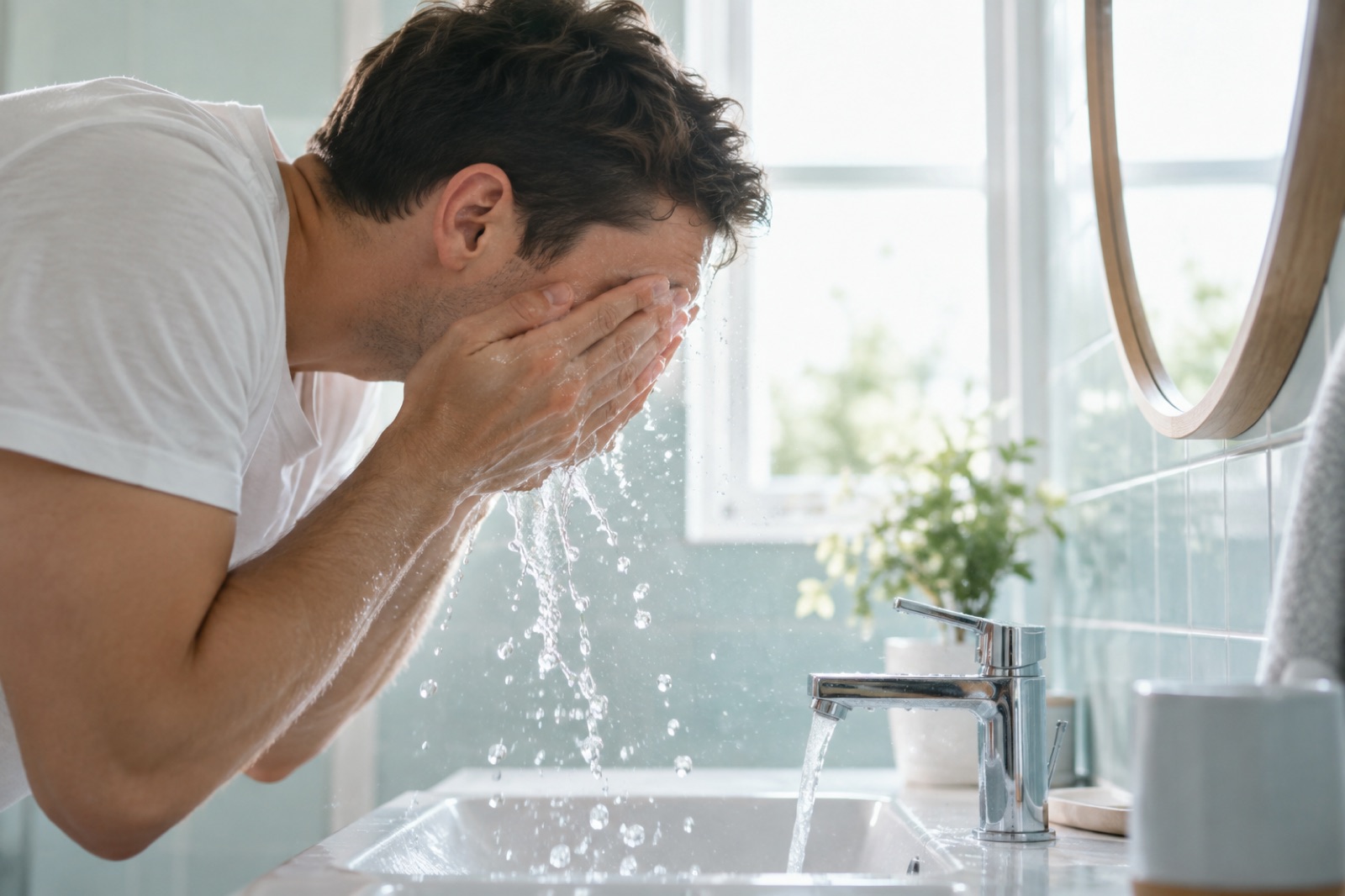
More washing is not better; twice a day is the standard. The UK’s NHS lists the belief that acne comes from poor hygiene as a myth and explains that most of the process behind acne happens beneath the skin. In a randomized trial that split men with acne into groups washing once, twice, or four times a day, the twice-a-day group had fewer non-inflamed lesions and the once-a-day group had more inflamed lesions, but the overall comparison across the three groups showed no significant difference (grade A). A review of 14 studies (671 people) on acne and washing also concluded that there were too few well-designed studies to make firm recommendations (grade A).
How should you choose products for acne-prone skin?
Health organizations recommend looking for oil-free, non-comedogenic labels. Still, the AAD notes that some products with these labels can cause acne, and our sources include no study that directly tests whether the label actually reduces acne. The AAD also advises using alcohol-free products and avoiding harsh products such as astringents, toners, and exfoliants.
It is better not to skip moisturizer. In studies where people used a moisturizer alongside acne medicine, dryness and water loss were lower. In one trial, 100% of the group using a moisturizer were still following their care plan at week 4, compared with 70% of the group using medicine alone (100 people, used with a prescription medicine, grade A). There is still little evidence on whether moisturizer alone reduces breakouts.
Why do I keep getting acne when I’ve tried everything?
Some reasons the same care gives different results are things lifestyle cannot change. The NHS explains that if both of your parents had acne, you are more likely to get it earlier and more severely. It also notes that women can get acne from hormone changes right before a period or in early pregnancy, and that anyone can get acne from certain medicines such as steroids or lithium. If you suspect one of these factors, seeing a doctor is often quicker than only changing your habits.

7 steps for acne care at home: start today, check in 6 to 8 weeks
Many searches look for a quick fix, but what you can do at home is follow the steps below, one at a time, and watch for 6 to 8 weeks. If irritation starts or gets worse in the meantime, stop that product right away.
| Step | What to do | Evidence |
|---|---|---|
| 1 | Wash twice a day (morning and night), plus after sweating; no extra washes | AAD, NHS |
| 2 | Use lukewarm water and a mild cleanser, washing gently with your fingertips (no scrubs, no rubbing) | AAD, NIAMS, NHS |
| 3 | If your skin is dry, apply an oil-free, non-comedogenic moisturizer daily | AAD |
| 4 | Make SPF 30 or higher non-comedogenic sunscreen your last morning step | AAD |
| 5 | Remove all makeup before bed | NHS, AAD |
| 6 | Do not squeeze or pick, and keep your hands off your face | AAD, NHS |
| 7 | Add only 1 to 2 new products at a time, and keep notes for 6 to 8 weeks | AAD |
If your hair is oily, washing it more often is another habit the AAD recommends. The AAD also explains that changing your routine every week can irritate your skin and may even lead to more breakouts.
When to see a dermatologist
- If your acne is deep, painful, or leaves scars, see a dermatologist.
- If new breakouts keep appearing after 6 to 8 weeks of these 7 steps, consider seeing a dermatologist. Don’t wait that long if acne is painful, getting worse, or leaving scars.
- If pimples leave dark marks behind as they heal, talk with a dermatologist.
- If you are pregnant or planning a pregnancy, talk with a dermatologist before using any acne ingredients.
Frequently asked questions
How should you take care of acne day to day?
The basics that health organizations agree on are gentle washing twice a day, oil-free and non-comedogenic products, no squeezing or picking, and removing makeup before bed. The American Academy of Dermatology (AAD) says to change only one or two things at a time and wait 6 to 8 weeks before judging the results.
Can you take care of acne at home?
The AAD considers mild acne, such as whiteheads, blackheads, and small pimples, suitable for self-care. At home, the job is to cut back on habits that make acne worse. Deep, painful acne or acne that leaves scars is hard to manage with store-bought products and needs a dermatologist.
How do you get rid of acne overnight?
We found no method in our sources that makes a difference in one day. The AAD says you need to use one approach for at least 4 weeks, usually 6 to 8 weeks, before you can judge whether it works.
How often should you wash your face with acne?
Health organizations agree on washing twice a day (morning and night), plus after sweating, with no extra washes beyond that. The UK's NHS lists the belief that acne comes from poor hygiene as a myth and says washing too often can irritate the skin.
When should you see a dermatologist for acne?
The AAD advises seeing a dermatologist for acne that is deep, painful, or leaves scars. Even with mild acne, consider a visit if new breakouts keep appearing after 6 to 8 weeks of care.
Why do some people not get acne?
The NHS and the US National Institute of Arthritis and Musculoskeletal and Skin Diseases (NIAMS) describe family history, hormone changes such as puberty or the days before a period, and some medicines as factors that raise acne risk. Because some factors cannot be changed by skincare, the same habits can lead to different results.
Sources
- AAD, 10 skin care habits that can worsen acneInstitutional
- AAD, Acne: Tips for managingInstitutional
- AAD, Adult acne: How to treat it yourselfInstitutional
- AAD, How to get rid of acne that won't clearInstitutional
- NHS, AcneInstitutional
- NHS 111 Wales, Health A-Z: Acne (updated 2024-11-07)Institutional
- NIAMS, AcneInstitutional
- Clinical evidence for washing and cleansers in acne vulgaris: a systematic review (2018, PMID 29460655)A
- A single-blinded, randomized, controlled clinical trial evaluating the effect of face washing on acne vulgaris (2006, PMID 17014635)A
- Study of the usefulness of moisturizers on adherence of acne patients treated with adapalene (2014, PMID 24930436)A
We never use YouTube videos or community posts as evidence for facts. Editorial policy
Product information related to this article
Product information from the site operator (KW Cosmetic, maker of the SKIN9HARI brand).
Revive Therapy N.F Cream
₩28,000 (KRW)
None of the health-organization advice or moisturizer studies in this article tested this cream, so their findings cannot be carried over to it. Revive Therapy N.F Cream is a 50 ml cream with 4 ceramides and 5 types of hyaluronic acid, no added fragrance per its ingredient list and a low-irritation formula, but there is no non-comedogenic testing behind it and no test on acne-prone skin. Its product page places it last, after the ampoule. For step 3 of the seven, the daily moisturizer when your skin feels dry, the product we suggest is Revive Therapy N.F Cream.
- Cream with 4 ceramides (NP, NS, EOP, AP), 5 types of hyaluronic acid and D-panthenol, 50 ml
- No added fragrance
- Low-irritation formula
Product details
- Type and size
- Soft, cushiony cream, 50 mL (1.69 fl oz)
- Step in routine
- Step 4 of 4 · Moisturize, the last step
- How to use
- As the last step of your routine, squeeze out a small amount. Warm it slightly between your palms. Press gently over your face, working outward from the center. Use morning and night after your ampoule or serum step.
- Before you use
- Contains dimethicone (silicone) — this is not a silicone-free formula. If redness, swelling or itching occurs, stop using and consult a dermatologist.
Based on the official product page, checked 2026-10-02
Cosmetics do not diagnose, treat, cure or prevent any disease. Test results apply only to the stated conditions.