Back Acne Body Wash: 7 Things to Check and How to Wash Gently
For back acne, washing gently without scrubbing matters more than the ingredients in your body wash. A body wash also has a limit: it rinses off quickly, so it touches your skin only briefly.
In this article8 sections
- Can switching body washes change your back acne?
- Should you use a low-pH (mildly acidic) body wash, or is soap okay?
- Can you use a salicylic acid (BHA) body wash every day?
- Can you use exfoliating towels, shower puffs, or back brushes?
- What should you do about showering and clothes after a workout?
- What about back acne sprays and exfoliating body washes?
- Back acne body wash and washing checklist
- When to see a dermatologist
| Topic | What the evidence says | Source |
|---|---|---|
| Expert advice | The AAD advises avoiding harsh soaps, astringents, rough scrubs, loofahs, and back brushes on back breakouts, and using gentle, fragrance-free products | AAD back acne · Institution |
| Limits of rinse-off products | In a back-skin study of a medicated ingredient, a 5.3% leave-on foam lowered acne bacteria by 1.9 log at week 1, while an 8% wash did not lower them even after 2 weeks (19 people) | 2010 back study · B |
| pH vs soap | In a 3-month face-washing comparison, irritation occurred in 40.4% of the alkaline soap group and 1.8% of the mildly acidic syndet bar group (120 people) | Face-washing study · A (face only) |
| Shower timing | In a 2-week study of 23 men, trunk acne did not differ significantly between showering within 1 hour and waiting 4+ hours after exercise (p=0.84) | Exercise and sweat · A (small) |
| EU salicylic acid limits | Considered safe up to 2.0% in general cosmetics (other than rinse-off hair products) and up to 0.5% (total) in body lotion | SCCS opinion · Institution |
Can switching body washes change your back acne?
A body wash touches your back only briefly before it rinses away, so it is more realistic to change how you wash, what you wear, and how you handle sweat than to expect one body wash to change things. Most studies of back cleansers looked at medicated ingredients. With the same ingredient, a leave-on foam lowered acne bacteria, but a rinse-off wash still had not lowered them after 2 weeks. This small study suggests that short contact time may be one limit of rinse-off products.
The AAD notes that back skin is thicker than facial skin and suggests leaving a medicated foaming wash on for 2 to 5 minutes, but that is how you use a medicine. Whether you need that kind of ingredient is a question for a medical visit. An everyday body wash is best seen as a gentle way to get clean. The AAD says to give a back-acne routine 6 to 8 weeks before judging it, and that it usually takes 3 to 4 months to see the full effect.
Should you use a low-pH (mildly acidic) body wash, or is soap okay?
No study in our evidence compares the pH of body washes used on the back, but a face-washing study found less irritation with a mildly acidic cleanser. In a trial where 120 acne-prone people washed their faces for 3 months, irritation occurred in 40.4% of the alkaline soap group and 1.8% of the mildly acidic syndet bar group. Another measurement study, though, found a syndet bar more irritating than soap, so it is more accurate to say results depend on the product.
So judge by how your skin reacts rather than by a pH label alone. If your back feels tight, stings, or turns red after washing, switch to something milder. If breakouts increased while you were using a mildly acidic product, look first at scrubbing, sweat, clothing, and hair product residue rather than pH.
Can you use a salicylic acid (BHA) body wash every day?
No study sets how often to use a body wash with salicylic acid, so the rule of thumb is to use it only as often as your skin tolerates without stinging or dryness. In the US, a body wash labeled for acne with salicylic acid is an OTC drug, so follow the directions on its Drug Facts label. The EU Scientific Committee on Consumer Safety (SCCS) considered salicylic acid safe up to 2.0% in general cosmetics other than rinse-off hair products, and up to 0.5% in body lotion (total, including use as a preservative). If you layer a salicylic acid body lotion or pads on top of the body wash, the same ingredient adds up.
For acne caused by friction from sports gear, the AAD mentions products containing salicylic acid, and suggests wiping with salicylic acid pads when you can’t shower after a workout. On the other hand, if scratching or scrubbing has left your skin raw, it is safer to take a break. One experiment (grade B) found salicylic acid absorption increased sharply through damaged skin.
Can you use exfoliating towels, shower puffs, or back brushes?
Official advice is not to scrub or use a back brush when you have back acne. The AAD says to avoid rough scrubs, loofahs, and back brushes on back breakouts, and explains that rubbing or scrubbing can irritate skin and make acne worse. Lather the wash in your hands, gently wash the areas you can reach, and rinse the rest well with the shower spray.
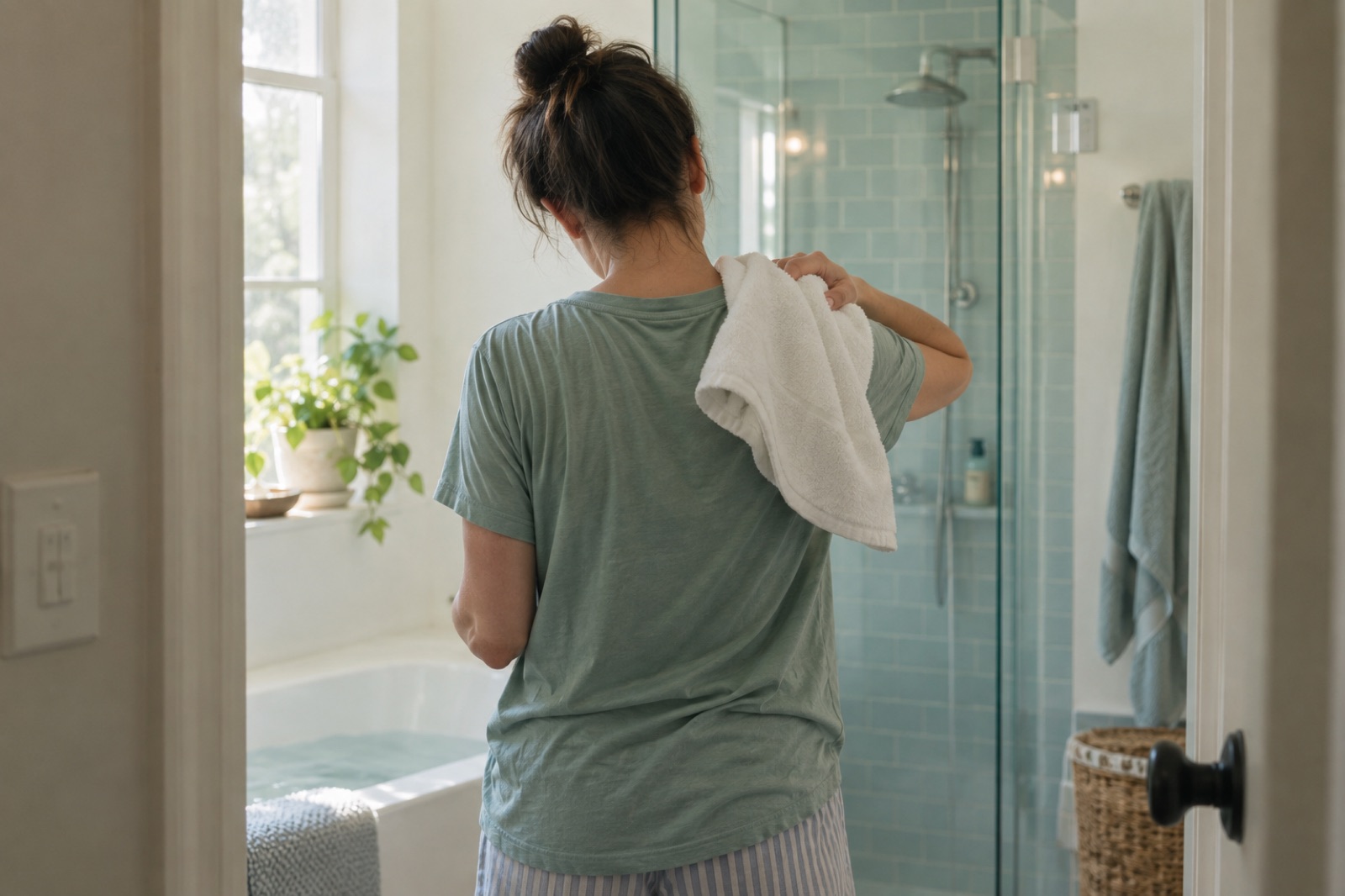
After your shower, pat your back dry with a towel instead of rubbing. That matches how the AAD suggests wiping away sweat during exercise. Oils from hair products can reach the back of your neck, so give your back one more rinse at the end to make sure no shampoo or conditioner lather is left.
What should you do about showering and clothes after a workout?
There is no evidence that you must shower within minutes of a workout, but institutions agree you shouldn’t stay in sweaty clothes for long. In a small trial, showering within 1 hour and waiting 4 or more hours made no significant difference. Even so, the NHS and AAD suggest showering and changing clothes as soon as you can after exercise.
The AAD recommends loose workout clothes that wick sweat away, washing workout clothes after every wear, and cutting down on things that rub your back, like backpacks. On days your back is exposed, it also recommends a sunscreen that is SPF 30 or higher, water-resistant, and non-comedogenic, because sun can make breakouts last longer. For possible causes, see back acne causes.
What about back acne sprays and exfoliating body washes?
Our evidence has no study comparing back acne sprays or exfoliating body washes, so look past the product name to two questions: does it stay on or rinse off, and does it repeat an ingredient you already use? A spray stays on your skin, so it deserves an even closer check than a body wash for the non-comedogenic and oil-free labels the AAD recommends for back breakouts. The SCCS salicylic acid opinion excluded sprays from its scope, so don’t apply those concentration limits directly to spray products.
Split exfoliating body washes into two kinds: physical scrubs with grains or beads, and washes that loosen dead skin with an ingredient. Since the AAD advises avoiding rough scrubs on back breakouts, it makes sense to pause grainy scrubs while your back is broken out. If you use a body wash with an exfoliating ingredient such as salicylic acid, check the full ingredient list to make sure it doesn’t repeat what’s in your spray, lotion, or pads, and cut back to one product if stinging or dryness starts.
Back acne body wash and washing checklist
| Check | What to look for | Source |
|---|---|---|
| 1. Fragrance and irritants | Fragrance-free and labeled as gentle | AAD back acne |
| 2. Salicylic acid | Whether it’s included, and whether it overlaps with lotions or pads | SCCS concentration limits |
| 3. How skin feels after | No tightness, stinging, or redness (this matters more than the pH label) | Face-washing studies · editorial rule |
| 4. Washing tools | Your hands instead of exfoliating towels, loofahs, or back brushes | AAD back acne |
| 5. Rinsing | No shampoo or conditioner lather left on your back | AAD hair products (back of neck) |
| 6. After exercise | Change out of wet clothes right away; wash workout clothes after every wear | AAD |
| 7. How long to watch | Change one thing at a time and track it for 6 to 8 weeks | AAD |
When to see a dermatologist
- If nothing changes after 6 to 8 weeks of care, or deep, painful lumps appear, consider seeing a dermatologist.
- If small, noticeably itchy bumps spread over your back and upper chest, it may be Malassezia folliculitis. Have a dermatologist check.
- If each bump has a red ring around it, or bumps appeared a day or two after using a hot tub, read folliculitis vs acne and get checked.
- If marks stay dark or start to look sunken, talk to a dermatologist.
Frequently asked questions
Is a low-pH body wash better than soap for back acne?
The evidence we used has no study comparing body wash pH on the back. In a face-washing study, the mildly acidic cleanser caused less irritation, but another measurement study found a mildly acidic syndet bar more irritating than soap. Rather than trusting a pH label, check whether your skin feels tight, stings, or turns red after washing.
Should I scrub or exfoliate my back acne?
The American Academy of Dermatology (AAD) advises avoiding gritty scrubs on back breakouts. If you use a product that exfoliates chemically, such as one with salicylic acid, use it only as long as it doesn't sting or dry you out, and pause it on scratched or peeling skin. One experiment found salicylic acid absorption rose sharply through damaged skin.
Can shampoo or conditioner cause back acne?
The AAD says oils in hair products can be linked to breakouts along the hairline and the back of the neck. No study has checked this on the back itself, but giving your back one extra rinse at the end of your shower, so no shampoo or conditioner is left on it, is an easy thing to try.
Do back acne sprays work?
The evidence we used has no study testing back acne sprays. Because a spray stays on your skin instead of rinsing off, check for a non-comedogenic or oil-free label (as the AAD advises) and make sure it doesn't repeat the same active ingredient as your body wash or lotion.
Can I use the same body wash for acne on my back and chest?
Use the same checks for both. In a study of 965 people with acne, chest and back acne severity were closely related. No study has compared using separate body washes for each area.
Can kids use a salicylic acid body wash?
The EU Scientific Committee on Consumer Safety (SCCS) concluded that for children aged 3 to 10, the current allowed levels are not safe when salicylic acid comes from several products at once. If you share a body wash with young children, check the full ingredient list.
Sources
- AAD — Back acne: How to see clearer skinInstitutional
- AAD — Is your workout causing your acne?Institutional
- AAD — 10 skin care habits that can worsen acneInstitutional
- NHS — Acne (reviewed 2026-09-22)Institutional
- NHS 111 Wales — Health A-Z: Acne (updated 2024-11-07)Institutional
- SCCS — Opinion on salicylic acid (CAS 69-72-7) - Submission I (SCCS/1601/18)Institutional
- SCCS — Opinion on Salicylic Acid (CAS No. 69-72-7, EC No. 200-712-3) - Children's exposure (SCCS/1675/25)Institutional
- The influence of the regular use of a soap or an acidic syndet bar on pre-acne (1995, PMID 7622270)A
- A single-blinded, randomized pilot study to evaluate the effect of exercise-induced sweat on truncal acne (2008, PMID 18304176)A
- Efficacy of benzoyl peroxide (5.3%) emollient foam and benzoyl peroxide (8%) wash in reducing Propionibacterium acnes on the back (2010, PMID 20645523)B
- Prevalence and severity of facial and truncal acne in a referral cohort (2008, PMID 18561586)B
We never use YouTube videos or community posts as evidence for facts. Editorial policy
Product information related to this article
Product information from the site operator (KW Cosmetic, maker of the SKIN9HARI brand).
Revive Therapy N.F Cream
₩28,000 (KRW)
The body-wash checks and back-skin trials in this article have nothing to do with this cream: Revive Therapy N.F Cream is a face cream, and there is no data on using it on the back or body. It is a 50 ml cream with 4 ceramides and 5 types of hyaluronic acid; on fragrance, the first item on this article's checklist, it has no added fragrance per its ingredient list, and it is a low-irritation formula. Its product page places it last in a facial routine, after the ampoule. After your shower, once your face is washed too, the product we suggest for the final facial moisturizing step is Revive Therapy N.F Cream.
- Cream with 4 ceramides (NP, NS, EOP, AP), 5 types of hyaluronic acid and D-panthenol, 50 ml
- No added fragrance
- Low-irritation formula
Product details
- Type and size
- Soft, cushiony cream, 50 mL (1.69 fl oz)
- Step in routine
- Step 4 of 4 · Moisturize, the last step
- How to use
- As the last step of your routine, squeeze out a small amount. Warm it slightly between your palms. Press gently over your face, working outward from the center. Use morning and night after your ampoule or serum step.
- Before you use
- Contains dimethicone (silicone) — this is not a silicone-free formula. If redness, swelling or itching occurs, stop using and consult a dermatologist.
Based on the official product page, checked 2026-10-02
Cosmetics do not diagnose, treat, cure or prevent any disease. Test results apply only to the stated conditions.