Dark Spots on Buttocks: Pimple Marks or Friction? 4 Checks
Dark spots on the buttocks can be marks left by pimples or can be related to friction. The first step is to stop squeezing the spots and rubbing the skin.
In this article6 sections
| Item | What we know | Source |
|---|---|---|
| Studies on the buttocks alone | The sources for this article had no study on pigmentation of the buttocks alone | Hyperpigmentation research summary · evidence gap |
| Marks after breakouts | A flat color change left where acne used to be is more likely post-inflammatory hyperpigmentation than a scar | AAD on acne scars · institution |
| Touching raises the risk | Squeezing, picking or scratching raises the risk of inflammation, infection and hyperpigmentation | AAD on acne scars · institution |
| Friction and hair follicles | Frequent friction, tight clothing and skin rubbing against skin are common triggers of hair follicle damage | AAD on folliculitis · institution |
| Frictional melanosis | Pigmentation from repeated friction is studied as frictional melanosis (a trial of 40 patients with it on the forearms) | 2015 RCT · A |
What causes dark spots on the buttocks?
A good starting point is to ask two questions: was there a pimple in that spot, and is it an area that is always pressed and rubbed? The sources we reviewed had no study on the buttocks alone, but health organization guidance points to two recurring paths. One is marks left after pimples or folliculitis settle down. The other is repeated friction.
The American Academy of Dermatology (AAD) names frequent friction and rubbing, tight clothing, skin rubbing against skin, and shaving as common triggers of folliculitis. On the buttocks, clothing keeps rubbing against the skin as you sit and walk, so several of these triggers can add up. We cover the causes of the pimples themselves and how to tell them from folliculitis in butt pimples.
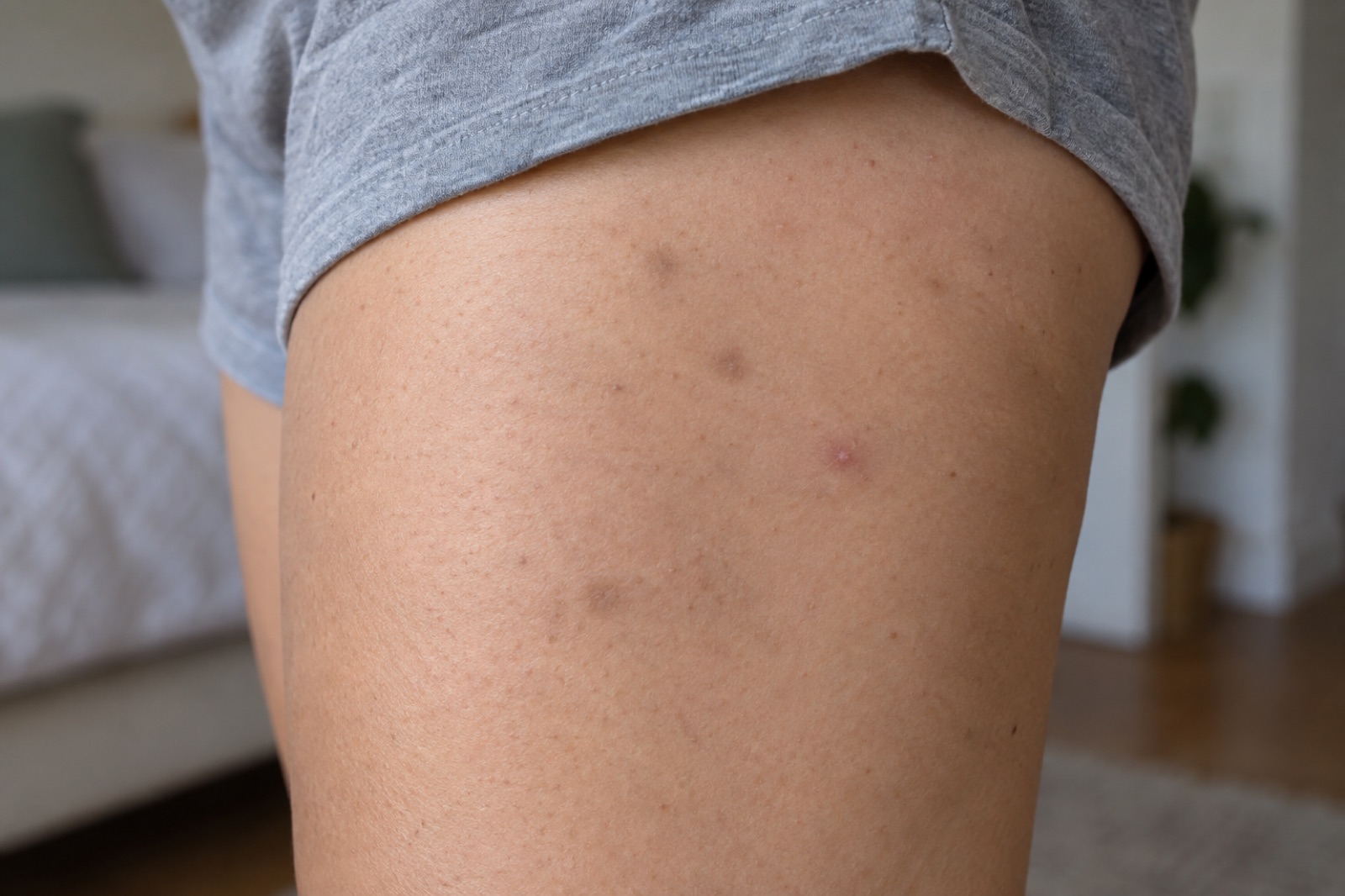
Butt acne marks: how are they different from scars?
Flat brown or dark marks left where pimples used to be are more likely post-inflammatory hyperpigmentation than pitted scars. The AAD explains that when a flat color change remains after acne clears up, it is likely post-inflammatory hyperpigmentation (PIH) rather than a scar. It also notes that darker skin tones are more likely to be left with hyperpigmentation after acne.
Touching marks can make things worse. The AAD says squeezing, picking or scratching raises the risk of inflammation, infection and hyperpigmentation. We explain how to tell marks from pitted scars in more detail in acne marks vs acne scars.
Can sitting for long periods or tight clothing cause it?
Friction can leave pigment behind, so if the color change is in an area that’s always rubbed, cutting down on friction comes first. Pigmentation from repeated friction is studied under the name frictional melanosis, and there is even a trial comparing two in-office peels in 40 patients with this pigment on their forearms. But the sources we reviewed had no study directly on sitting for long periods and pigment on the buttocks.
Health organization guidance points toward managing clothing and sweat. The AAD advises wearing loose clothing instead of tight clothing when it’s hot and humid, and changing clothes and showering right after exercise. Scrubbing hard with a rough towel or scrub also adds friction, so it’s better to wash gently and pat dry.

Creams for dark spots on the buttocks: what should you check first?
Before you choose something to apply, check whether new pimples keep appearing. If new breakouts continue, new marks keep forming too, so the AAD recommends dealing with acne early and consistently as the first step toward fewer scars and marks. The AAD also explains that there is no scientific evidence that cocoa butter evens out skin tone.
Creams that contain drug ingredients such as steroids or hydroquinone are for a doctor to decide on after finding the cause (in the US, hydroquinone is not sold over the counter). Rather than choosing one yourself and applying it for a long time, talk to a pharmacist or dermatologist first.
Checklist: 4 things to check for dark spots on the buttocks
| What to check | If this applies | First step |
|---|---|---|
| Where the mark started | A flat mark left where a pimple or folliculitis used to be | Don’t squeeze or scratch; cut down on new breakouts |
| Friction | An area that’s always pressed and rubbed, like where you sit or along underwear lines | Loose clothing; change out of sweaty clothes right away |
| Rubbing habits | Scrubbing hard with a rough towel or scrub | Wash gently and pat dry |
| How it spreads | Skin folds darkening over a wide area, or other body changes along with it | See a dermatologist to find the cause |
When to see a dermatologist
- If darkened skin spreads widely and comes with changes such as irregular periods, hair loss or more facial hair, see a doctor. The AAD notes that polycystic ovary syndrome can come with acne and darkened skin (acanthosis nigricans).
- If deep, painful lumps or pus keep coming back around the groin or buttocks, see a dermatologist.
- If marks keep increasing after several months of care, or you aren’t sure what they are, consider seeing a dermatologist.
- Once the cause is found, a doctor can decide whether you need a medicated cream at all.
Frequently asked questions
What causes dark spots on the buttocks?
The sources we reviewed had no study on the buttocks alone, but health organization guidance points to two recurring paths: marks left after pimples or folliculitis settle down (post-inflammatory hyperpigmentation), and repeated friction. The American Academy of Dermatology (AAD) names frequent friction, tight clothing and skin rubbing against skin as common triggers of hair follicle damage.
Can sitting for long periods cause dark spots on the buttocks?
The sources we reviewed had no study directly on sitting for long periods and pigment on the buttocks. But pigmentation from repeated friction is studied under the name frictional melanosis, so if the area is always pressed and rubbed, it's worth looking at your clothing and how long you sit.
Can I buy a cream for dark spots on my buttocks at the pharmacy?
Some creams contain drug ingredients such as steroids or hydroquinone (in the US, hydroquinone products can no longer be sold over the counter), so first confirm whether it's a mark or a different skin condition. At a pharmacy, tell the pharmacist where it is, when it appeared and how it has changed, and if the cause isn't clear, see a dermatologist first.
Do dark spots on the buttocks fade over time?
Our sources had no study on how butt marks change over time. The AAD describes flat color changes left where acne used to be as post-inflammatory hyperpigmentation rather than scars, and says squeezing or scratching raises the risk of hyperpigmentation. Cutting down on new pimples and leaving the area alone is the basic step.
Sources
- AAD — Acne scars: TreatmentInstitutional
- AAD — FolliculitisInstitutional
- AAD — How to clear acne in skin of colorInstitutional
- AAD — Adult acne: How to treat it yourselfInstitutional
- AAD — Is that stubborn acne really acne?Institutional
- Efficacy of 15% trichloroacetic Acid and 50% glycolic Acid peel in the treatment of frictional melanosis: a comparative study (2015, PMID 25949021)A
We never use YouTube videos or community posts as evidence for facts. Editorial policy
Product information related to this article
Product information from the site operator (KW Cosmetic, maker of the SKIN9HARI brand).
Revive Therapy N.F Cream
₩28,000 (KRW)
The AAD guidance and the forearm friction study cited here did not test this cream. Revive Therapy N.F Cream is a 50 ml face cream with 4 ceramides and 5 types of hyaluronic acid; it has no added fragrance and has been patch-tested for irritation, but there is no data on using it on the buttocks or elsewhere on the body, and no test has measured skin color. Its product page places it as the last step of a facial routine, after the ampoule. Separate from the checks for the buttocks, for the final moisturizing step after washing your face, the product we suggest is Revive Therapy N.F Cream.
- Cream with 4 ceramides (NP, NS, EOP, AP), 5 types of hyaluronic acid and D-panthenol, 50 ml
- No added fragrance
- Low-irritation formula
Product details
- Type and size
- Soft, cushiony cream, 50 mL (1.69 fl oz)
- Step in routine
- Step 4 of 4 · Moisturize, the last step
- How to use
- As the last step of your routine, squeeze out a small amount. Warm it slightly between your palms. Press gently over your face, working outward from the center. Use morning and night after your ampoule or serum step.
- Before you use
- Contains dimethicone (silicone) — this is not a silicone-free formula. If redness, swelling or itching occurs, stop using and consult a dermatologist.
Based on the official product page, checked 2026-10-02
Cosmetics do not diagnose, treat, cure or prevent any disease. Test results apply only to the stated conditions.