Ceramide Cream: How to Choose It and 4 Checks If You Break Out
Studies of ceramide cream mostly measured hydration and barrier markers. If you break out easily, choose one based on how greasy it feels and what other ingredients it contains.
In this article8 sections
- What does ceramide do for skin when it’s in a cream?
- Is there evidence that ceramides cause acne?
- Why am I breaking out after using a barrier cream?
- Is an expensive barrier cream better than other moisturizers?
- Should you pick by ceramide type, like NP or EOP, or by amount?
- How to choose a barrier cream if you break out easily
- Barrier cream breakout log
- When to see a dermatologist
| Point | What the evidence shows | Source |
|---|---|---|
| Who was studied | Most ceramide cream studies had people with dry or sensitive skin, or barrier-related skin conditions, use finished products with many ingredients for 2 to 12 weeks | Ceramide studies · A |
| Repeated results | After use, hydration tended to go up and transepidermal water loss (TEWL) tended to go down | Ceramide studies · A |
| Compared with other moisturizers | Some randomized controlled trials found no difference from petrolatum or paraffin moisturizers | Ceramide studies · A |
| Alongside acne medicine | Some studies found less dryness and irritation during retinoid or isotretinoin use (all multi-ingredient finished products) | Ceramide studies · A |
| Non-comedogenic label | Not an official standard managed by regulators | Comedogenicity studies · A |
What does ceramide do for skin when it’s in a cream?
Ceramides are lipids that, along with cholesterol and fatty acids, fill the spaces in the outer skin layer, and ceramide cream studies mainly looked at whether barrier markers such as hydration and transepidermal water loss (TEWL) changed. Several studies of people using ceramide cream found that measured ceramide levels in the outer skin layer went up.
In numbers: in a study of 58 adults with a history of barrier-related skin conditions, TEWL went down from 38.02 to 29.79 g/m²/h, while a product with glycerin alone had no effect in the same study. In a study where 34 adults with dry skin or a tendency toward skin conditions applied creams to opposite sides for 4 weeks, the ceramide cream side reacted less to experimental irritation (SLS) than the paraffin cream side. On safety, the expert panel of the US Cosmetic Ingredient Review (CIR) concluded that 23 ceramides are safe in cosmetics at current use levels.
But these results mostly come from people with dry or sensitive skin, or a tendency toward skin conditions, using finished products with many ingredients. We don’t carry them over directly to breakout-prone facial skin.
Is there evidence that ceramides cause acne?
Our sources had no human study showing that ceramides cause acne. On the other hand, there is also no ingredient-level study confirming that ceramides don’t clog pores. Because most studies tested multi-ingredient finished products, results can’t be credited to or blamed on ceramides.
Studies linked to acne point in a slightly different direction. In 27 people taking isotretinoin, dryness, itching, and redness went down more with a ceramide moisturizer than with placebo, and during adapalene and benzoyl peroxide use, TEWL and dryness were better than in the control group. These studies looked at whether a moisturizer eased the dryness and irritation of acne medicine, not at whether a cream reduces breakouts.
Why am I breaking out after using a barrier cream?
If breakouts increase after you start a barrier cream, look at the whole cream rather than ceramides alone, and check the four points below in order.
The first is texture and oiliness. The UK’s NICE and the American Academy of Dermatology (AAD) advise people with acne-prone skin to avoid oil-based and comedogenic products and use ones labeled oil-free or non-comedogenic. Many of the products in barrier cream studies were formulas that add outer-layer lipids such as ceramides and cholesterol, and how greasy they feel varies from product to product.
The second is the other ingredients. Whether a substance forms comedones can be tested with occlusive patch tests on the skin of people’s backs (grade B), but there is no human evidence sorting out which cosmetic ingredients form comedones on the face. The fact that a cream contains ceramides alone doesn’t tell you whether it’s fine or a problem.
The third is timing. The AAD says acne caused by cosmetics can show up late, anywhere from a few days to up to 6 months. If you also changed your cleanser, sunscreen, or medicine around the same time, it’s hard to narrow down the cause.
The fourth is the gap between expectations and research. What ceramide cream studies repeatedly showed was barrier markers such as hydration; they don’t tell us whether existing breakouts calm down.
Is an expensive barrier cream better than other moisturizers?
Whether ceramide moisturizers beat other moisturizers varies from study to study. In a study of 39 children with a skin condition, there was no difference among a ceramide cream, a glycyrrhetinic acid cream, and a petrolatum moisturizer. In a study of 100 adults there was also no difference between groups in severity scores, and in a meta-analysis the mean difference in TEWL of -3.56 was not significant (P=0.17).
So if you break out easily, it’s more realistic to go by how greasy it feels and how your skin reacts than by whether it contains ceramides.
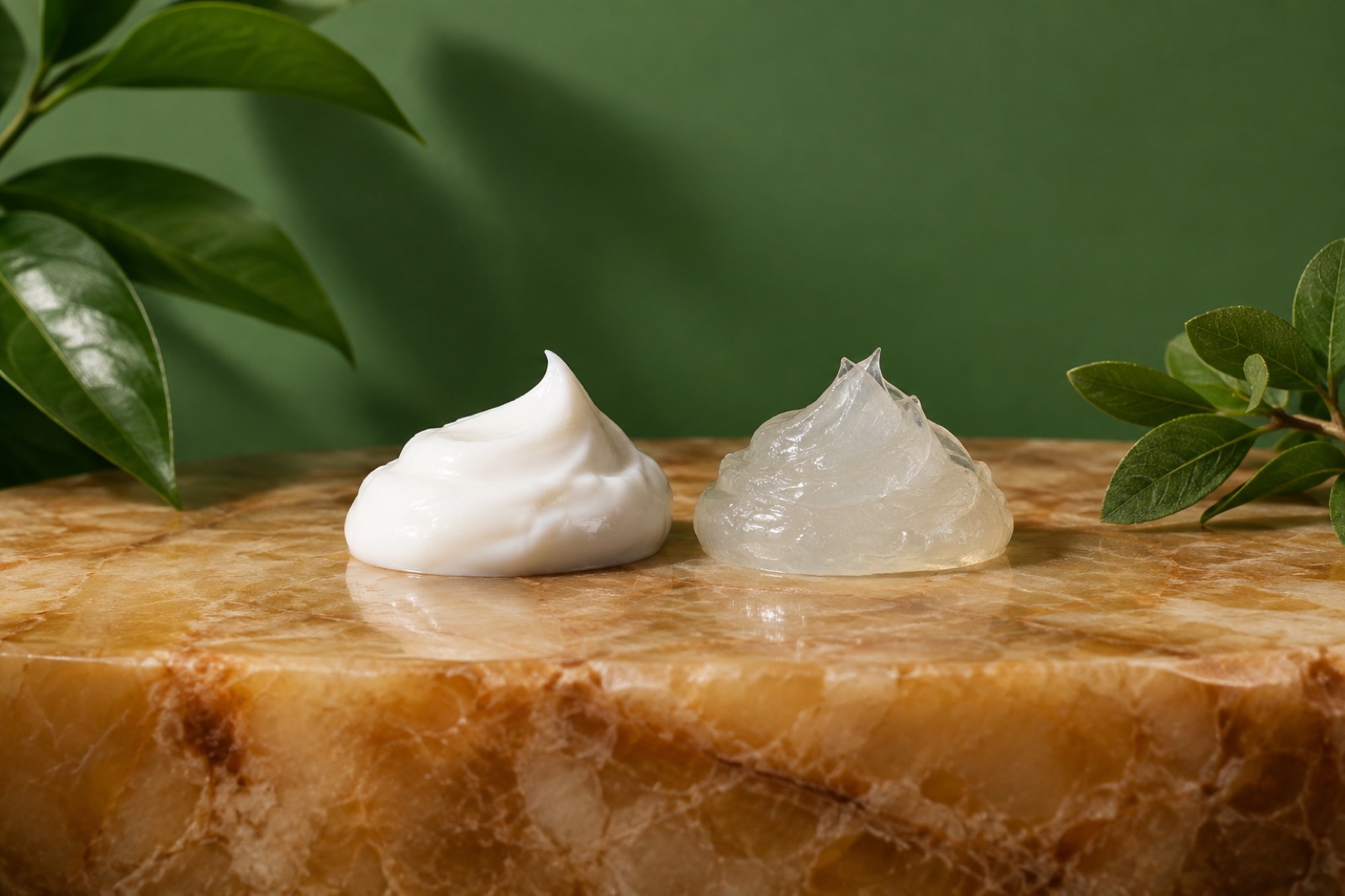
Should you pick by ceramide type, like NP or EOP, or by amount?
There is no human study yet that directly compares whether results differ by ceramide type (NP, AP, EOS, and so on), concentration, or the ratio of cholesterol and fatty acids. The sources we reviewed include just one study, a retinol patch test that compared two ceramide-plus-cholesterol formulas. So there isn’t enough evidence to rank creams just by the number of ceramide types on the ingredient list.
Consider ingredients listed as “pseudo-ceramide” or “ceramide-like” as different from ceramides, and don’t carry results over between them. If you break out easily, look first at how greasy the cream is, whether it’s labeled oil-free or non-comedogenic, and whether tiny bumps or shine show up after you apply it, before worrying about the type.
How to choose a barrier cream if you break out easily
The AAD advises people with acne-prone skin to choose a moisturizer labeled oil-free, non-comedogenic, or won’t clog pores, and to apply it while the skin is still slightly damp after washing. It also explains that if you are using acne medicine, using a moisturizer every day alongside it helps you tolerate the medicine.
But the non-comedogenic label is not a standard managed by regulators, so use it as a first filter and make the real decision with the log below.
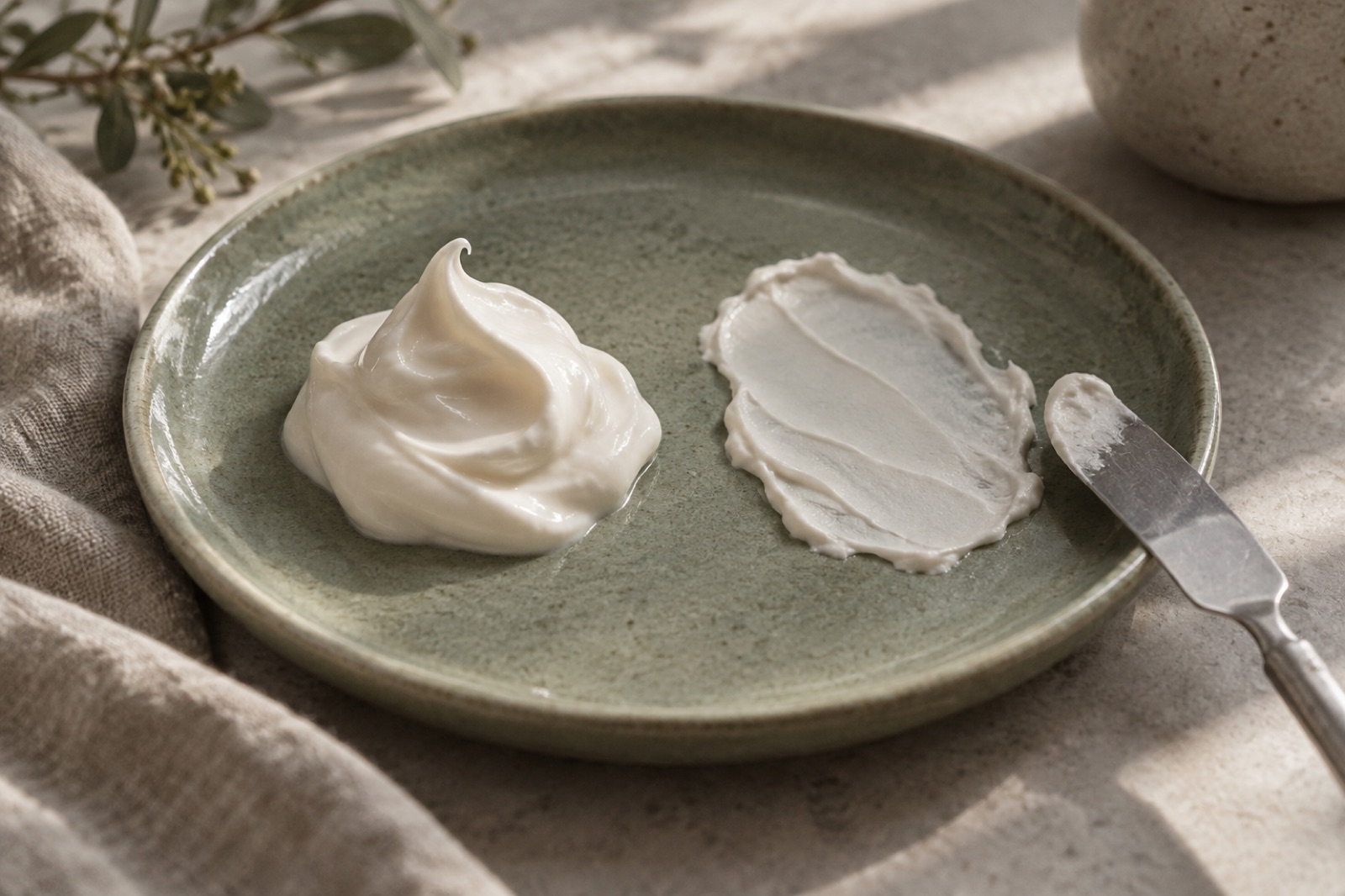
Barrier cream breakout log
| Check | What to write down | How to read it |
|---|---|---|
| 1. Texture and oiliness | Cream texture, shine after applying, whether it’s labeled oil-free or non-comedogenic | If it feels heavy and has no such label, suspect it first |
| 2. Other ingredients | Ingredients near the top of the list, oils and waxes | Record ingredients other than ceramides with equal weight |
| 3. Timing of changes | Date you switched creams, and any cleanser, sunscreen, or medicine you changed at the same time | Change only one skincare product at a time to narrow down the cause; don’t change or stop a prescription medicine on your own |
| 4. Breakout type and location | Tiny bumps or red pimples, and whether they overlap where you apply the cream | If they cluster where you apply it, stop that product and write it down |
When to see a dermatologist
- If breakouts keep increasing or spreading several weeks after you stop the cream, consider seeing a dermatologist.
- The AAD says deep, painful acne or acne that leaves scars is hard to manage with store-bought products. See a dermatologist.
- If itching, a red rash, or swelling appears where you applied it, stop using it and see a doctor.
- If dryness or irritation from acne medicine is too much to keep going, talk to the clinic that prescribed it.
- If you use a prescription medicine, decide how much to use and in what order with the doctor who prescribed it.
Frequently asked questions
What does ceramide do for your skin?
Ceramides are lipids that, along with cholesterol and fatty acids, fill the spaces in the outer skin layer. The repeated result in ceramide cream studies was a trend toward higher hydration and lower water loss through the skin, mostly in people with dry or sensitive skin, or a tendency toward skin conditions, who used finished products with many ingredients. These studies don't tell us whether existing breakouts calm down.
Can ceramides cause acne?
Our sources had no human study showing that ceramides cause acne, and no ingredient-level study confirming they don't clog pores either. Most studies tested finished products with many ingredients, so results can't be credited to or blamed on ceramides alone. If you break out, look at the whole cream, not just the ceramides.
What is a barrier cream?
It is a common name for a moisturizer that adds lipids found in the outer skin layer, such as ceramides and cholesterol, and many of the barrier creams in the studies we used were formulas like this. The name alone doesn't tell you the ingredients or how greasy it is, so check the ingredient list and how your skin reacts.
Are there side effects of ceramides?
The expert panel of the US Cosmetic Ingredient Review (CIR) concluded that 23 ceramides are safe in cosmetics at current use levels. But a cream is a finished product with many ingredients, so depending on the formula and other ingredients, breakouts or stinging can happen. If so, stop using it and write it down.
Can I use ceramide cream every day?
If you are using acne medicine, the American Academy of Dermatology (AAD) advises using a moisturizer every day alongside it. But there are no studies of healthy skin using it for months, and in studies where it was applied to the arms for 4 to 7 weeks, barrier measures got better or worse depending on the formula. Keep going while watching how your skin reacts.
I got tiny bumps after using a barrier cream. Should I keep using it?
If tiny bumps cluster where you applied the cream, stop that product and write down the dates and locations. If you changed other products around the same time, undo those changes one at a time, going back to what you used before, to narrow it down. Don't change a prescription medicine on your own.
Should I still moisturize while using acne medicine?
The AAD says acne medicine can dry out your skin, so it advises using a moisturizer every day alongside it. It recommends an oil-free, non-comedogenic moisturizer applied while your skin is still slightly damp after washing.
Sources
- Reducing the oral isotretinoin skin side effects: efficacy of 8% omega-ceramides, hydrophilic sugars, 5% niacinamide cream compound in acne patients (2018, PMID 29564872)A
- Ceramide-Containing Adjunctive Skin Care for Skin Barrier Restoration During Acne Vulgaris Treatment (2023, PMID 37276158)A
- An over-the-counter moisturizer is as clinically effective as, and more cost-effective than, prescription barrier creams in the treatment of children with mild-to-moderate atopic dermatitis: a randomized, controlled trial (2011, PMID 21533301)A
- The Efficacy of Moisturisers Containing Ceramide Compared with Other Moisturisers in the Management of Atopic Dermatitis: A Systematic Literature Review and Meta-Analysis (2023, PMID 37151263)A
- Clinical utility of marketing terms used for over-the-counter dermatologic products (2018, PMID 29671667)A
- AAD, Moisturizer: Why you may need itInstitutional
- AAD, Is it okay to wear makeup?Institutional
- NICE, Acne vulgaris: management (NG198)Institutional
- Topical supplementation with physiological lipids rebalances the stratum corneum ceramide profile and strengthens skin barrier function in adults predisposed to atopic dermatitis (2025, PMID 40408261)A
- Enhancement of stratum corneum lipid structure improves skin barrier function and protects against irritation in adults with dry, eczema-prone skin (2022, PMID 34921679)A
- Effect of long-term use of moisturizer on skin hydration, barrier function and susceptibility to irritants (1999, PMID 10086859)A
- Changes in skin barrier function following long-term treatment with moisturizers, a randomized controlled trial (2007, PMID 17300239)A
- Cosmetic Ingredient Review, Safety Assessment of Ceramides as Used in Cosmetics (final report, 2015)Institutional
- A daily regimen of a ceramide-dominant moisturizing cream and cleanser restores the skin permeability barrier in adults with moderate eczema: A randomized trial (2021, PMID 33984185)A
We never use YouTube videos or community posts as evidence for facts. Editorial policy
Product information related to this article
Product information from the site operator (KW Cosmetic, maker of the SKIN9HARI brand).
Revive Therapy N.F Cream
₩28,000 (KRW)
- Cream with 4 ceramides (NP, NS, EOP, AP), 5 types of hyaluronic acid and D-panthenol, 50 ml
- No added fragrance
- Low-irritation formula
Product details
- Type and size
- Soft, cushiony cream, 50 mL (1.69 fl oz)
- Step in routine
- Step 4 of 4 · Moisturize, the last step
- How to use
- As the last step of your routine, squeeze out a small amount. Warm it slightly between your palms. Press gently over your face, working outward from the center. Use morning and night after your ampoule or serum step.
- Before you use
- Contains dimethicone (silicone) — this is not a silicone-free formula. If redness, swelling or itching occurs, stop using and consult a dermatologist.
Based on the official product page, checked 2026-10-02
Cosmetics do not diagnose, treat, cure or prevent any disease. Test results apply only to the stated conditions.