Calming Sheet Mask: What a Cool, Moist Feel Does and Doesn't Mean
The cool and moist feelings from a calming sheet mask match what studies measured as sensation and outer-layer hydration, but we found no evidence that they mean your skin has settled down.
In this article7 sections
- Does menthol’s cooling feeling actually lower skin temperature?
- Can something cold actually irritate your skin?
- Does a moist feel mean your skin barrier is better?
- Are masks labeled “calming,” “gentle,” or “natural” really milder?
- Why can a mask labeled “for sensitive skin” still sting?
- Calming sheet mask feelings: how far the evidence goes
- When to see a dermatologist
| Item | What the research found | Evidence grade |
|---|---|---|
| Menthol’s cool feeling | Of 18 healthy adults, 12 felt cooling for up to 70 minutes, but their cold and warm thresholds stayed the same | B (1996 human study) |
| When cold and menthol combine | In a forearm experiment, cooling the skin let menthol strengthen sensations and increased reports of burning | B (1992 lab sensory test) |
| A mask’s moist feel | In a 3-hour peel-off mask comparison, stratum corneum hydration rose more, but transepidermal water loss (TEWL) did not differ | A (RCT · number of participants not stated) |
| Labels like “low-irritation” and “fragrance-free” | A review of 1985–2017 literature found they are labels that no regulator oversees | A (systematic review) |
| People who say their skin is sensitive | Of 51,783 people in 18 countries, 71% said their skin was sensitive to some degree (survey) | A (meta-analysis) |
Does menthol’s cooling feeling actually lower skin temperature?
The cool feeling menthol gives is better read as a sensory response than as a sign that your skin temperature has dropped. In a 1996 study, researchers applied menthol and alcohol to the skin of 18 healthy adults and compared them. Menthol gave 12 of them a subjective cooling sensation for up to 70 minutes, but it did not change the thresholds at which they started to feel cold or warmth. It also did not lower the intensity or length of itch set off with histamine.
In the same study, transepidermal water loss (TEWL) where menthol was applied was significantly higher than where alcohol was applied and at control sites, and the researchers read this as a possible sign of irritation. It is an 18-person study summarized from its abstract, so it can’t be carried over directly to faces or sheet masks. Still, it clearly shows that “it feels cool” and “my skin is in better shape” are two different statements.
Can something cold actually irritate your skin?
An experiment suggests that when cold and menthol overlap, it is not only the cool feeling that grows; reports of burning can rise too. A 1992 psychophysics study applied l-menthol to the forearms of healthy adults, and when the skin was cooled, menthol strengthened skin sensations and increased reports of burning. Menthol did not change the thresholds for sensing warmth or pain. It was a small lab sensory test on the forearm, so it should not be read as a result for a sheet mask on your face.
The sources this article checked include no study measuring whether a sheet mask kept in the fridge actually lowers heat on the face. We also found no study looking separately at people who are bothered by cold itself, such as those who say cold water makes them itchier. So for using a menthol-type mask chilled, the evidence reaches only this far: as the cool feeling grows, burning may grow with it.
Does a moist feel mean your skin barrier is better?
The moist feel after you peel off a mask is closer to a measurement of water in the skin’s outer layer, and it can move separately from the markers used to look at the barrier. A 2014 randomized comparison tested a peel-off mask made with polyvinyl alcohol (PVA) against an oil-in-water emulsion for 3 hours in a temperature-controlled room. Stratum corneum hydration (Corneometer) was significantly higher with the mask, but transepidermal water loss and elasticity did not differ between the two formulas.
The researchers concluded that the mask’s rise in hydration came from the occlusive effect of covering the skin, whether or not the fermented soybean extract was added. A peel-off mask is a different format from a sheet mask, and the abstract does not state the number of participants or their skin types. Because hydration and the barrier are different measures, reading “it got moist” as “my barrier got stronger” goes beyond what this evidence covers.
We also found no study measuring how much the brief coolness you feel as a wet sheet dries changes skin temperature. Whether you can use a sheet mask every day and how many minutes to leave it on are covered separately in our article on using a sheet mask every day.
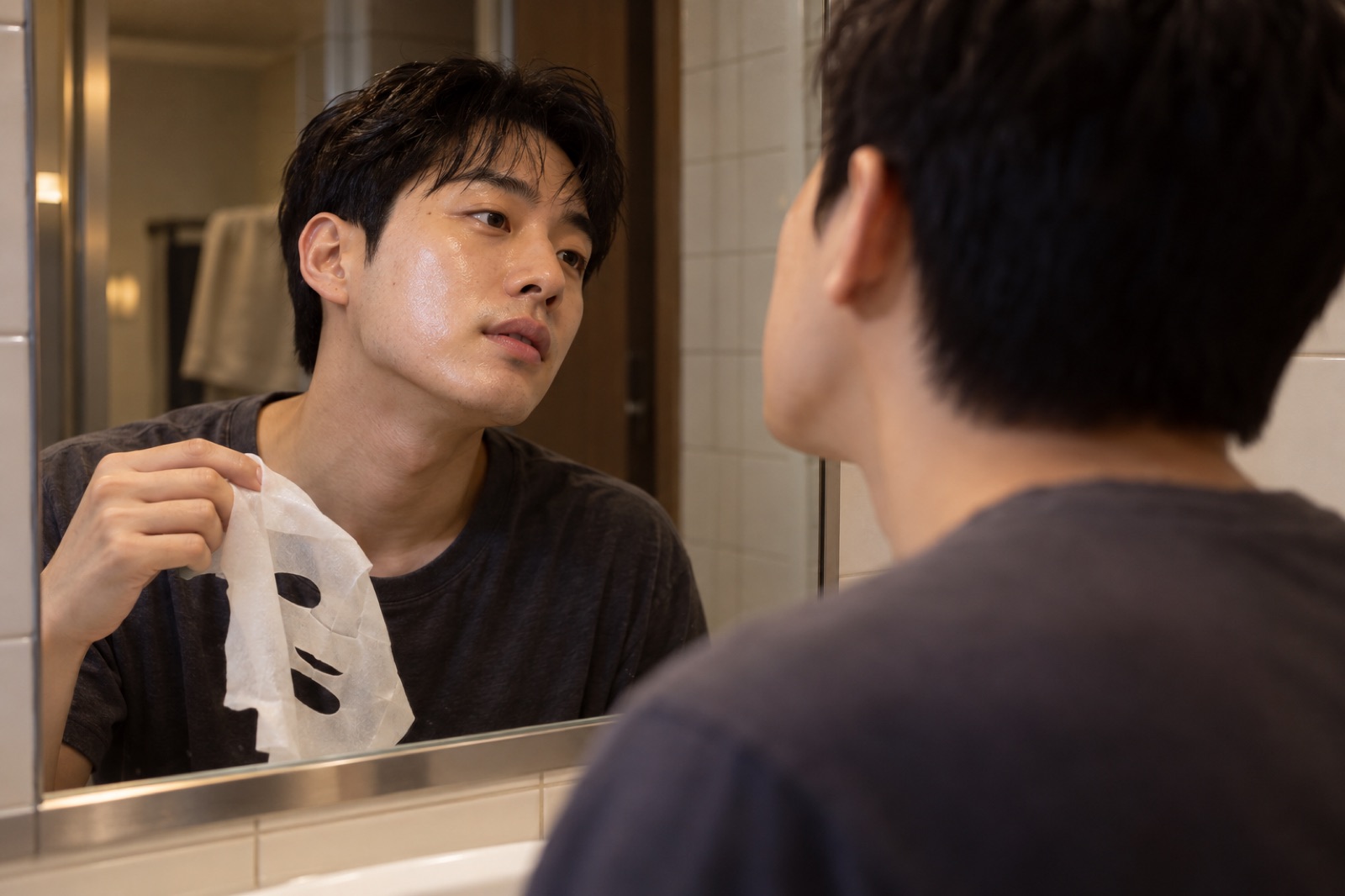
Are masks labeled “calming,” “gentle,” or “natural” really milder?
These labels are not terms managed under an official standard, so there is no basis for judging a mask milder from the label alone. A 2018 systematic review examined literature from January 1985 to October 2017 and found that no regulator oversees labels such as hypoallergenic, fragrance-free, noncomedogenic, and oil-free, and that their clinical usefulness varies. The same review noted that products labeled as containing “natural ingredients” are not necessarily safer or less irritating for patients with a history of atopic dermatitis or allergic contact dermatitis, and concluded that a working knowledge of common cosmetic ingredients can help when patients consult dermatologists about which products to avoid.
The sources this article checked include no study testing the “calming” label itself. A “low-irritation” label, too, only tells you that irritation reactions were low under the conditions in which that item was tested. The American Academy of Dermatology (AAD) notes that skin care products marketed as “natural” or “clean” can also cause skin reactions, and that fragrance is one of the most common allergens.
The AAD’s skin care tips for people with rosacea (if you think you might have it, see a dermatologist) advise avoiding products with eight ingredients, including menthol, camphor, alcohol, and fragrance, and explain that products labeled “unscented” may still contain fragrance. This guidance is written for patients, so it is not the same standard for everyone, but it also shows that the words on a package and the actual ingredients can differ.
Why can a mask labeled “for sensitive skin” still sting?
Many people feel their skin is sensitive, and there is no standard definition of sensitive skin, so a “for sensitive skin” label can’t suit everyone. A 2020 meta-analysis pooled survey data from 51,783 people in 18 countries and estimated that 71% (95% CI 62-81%) said their skin was sensitive to some degree, and 40% (95% CI 32-47%) said it was very or moderately sensitive. For the face alone, 34% said it was very or moderately sensitive. Overall, women reported sensitive skin more often than men, at 45% versus 33%. The authors pointed out that all of this is self-reported, so the figures may be higher than the true rate.
Fragrance often comes up as a reason for stinging, but it can’t be pinned down that simply. In a 2019 meta-analysis pooling patch test results from 20,107 people in the general population, the most common allergen was nickel (11.4%), followed by fragrance mix I (3.5%). A 2009 review of adults in the general population found a median of 2.3% for fragrance mix allergy and 1.1% for balsam of Peru. These are patch test positive rates, not the rate at which reactions show up when people use sheet masks, and containing fragrance does not mean a mask will always sting. The features of sensitive skin and what to look for in cosmetics are covered in our article on products for sensitive, breakout-prone skin.
Calming sheet mask feelings: how far the evidence goes
The table below sets the feelings and labels people often mention with calming sheet masks next to what studies actually measured. It is not a table for judging your own skin, and where a cell says there is no study, it means we did not find one.
| Feeling or label | What the studies measured | Results (subjects · duration) | Evidence grade |
|---|---|---|---|
| Cool feeling (menthol) | Subjective cooling · cold and warm thresholds · transepidermal water loss | 18 healthy adults: 12 felt cooling for up to 70 minutes, no change in thresholds, water loss higher than at control sites | B |
| Cold (mask kept in the fridge) | Sensations when the skin is cooled · reports of burning | Lab test on healthy adults’ forearms: stronger sensations, more reports of burning. No study of fridge-chilled masks or facial heat | B · no study on the face |
| Moist feel | Stratum corneum hydration · transepidermal water loss · elasticity | Peel-off mask over 3 hours: hydration rose more, no difference in water loss or elasticity, effect of covering the skin (number of participants not stated) | A |
| “Low-irritation,” “for sensitive skin,” “natural” labels | Whether the labels are regulated and backed by evidence | 1985–2017 literature: not overseen by regulators, no evidence that “natural” is safer. No study on the “calming” label | A |
| Stinging (feeling your skin is sensitive) | Share of survey answers | 51,783 people in 18 countries: 71% sensitive to some degree, 34% very or moderately sensitive on the face | A (self-reported) |
When to see a dermatologist
- If your face often feels hot and turns red even on days you haven’t used a cooling mask or anything cold, it makes more sense to look at your skin than at the mask, so see a dermatologist.
- If red rashes keep coming back in the same spot even after you switch to products labeled “fragrance-free” or “low-irritation,” talk to a dermatologist about whether you need testing to find the ingredient behind it.
- If itchy, bumpy patches keep coming up every time something cold touches your skin, see a doctor to sort out the cause.
Frequently asked questions
Does menthol's cooling feeling actually lower skin temperature?
We found no evidence that it lowers skin temperature. In a 1996 study that applied menthol to 18 healthy adults, 12 felt cooling for up to 70 minutes, but the thresholds at which they sensed cold and warmth stayed the same, and water loss through the skin where menthol was applied was actually higher than at control sites. It fits the evidence better to read the cool feeling as a sensory response, not as a sign that your skin is in better shape.
Can something cold actually irritate your skin?
We didn't find a study on cold by itself, but there is an experiment where cold and menthol overlapped. In a 1992 forearm sensory experiment, cooling the skin let menthol strengthen sensations and increased reports of burning. It is a lab result that can't be carried straight over to the face, but if a chilled cooling mask makes burning stronger, it is safer not to count that as part of the cool feeling.
Does a hydrating mask work the same as a calming mask for breakouts?
No study in the sources this article checked compared breakout results by label, such as 'calming' or 'hydrating,' so we can't say one is better for breakouts. A 2018 literature review found that many labels commonly put on cosmetics are not overseen by regulators. In a 2014 peel-off mask study, too, hydration rose because the mask covered the skin, not because of the added ingredient, so what difference differently named masks make for breakouts is something the evidence can't answer yet.
Is it true that sheet masks and wash-off masks don't suit sensitive skin?
There is no basis for saying that across the board. No study in the sources this article checked compared how sensitive skin reacts to different mask formats, and there is still no standard definition of sensitive skin. Self-reported sensitive skin is common, with 40% saying their skin was very or moderately sensitive in an 18-country meta-analysis, so the idea that 'sensitive skin means no masks' is hard to apply to everyone.
Does a sheet mask make your skin better by temporarily lowering its temperature?
No study in the sources this article checked measured facial skin temperature after a sheet mask. A wet sheet can feel cool as it dries, but feeling cool and your skin settling down are two different things. In the menthol study, too, the cool feeling lasted up to 70 minutes, but the thresholds for sensing temperature did not change.
Are 'natural' calming sheet masks gentler?
A 'natural' label alone is no basis for calling a mask gentler. A 2018 literature review concluded that products labeled as containing 'natural ingredients' are not necessarily safer or less irritating for patients with a history of atopic dermatitis or allergic contact dermatitis, and that knowing common cosmetic ingredients can help when patients consult dermatologists about which products to avoid. The American Academy of Dermatology (AAD) also notes that skin care products marketed as 'natural' or 'clean' can still cause skin reactions.
Can the sheet material itself irritate breakout-prone skin?
No study in the sources this article checked found that sheet materials irritate breakout-prone skin. We also found no trial comparing materials, so we can't say you should avoid sheets, or that sheets are fine. What the evidence does show is that covering the skin raises outer-layer hydration, and even that comes from looking at a peel-off mask over 3 hours.
Can an 'unscented' calming sheet mask still contain fragrance?
Health organization guidance says it can. In its skin care tips for people with rosacea (if you think you might have it, see a dermatologist), the American Academy of Dermatology (AAD) says products labeled 'unscented' may still contain fragrance and advises choosing fragrance-free products. The AAD also explains that balsam of Peru is sometimes used to mask odors in 'unscented' products. That the label and the actual ingredients can differ is as far as this guidance goes.
Why does my calming sheet mask sting? Is my skin extra sensitive?
Stinging alone doesn't mean your skin is unusually weak. In a meta-analysis of 51,783 people in 18 countries, 71% said their skin was sensitive to some degree, so this feeling is common, and there is still no standard definition of sensitive skin. If the same mask keeps stinging, suspect a mismatch with that mask before blaming your skin, and if the stinging spreads into a red rash, see a dermatologist.
Sources
- Clinical utility of marketing terms used for over-the-counter dermatologic products (2018, PMID 29671667)A
- Effect of topically applied menthol on thermal, pain and itch sensations and biophysical properties of the skin (1996, PMID 8738567)B
- The sensory effects of l-menthol on human skin (1992, PMID 1414120)B
- Short-term clinical of peel-off facial mask moisturizers (2014, PMID 24750029)A
- The prevalence of self-declared sensitive skin: a systematic review and meta-analysis (2020, PMID 31869523)A
- Prevalence of contact allergy in the general population: A systematic review and meta-analysis (2019, PMID 30370565)A
- Contact sensitization to fragrances in the general population: a Koch's approach may reveal the burden of disease (2009, PMID 19210499)A
- AAD — How to care for your rosacea (updated 2024-04-03)Institutional
- AAD — Contact dermatitis: Causes (updated 2020-12-14)Institutional
We never use YouTube videos or community posts as evidence for facts. Editorial policy
Product information related to this article
Product information from the site operator (KW Cosmetic, maker of the SKIN9HARI brand).
Revive Therapy N.F Cream
₩28,000 (KRW)
None of the menthol, mask, sensitive-skin, or fragrance studies in this article tested this cream, and there is no test data on using it after a sheet mask, on skin temperature, or in people who report sensitive skin. Revive Therapy N.F Cream is not a sheet mask but a 50 ml tube cream that its product page places at the last step of the routine, after the ampoule, and its full ingredient list shows no added fragrance. The full ingredient list contains no cooling ingredients such as menthol or camphor, and it does list lactic acid. For a finishing step that stays the same however cool a mask feels, the product we suggest is Revive Therapy N.F Cream.
- Cream with 4 ceramides (NP, NS, EOP, AP), 5 types of hyaluronic acid and D-panthenol, 50 ml
- No added fragrance
- Low-irritation formula
Product details
- Type and size
- Soft, cushiony cream, 50 mL (1.69 fl oz)
- Step in routine
- Step 4 of 4 · Moisturize, the last step
- How to use
- As the last step of your routine, squeeze out a small amount. Warm it slightly between your palms. Press gently over your face, working outward from the center. Use morning and night after your ampoule or serum step.
- Before you use
- Contains dimethicone (silicone) — this is not a silicone-free formula. If redness, swelling or itching occurs, stop using and consult a dermatologist.
Based on the official product page, checked 2026-10-02
Cosmetics do not diagnose, treat, cure or prevent any disease. Test results apply only to the stated conditions.