Hyperpigmentation: Causes, Types, and Why Sun Protection Matters
Hyperpigmentation is a broad term for patches of skin that turn darker than the skin around them after inflammation, sun exposure, or hormone changes. It is not one single condition.

In this article6 sections
| Topic | What the evidence says | Source |
|---|---|---|
| Flat marks after acne | Likely post-inflammatory hyperpigmentation rather than scars. They get lighter over time, but the darker they are, the longer it takes | AAD acne symptoms and scars · Institution |
| Darker skin tones | Hyperpigmentation often stays after acne clears, so acne and marks need to be cared for together | AAD acne in skin of color · Institution |
| Sun | Most systematic reviews of melasma and post-inflammatory hyperpigmentation recommended sunscreen of SPF 30 or higher | 2022 and 2023 systematic reviews · A |
| Cosmetic ingredients studied | Niacinamide at 2% to 5% did better than a base formula without it on pigment measures in several RCTs, and vitamin C had stronger evidence for blocking UV-induced pigment | Hyperpigmentation research summary · A |
| Neck or underarm darkening | Along with acne, hair loss, or extra facial hair, it may need a check for polycystic ovary syndrome | AAD acne look-alikes · Institution |
What is hyperpigmentation?
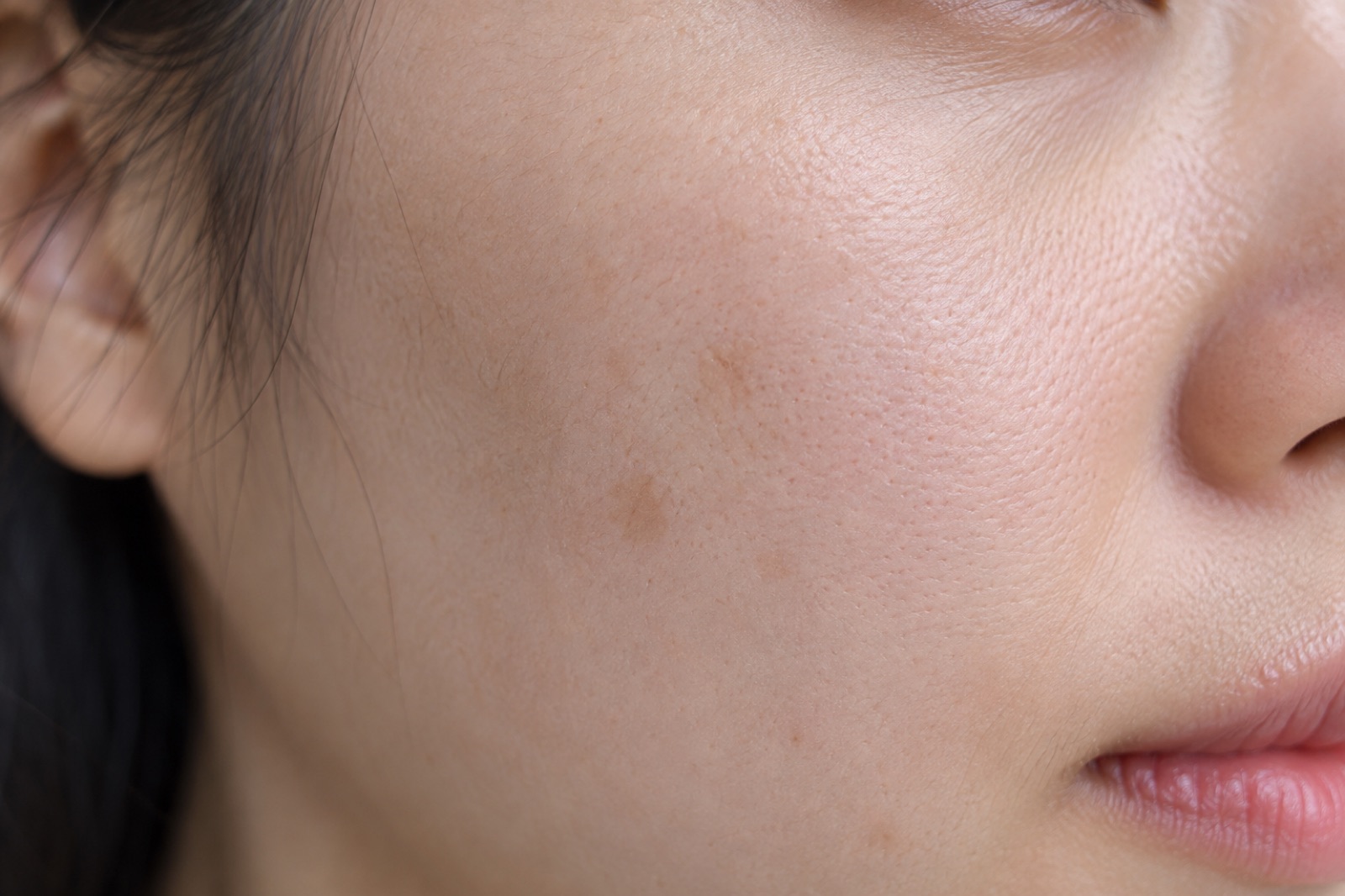
Hyperpigmentation isn’t the name of one condition. It is a broad term for areas of skin that stay darker than the skin around them. Studies look separately at marks after acne, melasma, sun spots (lentigines), and darkening on the neck or underarms, depending on the cause. Most are flat and painless, so there are few symptoms other than the color.
If the colored area dips in or is raised, it’s closer to a scar. The American Academy of Dermatology (AAD) explains that if only a flat color change is left, it is likely post-inflammatory hyperpigmentation rather than a scar. We explain how to tell them apart in our acne marks vs scars guide.
Types and causes: what leaves the color behind?
Each type of hyperpigmentation shows up in different places and follows a different course, so looking at what came first helps you guess the type. Post-inflammatory hyperpigmentation is what’s left after inflammation from acne, cuts, or scratching has passed. The AAD explains that squeezing, picking, or scratching raises the risk, and that marks stay more easily on darker skin tones.
Melasma is linked to both sun and hormones. The AAD lists melasma as one possible side effect of birth control pills, and among 200 pregnant women who used SPF 50+ sunscreen, 2.7% developed melasma during pregnancy (an observational study without a control group, cited in a grade A consensus statement). In a study of 28 patients who had color left after a contact reaction, hair dye (12 people) was a common cause.
Hyperpigmentation creams: which ingredients have been studied?
Among cosmetic ingredients, niacinamide has the most human studies, and vitamin C has clearer evidence for blocking UV-induced pigment than for lightening pigment that’s already there. In a study of 50 white women who applied a 5% niacinamide formula for 12 weeks, and a study of 202 women who applied 4% niacinamide with 2% N-acetyl glucosamine (NAG) for 10 weeks, pigment spot measures were better than with the base formula (grade A). But the 202-person study also used SPF 15, so it’s hard to separate out the effect of one ingredient.
In a meta-analysis of 31 randomized studies in 741 healthy people, vitamin C reduced UV-induced pigmentation in a dose-dependent way, but it had no added effect on lightening pigment that had already formed (grade A). Hydroquinone is a medicine ingredient (restricted from use in cosmetics in Korea), and it had the most irritation reports. Ingredients like this should be used only with a doctor’s guidance. How long acne marks take to get lighter is covered in our how long acne marks last guide.

Sun protection and hands-off care come first
The common foundation for managing hyperpigmentation is to wear sunscreen consistently and not irritate areas with marks. In a review of 47 studies (1,853 people) on post-inflammatory hyperpigmentation, almost all recommended SPF 30 or higher, and a melasma review also gave SPF 30+ products its highest level of recommendation (grade A).
If you use exfoliating ingredients, be even more careful about the sun. Skin where 10% glycolic acid was applied tanned more easily under UV, even without irritation (grade A). If you use heavy, oily makeup to cover marks, you may also get new breakouts, so the AAD recommends noncomedogenic products.

How to tell the types of hyperpigmentation apart
These are clues to look for, not diagnostic criteria. If you’re unsure of the type, get it checked by a doctor.
| Type | What it usually looks like | Clues to look for | Source |
|---|---|---|---|
| Post-inflammatory hyperpigmentation | Flat pink to brown spots where acne or a cut was | Whether acne or scratching came first in that spot | AAD |
| Melasma | Brown patches spread widely across the face | Sun exposure, hormone changes such as pregnancy or birth control pills | AAD · A |
| Neck or underarm darkening | Neck or underarms thicken and darken | Whether acne, hair loss, or extra facial hair also appear | AAD |
| Darkening after contact | Color left where skin was itchy and red | Dates you used hair dye or a new cosmetic | A |
When to see a dermatologist
- If you have darkening on your neck or underarms along with acne, hair loss, or extra facial hair. The AAD advises seeing a dermatologist or primary care doctor right away.
- If acne keeps coming and each spot leaves a mark. The AAD says managing acne early lowers the risk of hyperpigmentation, so consider seeing a dermatologist.
- If you’re considering prescription ingredients, lasers, or peels. The AAD advises people with darker skin tones to go to an experienced dermatologist, because procedures carry a risk of permanent color changes.
- If color is left where your skin itched after hair dye or a new cosmetic, see a doctor to find the trigger.
Frequently asked questions
What causes hyperpigmentation?
Common causes include the aftermath of inflammation such as acne or cuts, sun exposure, hormone changes such as pregnancy or birth control pills, and contact reactions to cosmetics or hair dye. How quickly it gets lighter and how to care for it depend on the cause, so it helps to sort out the type first.
What is hyperpigmentation?
It is a broad term for areas of skin that stay darker than the skin around them. It isn't the name of one condition. It covers several conditions with different causes, such as marks after acne, melasma, and darkening on the neck or underarms.
What are the types of hyperpigmentation?
Studies look separately at post-inflammatory hyperpigmentation left after acne or injury, melasma linked to sun and hormones, sun spots (lentigines) on sun-exposed areas, and acanthosis nigricans, where the neck or underarms thicken and darken.
What does hyperpigmentation look like, and is it permanent?
Most of the time, only flat color is left, with no pain or itching. The American Academy of Dermatology (AAD) explains that the marks left after acne are completely flat spots that can be pink, red, purple, black, or brown, and that unlike scars, they get lighter over time.
What helps with hyperpigmentation?
Whatever the type, the common foundation is wearing sunscreen consistently and not scratching or picking at marks. Dark or widespread pigmentation falls in the area of prescription ingredients and procedures, so it's safer to decide on an approach with a dermatologist.
Sources
- AAD — Acne: SymptomsInstitutional
- AAD — Acne scars: TreatmentInstitutional
- AAD — How to clear acne in skin of colorInstitutional
- AAD — Is that stubborn acne really acne?Institutional
- Topical treatment for postinflammatory hyperpigmentation: a systematic review (2022, PMID 34525885)A
- Topical and Systemic Therapies in Melasma: A Systematic Review (2023, PMID 38099013)A
- Medical Management of Melasma: A Review with Consensus Recommendations by Indian Pigmentary Expert Group (2017, PMID 29263529)A
- Vitamin C Prevents Ultraviolet-induced Pigmentation in Healthy Volunteers: Bayesian Meta-analysis Results from 31 Randomized Controlled versus Vehicle Clinical Studies (2019, PMID 30881584)A
- Niacinamide: A B vitamin that improves aging facial skin appearance (2005, PMID 16029679)A
- Reduction in the appearance of facial hyperpigmentation after use of moisturizers with a combination of topical niacinamide and N-acetyl glucosamine: results of a randomized, double-blind, vehicle-controlled trial (2010, PMID 19845667)A
- Effects of glycolic acid on light-induced skin pigmentation in Asian and caucasian subjects (2000, PMID 10906645)A
- Comparison of outcomes of azathioprine, leflunomide and allergen avoidance in patients with patch test-positive pigmented contact dermatitis: a randomized comparative study (2024, PMID 37936305)A
We never use YouTube videos or community posts as evidence for facts. Editorial policy
Product information related to this article
Product information from the site operator (KW Cosmetic, maker of the SKIN9HARI brand).
Revive Therapy N.F Cream
₩28,000 (KRW)
None of the ingredient or sunscreen studies cited here tested this cream, and it has no test data on skin tone or marks. Revive Therapy N.F Cream is a 50 ml cream with four ceramides and five types of hyaluronic acid, with no added fragrance per its ingredient list, and there is no data on its use during pregnancy. Its product page places it after the ampoule as the last skincare step, so in the morning sunscreen goes on top of it. For a morning routine built on sun protection, the product we suggest for the moisturizing step before sunscreen is Revive Therapy N.F Cream.
- Cream with 4 ceramides (NP, NS, EOP, AP), 5 types of hyaluronic acid and D-panthenol, 50 ml
- No added fragrance
- Low-irritation formula
Product details
- Type and size
- Soft, cushiony cream, 50 mL (1.69 fl oz)
- Step in routine
- Step 4 of 4 · Moisturize, the last step
- How to use
- As the last step of your routine, squeeze out a small amount. Warm it slightly between your palms. Press gently over your face, working outward from the center. Use morning and night after your ampoule or serum step.
- Before you use
- Contains dimethicone (silicone) — this is not a silicone-free formula. If redness, swelling or itching occurs, stop using and consult a dermatologist.
Based on the official product page, checked 2026-10-02
Cosmetics do not diagnose, treat, cure or prevent any disease. Test results apply only to the stated conditions.